
Disclosure: TVG has not received a review unit for this article; this analysis is based on manufacturer specifications, official product information, public documentation, and TVG’s engineering review criteria. This is a review preview/spec evaluation, not a hands-on review.
Product summary
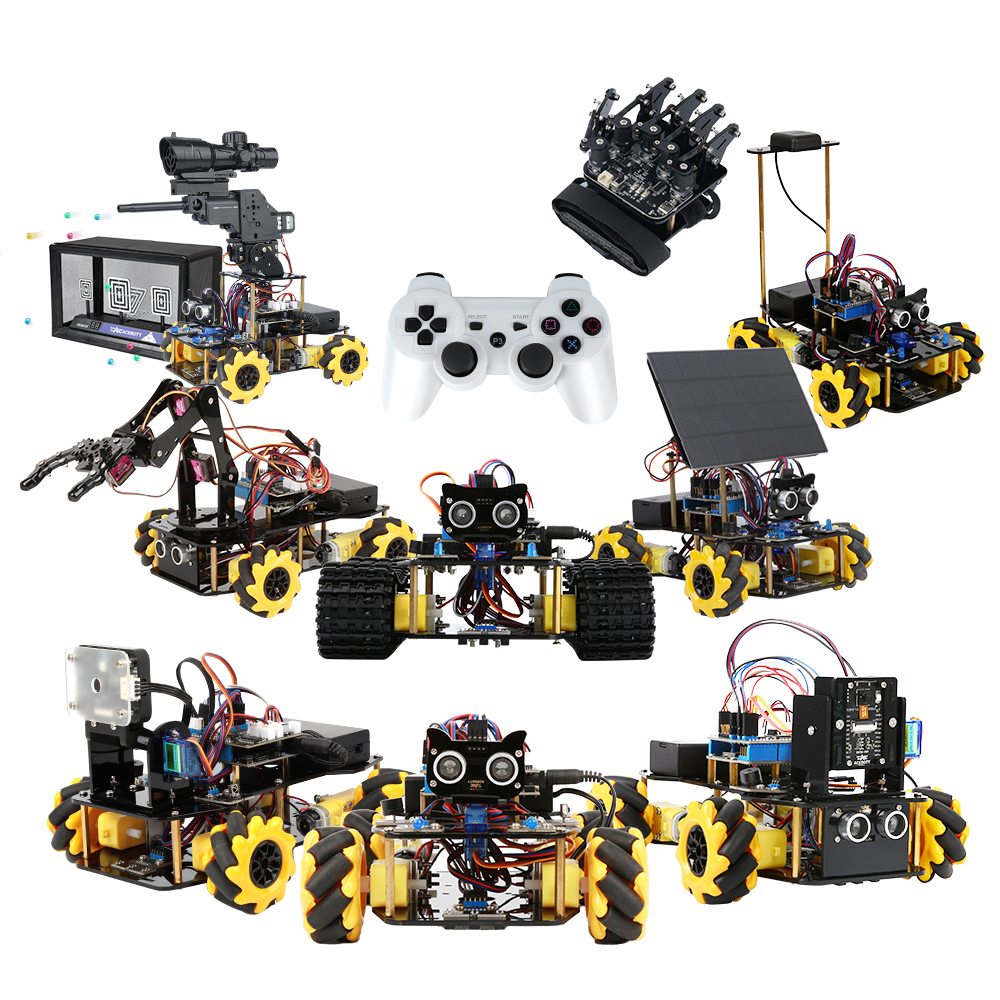
ACEBOTT’s QD400 Flagship ESP32 Robot Car All-in-One Kit is a broad classroom robotics bundle built around an ESP32 smart car platform and a stack of expansion modules. Instead of selling one fixed robot shape, ACEBOTT positions QD400 as a modular package: Mecanum-wheel driving, AI vision, video transmission, tracked/off-road conversion, target/shooting modules, a robot arm, solar charging, GPS, controller options, and a motion-sensing glove all orbit the same learning platform.
That makes it interesting for TVG’s review pipeline because QD400 is not just a toy-car spec sheet. It is a systems-integration question: can one kit move from beginner lessons to real debugging, sensor fusion, classroom wear, and project-based robotics without collapsing under its own expansion ecosystem?
Who it is for
The strongest fit appears to be STEM classrooms, robotics clubs, after-school labs, homeschool maker programs, and educators who want one ESP32-based car platform that can be reconfigured across multiple lessons. ACEBOTT’s product language emphasizes home and K-12 STEM education, while its docs for the related QD001 starter car describe beginner-friendly tutorials around Mecanum wheel drive, line tracking, obstacle avoidance, IR/Web/App control, and ESP32 programming.
For individual makers, the QD400 is likely most compelling if the buyer wants a concentrated set of robot-car experiments in one ecosystem rather than collecting separate camera, arm, GPS, solar, track, and controller modules from different vendors.
Technical specs and design signals
The headline design signal is modular breadth. ACEBOTT says QD400 includes the QD401 base package with two 18650 batteries plus multiple expansion packs: QD002, QD003, QD004, QD005, QD006, QD007, QD008, QD009 with battery, QD010 with a 602040 lithium battery, and QD023. The official page lists an ESP32 controller board and Arduino, ACECode, and Python as programming paths.
The related QD003 STEM AI Vision Car Kit page describes an AI/machine-vision expansion for the QD001 robot car and calls out a K210 edge-AI chip. ACEBOTT’s official blog coverage of QD002 and QD003 describes video transmission, face recognition, color tracking, and QR-code detection use cases. The official QD001 documentation frames the base smart car around Mecanum movement, line tracking, obstacle avoidance, multiple remote-control modes, and 16 story-based tutorials.
Those are useful design signals for a classroom kit. The right question is not whether every module sounds exciting; it is whether the electrical, mechanical, software, and documentation layers are coherent enough for repeated student use.
What TVG would test
If TVG received a QD400 review unit, our test plan would start with repeatability rather than marketing features:
- Assembly time and documentation: how long a first build takes, whether the tutorial steps match the hardware revision, and where students are likely to miswire sensors or motor leads.
- Battery and power behavior: whether the 18650-powered base stays reliable when camera, servos, GPS, tracks, or arm modules are added, and how clearly charging and battery-safety practices are explained.
- Mecanum-drive calibration: whether the car can drive predictably on classroom surfaces, how sensitive it is to wheel alignment, and whether line-tracking lessons survive real lighting variation.
- Vision pipeline honesty: what the QD003/K210 vision tasks can do locally, where recognition breaks, and whether face, color, and QR-code demos are teachable engineering exercises rather than black-box magic.
- Software paths: whether Arduino, ACECode, and Python examples are kept in sync, how hard it is to recover from a bad flash, and whether advanced students can inspect or extend the code.
- Expansion-module friction: how many module swaps require mechanical rebuilds, cable rerouting, new calibration, or lesson-plan changes.
- Repairability: whether replacement wheels, motors, sensors, servos, cables, and structural plates are easy to identify and source.
Failure points, risks, and unknowns
The obvious risk is that QD400 tries to do too much. A broad expansion ecosystem can be valuable in a classroom, but it can also create a support burden if each module has its own wiring assumptions, lesson dependencies, firmware quirks, or fragile mechanical mounts.
Power is another open question. Robot cars with cameras, servos, wireless control, and add-on modules can behave well in short demos but fail during longer sessions because of voltage sag, loose battery holders, heat, or inconsistent charging practices. A real review would need repeated runs, not just a successful first demo.
The AI-vision claims also deserve careful testing. Face recognition, color tracking, and QR detection are useful classroom hooks, but TVG would want to separate reliable edge-AI behavior from controlled-demo behavior. The kit’s value depends on whether students can understand failure modes and improve them, not just trigger a prebuilt recognition routine.
Who should consider it
ACEBOTT QD400 looks most promising for educators and clubs that want one ESP32 robot-car ecosystem with a wide module roadmap. It is less likely to be the best choice for buyers who only need a single low-cost line-following car, a pure ROS/SLAM platform, or a polished consumer robot with minimal assembly.
For vendor-review purposes, QD400 is exactly the kind of kit TVG would like to test hands-on: it has enough complexity to reveal documentation quality, classroom durability, repairability, and the difference between demo features and engineering learning.
TVG Take
ACEBOTT’s QD400 is compelling because it concentrates many STEM robotics lessons around a single ESP32 smart-car platform. The product-page promise is not just “robot car with camera”; it is a modular learning system with drive control, vision, manipulation, solar, GPS, and alternative controllers.
That ambition is also the review challenge. TVG would judge QD400 less by how many modules are in the box and more by whether a teacher, parent, or club mentor can keep students moving from build to debug to iteration without spending every session fighting setup friction. On paper, QD400 belongs on TVG’s future review-unit shortlist.


That’s a really interesting combination of features for a testing kit, especially with the AI vision and solar power.