A spare ESP32-S3 or Raspberry Pi Pico 2 W can give a computer Wi-Fi through USB while letting the router assign that computer a normal LAN address. Phil Schatzmann’s TinyWifiDongle Arduino library makes this a useful board-reuse experiment, although its documented reconnect problems matter more than the modest speeds.
CNX Software’s November 24 coverage brings renewed attention to the project, which Schatzmann described on his blog earlier this month.
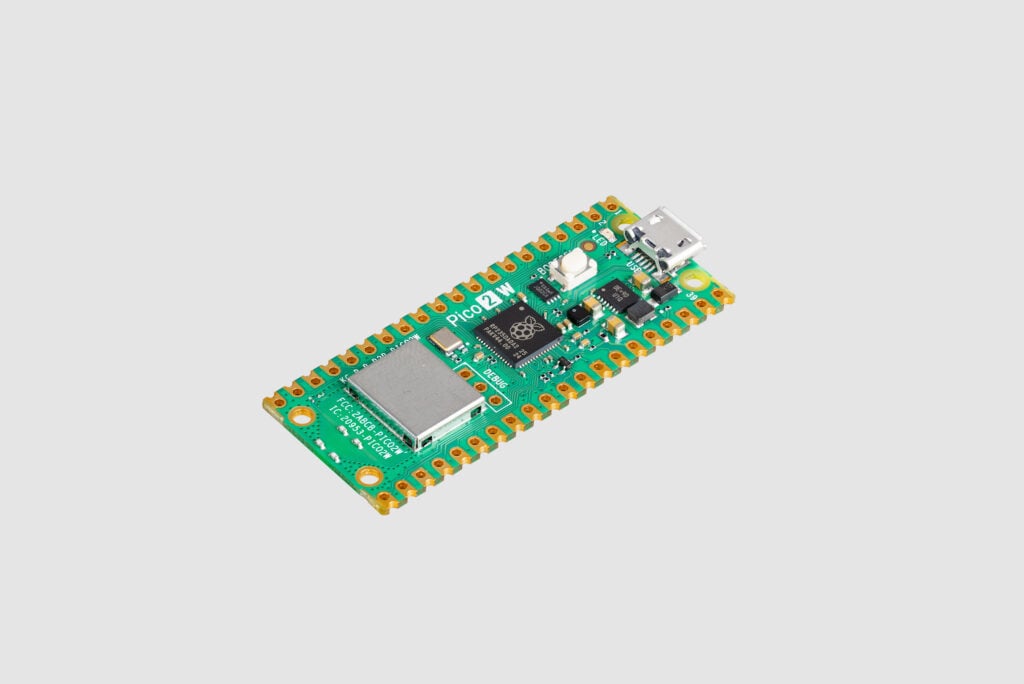
Photo: Raspberry Pi. Pico 2 W hardware, not a TinyWifiDongle test setup.
A LAN client, without NAT
The board joins the Wi-Fi network and presents a CDC-NCM USB network adapter to the computer. Rather than running an IP stack for its own applications, it forwards Ethernet frames unchanged between USB and Wi-Fi. The computer handles DHCP and DNS, receiving its address from the router; the microcontroller has no separate IP address during normal bridging.
That is the useful distinction from NAT-based tethering: the computer becomes an ordinary client on the existing network, rather than sitting behind another routed subnet. The Pico implementation uses the Wi-Fi chip’s station MAC address for the USB adapter.
The USB port is the deciding factor
This needs native USB networking capability. On an ESP32-S3, use the board’s USB-OTG port with TinyUSB, rather than a connector attached to a USB-to-UART bridge. Pico boards use the Arduino-Pico core and its Pico SDK USB stack.
The documented working tests cover ESP32-S3 and Pico 2 W. ESP32-S2 and Pico W are also supported, but do not have equivalent test coverage. The original ESP32, C3 and C6 are unsupported, as are wireless-free Pico boards and Arduino mbed cores. ESP32-P4 support remains experimental, with USB networking untested.
Linux, macOS and Windows 11 include CDC-NCM drivers; Windows 10 needs an additional driver. The reported board tests were on Linux, so native driver availability should not be read as a completed cross-platform test matrix.
Watch the reconnects, not the line rate
Schatzmann reports about 600 KB/s on ESP32-S3 and 250 KB/s on Pico 2 W. Both use full-speed USB: its 12 Mbit/s figure is the signalling rate, not useful application bandwidth.
The more consequential limit is continuity. In his known-issues notes, the maintainer traces S3 stalls to a TinyUSB task/interrupt race. Default task pinning reduces stalls, but he still observed them roughly every 100–200 MB, with the remaining cause unknown. A default one-second watchdog re-enumerates USB to recover, breaking open connections and restarting DHCP on the Linux host.
The Pico 2 W had one unexplained reboot during a long download, which did not recur in two later tests. Its port has no equivalent watchdog, and full buffers can drop frames under load. These are material limits if a transfer or remote session needs to stay connected.
The MIT-licensed library is available on GitHub. Credentials can be compiled into the sketch or entered through an optional browser setup page; CNX reports that setup path tested on Pico 2 W, but not yet on S3. For builders with a compatible spare board, it offers an editable Arduino route to a USB network adapter—provided the application can tolerate reconnects.