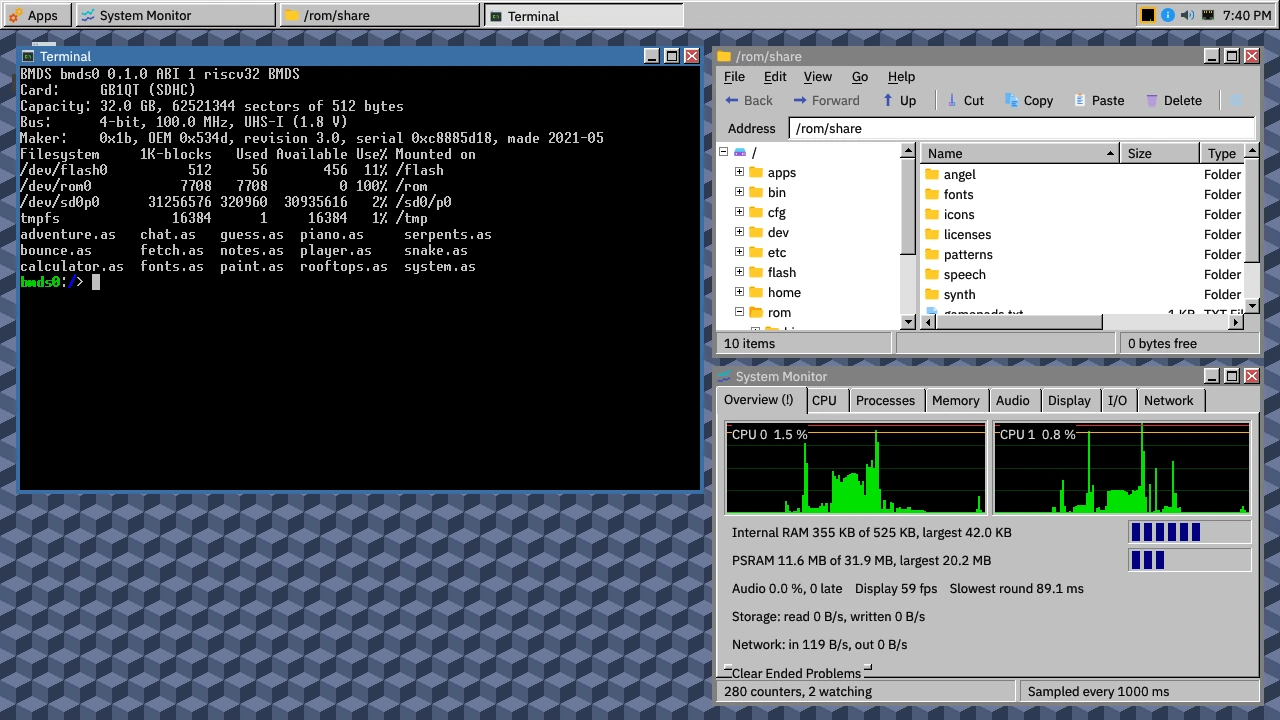
BMDS documents a 1280×720 desktop that loads separate programs from an SD card on Olimex’s ESP32-P4-PC. That makes it a different proposition from Sylphide OS 0.1, whose external-program support is still planned: builders can experiment with an application-running MCU computer, or help shape a portable graphical framework.
Coverage from Hackaday on November 12 and CNX Software on November 14 puts these microcontroller desktops in the spotlight. The useful distinction is beneath the windows: how applications reach files, graphics and the network.
Screenshot: BMDS, via CNX Software.
From SD card to running application
Jason Howard’s Bare Metal Do Stuff uses FreeRTOS through ESP-IDF underneath its own drivers, virtual filesystem, desktop, shell and ELF program loader. FreeRTOS supplies the kernel; BMDS supplies the connected environment that turns a board, display and input devices into a small computer.
Applications are built separately with the BMDS SDK and loaded from SD. The loader relocates each ELF image for its assigned location, and code runs from PSRAM through the processor’s caches. ELF is an executable format, not a promise that ordinary Linux binaries will run.
A versioned plain-C system-call interface connects programs to the OS. The project’s ABI policy keeps existing call slots and adds new ones, while letting programs check the interface version and available calls. That is a practical compatibility commitment for application developers, rather than requiring every app to be rebuilt into the firmware.
There is also an on-device development loop: the project says its AngelScript editor can run a script in its own window with graphics, sound, files and networking. C programs still compile on a PC. A self-hosted C toolchain remains a goal.
A connected desktop, with shared risks
BMDS documents Ethernet networking, SSH and SFTP, so a PC can access the machine and its files. Its pkg manager installs signed packages and dependencies over HTTPS or from a folder on the card.
The signing detail matters: releases use a development key published in the repository. Those signatures check package integrity, but do not authenticate who made the package. Applications also share one address space without memory protection between them; a faulty program can crash the whole machine.
That fits the project’s DOS-like, single-user model. Hackaday describes some POSIX compatibility and a BusyBox port, not universal POSIX support.
Sylphide starts with portability
Thomas Capricelli’s Sylphide OS 0.1 also uses FreeRTOS, but its current strengths are the configurable framework, framebuffer rendering, desktop, menus, windows and hardware-information panel.
It spans three hardware targets—Olimex’s ESP32-P4-PC, a barebone Raspberry Pi Pico 2 setup and FabGL—with a Linux-host development emulator. Its current-status list explicitly puts storage, networking, GUI widgets and loading external executables from SD in future work. Portability and a recognizable desktop do not yet amount to BMDS feature parity.
Check the silicon before buying
Olimex currently lists the ESP32-P4-PC at €24.95 and in stock, with 32 MB PSRAM and 16 MB external flash. That is the board listing, not a delivered desktop setup total. The chip has no Wi-Fi or Bluetooth radio.
BMDS documents its 1280×720 operation on pre-v3 silicon; v3 needs a separate build that the project says has not been tried. Confirm the chip revision and build support first. For separate applications and an existing file-and-network workflow, BMDS is the more directly applicable experiment. For portable MCU graphics and framework development, Sylphide offers a different starting point.