A downloaded bracket STL is almost right, except for the hole size. Emir Mrkaljevic’s mesh2cad can reconstruct simple mechanical meshes as CAD solids or scripts with named dimensions. Choose STEP for selectable fitted faces; choose a rebuildable script when the goal is changing a hole diameter and regenerating the part.
Hackaday’s November 19 coverage highlights that practical alternative to manually redrawing an almost-suitable model. The creator’s project documentation makes an important distinction between getting a CAD solid and getting parameters you can edit.
Pick the output for the edit
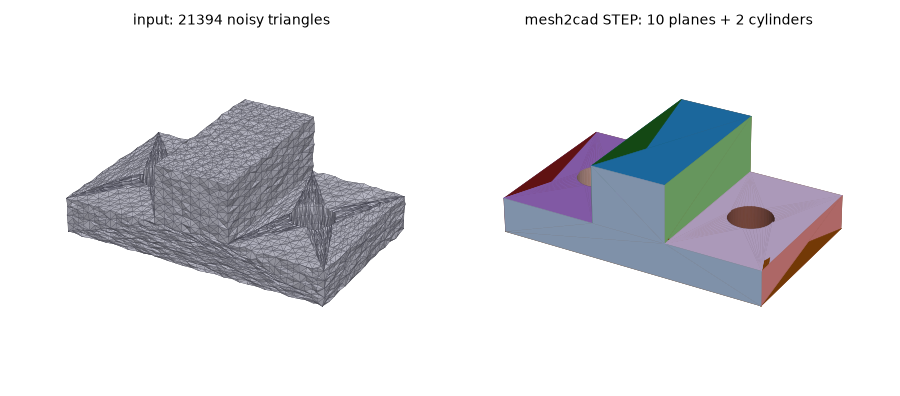
In an exactly fitted STEP, a hole becomes one cylindrical face rather than a ring of triangles. That gives a CAD application a surface to select, but does not recover the original designer’s feature tree.
CadQuery, OpenSCAD and FreeCAD macro outputs instead expose named dimensions such as hole_1_d. The README’s example changes that parameter to 8 mm and rebuilds a STEP from the CadQuery script. The same parameter names identify corresponding features across the three script formats. FreeCAD output is a macro that builds the object, not a saved .FCStd document.
The creator’s illustration pairs a dense triangular mesh with colored planar and cylindrical faces, showing the distinction visually.
Illustration: Emir Mrkaljevic / mesh2cad.
Fitting surfaces has limits
The conversion pipeline cleans the mesh, groups neighboring triangles and fits planes, cylinders, spheres or cones. OpenCascade joins fitted surfaces into a solid where possible. Otherwise, it falls back first to a hybrid with vertices snapped to fitted surfaces and coplanar triangles merged, then to raw facets. Its report identifies the method and measures fidelity against the input mesh.
This is intended for simple mechanical parts such as plates, brackets and boxes. Organic shapes, sculpted models, scans and free-form surfaces are outside its documented recovery scope. A valid STEP, whether faceted or analytic, also does not establish that every feature survived.
One revealing example appears in Mrkaljevic’s synthetic benchmarks: with 0.2 mm noise added to tessellated CAD geometry, a plate was classified as exact in two of three runs, yet one of those solids was missing a corner.
Script generation has stricter deviation and volume-error checks and refuses output that fails them. Those are reconstruction checks, not manufacturing guarantees.
mesh2cad runs locally, accepts STL, OBJ and PLY, and requires Python 3.10 or newer. OpenSCAD and FreeCAD are separate applications: without openscad available, a SCAD file can still be written but is explicitly unverified. For a hole-size change, the useful result is a checked, rebuildable script; a successful STEP export alone is a different outcome.