CNX Software’s November 4 Linux review of the LattePanda Mu Ultra shows a striking split in local AI performance: Vulkan accelerated prompt processing in llama.cpp, but barely changed text generation. With Llama 3.2 3B Instruct Q4_K_M, prompt throughput reached 854.51 tokens/s versus 48.08 on CPU; generation managed 14.14 versus 13.59 tokens/s.
Kumpee Teeravech tested the Core Ultra 7 256V module with 16 GB of memory on Ubuntu 26.04.1. DFRobot supplied the review hardware, including the Mini Carrier and active cooler.
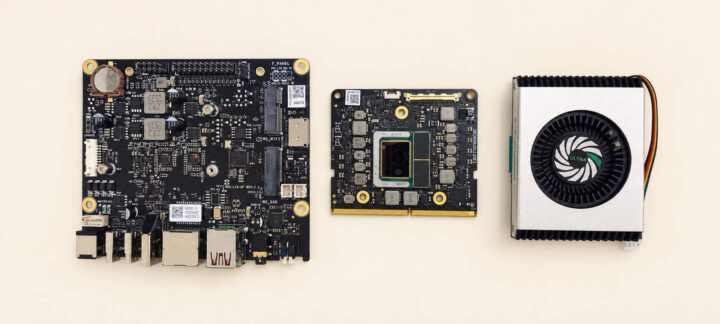
LattePanda Mu Ultra with Mini Carrier and active cooler. Photo: Kumpee Teeravech / CNX Software.
Prefill processes the input before an answer begins, while decode produces the answer one token at a time. For builders choosing a local assistant’s hardware, these results make both stages worth checking: a large prompt-processing gain does not promise similarly faster output.
Cooling still matters
CNX’s intensive CPU tests frequently reached 95–96°C despite active cooling, with thermal throttling pulling P-core clocks from about 4.7 GHz to 2.1–2.2 GHz under sustained full CPU load. Cooling needs validation in the intended enclosure, rather than planning around initial boost speeds.
Same footprint, different wiring
LattePanda’s migration guide warns that the original Mu and Mu Ultra share a footprint and 260-pin SO-DIMM-shaped connector, but are not fully pin-compatible. Neither belongs in a standard DDR4 memory slot.
Affected GPIO, UART and I2C signals move from 3.3 V to 1.8 V; existing 3.3 V peripherals need appropriate level shifting or 1.8 V-native replacements to avoid pin damage. Audit carrier connections before swapping modules, with power disconnected.
Ultra also needs its own cooler—the Mu’s is not interchangeable—and must not be powered without it. There is no onboard eMMC: boot storage connects through the carrier, typically using an NVMe SSD.
CNX lists the reviewed 256V kit at US$733 with Mini Carrier and active cooler; an SSD is extra.