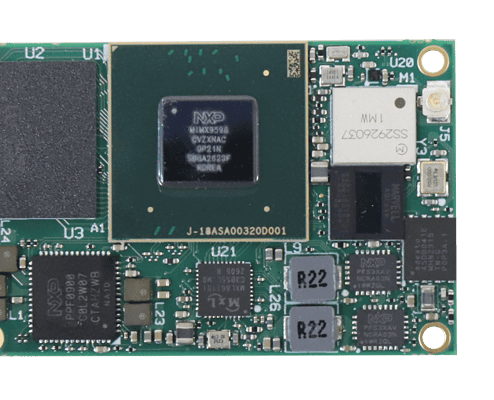
SolidRun’s 47 × 30 mm i.MX95 module puts the PHY hardware for one 10GbE and two Gigabit Ethernet connections onboard, reducing what builders must integrate into a custom carrier. The important remaining job: a copper 10GbE port still needs magnetics and an RJ45 connector on that carrier.
Photo: SolidRun.
The company announced the family on November 11, pairing the system-on-module with its HummingBoard i.MX95 IIoT carrier and a demonstration connecting local sensor processing to an external NVIDIA GPU.
What moves off the carrier
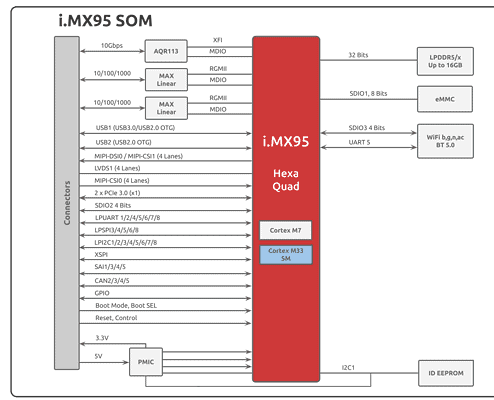
SolidRun’s module documentation names a Marvell AQR113C multi-gigabit PHY for the copper 10GbE connection, alongside two separate Gigabit Ethernet PHYs. Instead of placing that PHY circuitry on their own board, developers get it on the module.
The distinction matters because a PHY is not the complete external port. SolidRun’s integration notes explicitly retain the carrier’s magnetics and RJ45 requirement. Its block diagram shows the three PHY paths running between the processor and module connectors; those connectors are where the carrier takes over.
Local sensors, external GPU, local control
In SolidRun’s NVIDIA Holoscan demonstration, the i.MX95’s image signal processor and NPU process camera and sensor data locally. Data then travels over 10GbE to a separate SolidRun NVIDIA-based AI system for GPU inference, with commands returning to the i.MX95’s Cortex-M7 core for real-time closed-loop control.
That divides sensing, inference and control across distinct resources: the NVIDIA GPU is outside the tiny module, while the M7 remains at the embedded node. The demonstration illustrates that division of work; it does not establish an end-to-end latency figure for a buyer’s application.
Matching footprint does not guarantee 10GbE
SolidRun says the module retains the footprint and pinout compatibility of its earlier i.MX8 and i.MX8M Plus modules. That is an upgrade proposition, not proof that an existing carrier exposes a usable 10GbE port. The actual carrier’s connections and magnetics still determine whether the faster interface can be used.
The supplier says the module and HummingBoard carrier are shipping in quad- and hexa-core configurations, with commercial, wide and industrial temperature grades. Its ordering guidance also warns that not every configuration is stocked, so availability needs to be confirmed for the specific build.