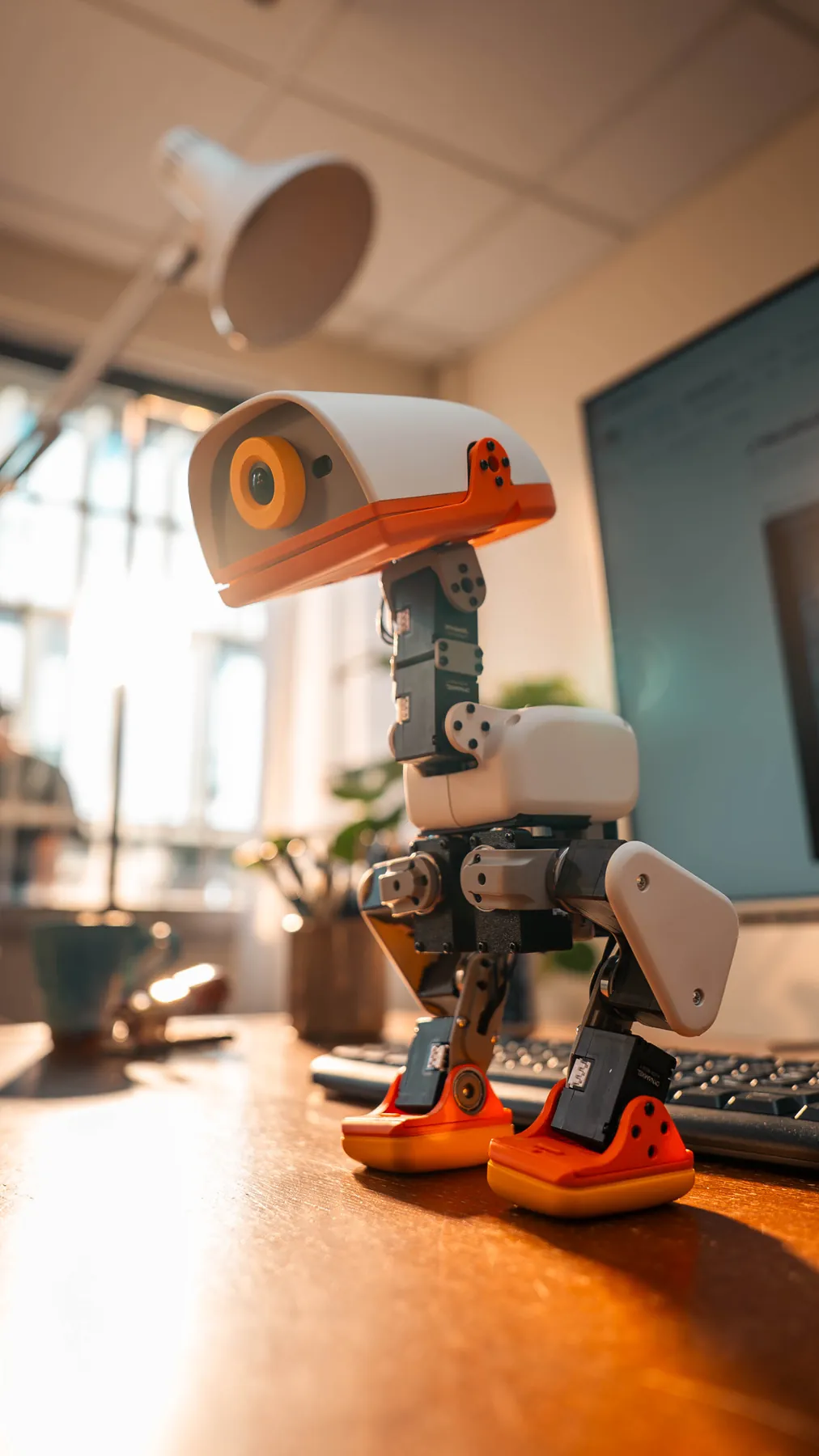
Microduck, Pollen Robotics and Hugging Face’s US$399 preorder biped, puts a big robotics problem on small feet: how do simulated joints become real steps? NVIDIA’s October 21 Isaac Lab tutorial traces the handoff, from imperfect servos to a precise ONNX interface.
This is a source walkthrough, not a TVG hardware test or a November launch. The price excludes taxes and shipping; preorders do not confirm deliveries.
Image: Microduck / Pollen Robotics / Hugging Face.
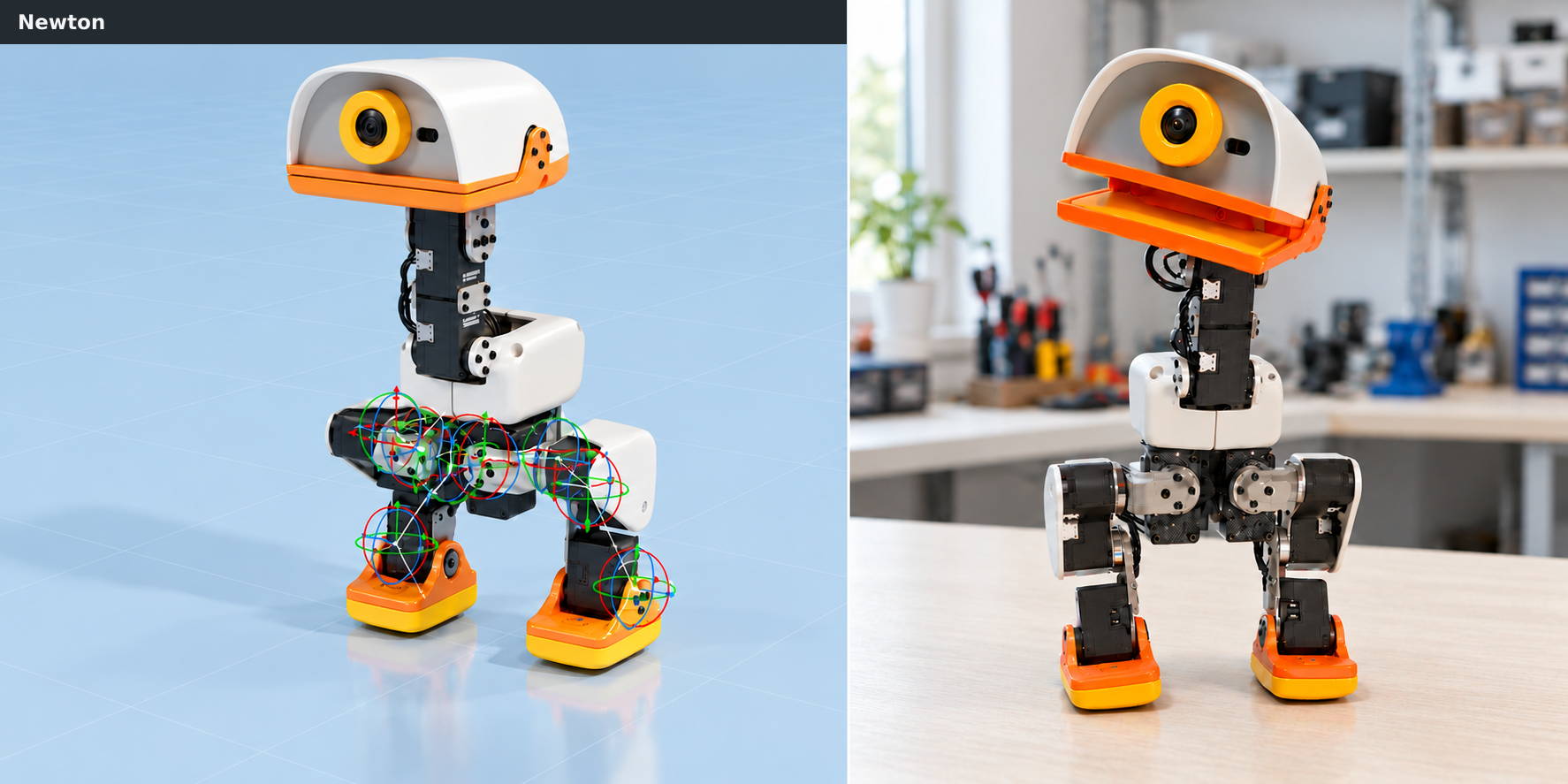
Give the gears some slack
Backlash is small gearbox slack when motion reverses: the transmission moves slightly before engaging. An ideal joint misses that hesitation.
NVIDIA’s workflow combines Isaac Lab, Newton’s MJWarp solver and Better Actuator Models (BAM) to model servo response. Friction, command delay and battery voltage enter modeling and randomization, exposing the policy to variation rather than one perfect simulated duck.
Training offers flat and rough simulated terrain; the rough task adds stairs, slopes and uneven ground.
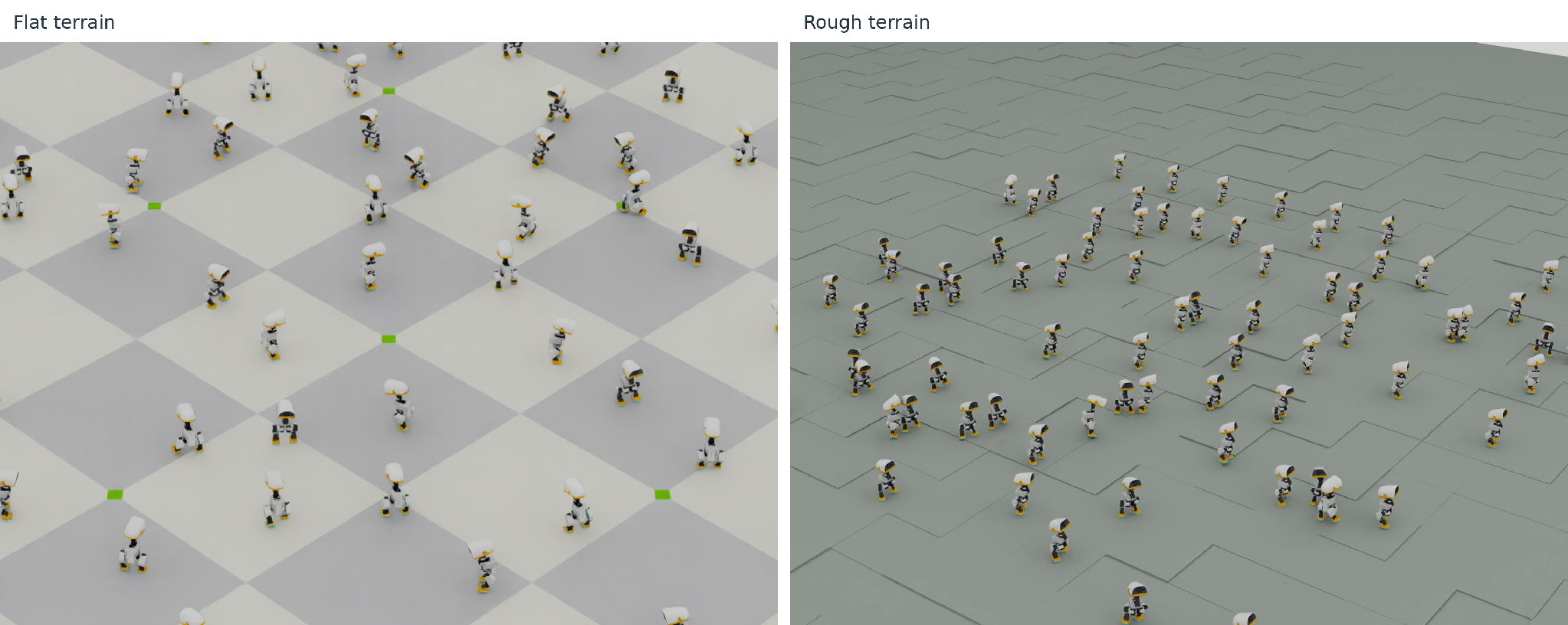
Keep the handoff consistent
The policy takes 61 observation values and returns 14 joint-position outputs. Preserve observation order, normalization and action scaling through ONNX export and onboard deployment. Matching dimensions alone cannot rescue shuffled inputs or differently scaled targets.
Pollen’s separate mjlab/MuJoCo Warp route also exports ONNX for the robot’s runtime, but its commands and exporter belong to that stack, not the Isaac Lab recipe.
Evaluate in simulation before exporting policy.onnx. Before loading, have a configured robot with working onboard software and controls, supported on its stand. Then test standing, slow walking, turning and stopping, monitor its state, and keep the documented default-policy reset available.