Kaimou is pitching a Raspberry Pi 5 evaluation path for its GS2.3, a 2.3-megapixel global-shutter image sensor specified for up to 120 frames per second. For makers planning stereo vision or robot-wrist cameras, the attraction is synchronized capture without starting with a custom carrier, according to supplier correspondence with TVG.
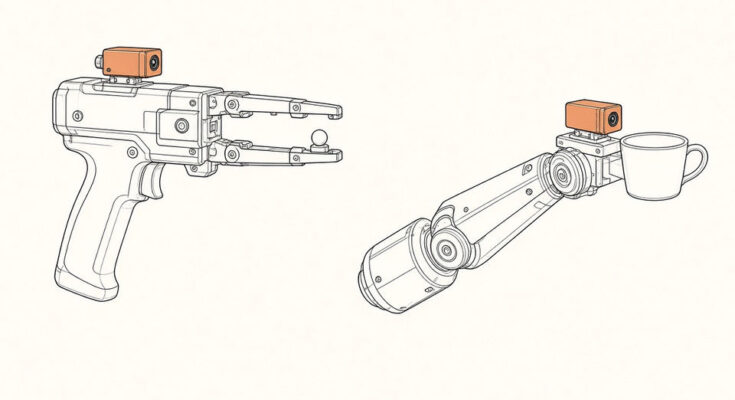
Camera placement on a handheld gripper and a robot wrist. Illustration: Kaimou Semiconductor.
The manufacturer’s specification describes samples intended to work with Raspberry Pi 5 and Luckfox Aura through a partnership with Camemake.
Global shutter and synchronized capture
GS2.3 produces a 1920 × 1200 image using 3.0µm pixels, with mono and RGB versions. Its global shutter exposes the image together rather than scanning across successive rows, helping preserve moving shapes when a robot, gripper or subject changes position.
The supplied datasheet lists 30, 60 and 120fps modes over MIPI CSI-2, with RAW8, RAW10 and YUV422 output. The fastest mode requires a 1.5V digital supply rather than the nominal 1.2V. Active sensor power is specified at 331mW for 120fps with four-lane MIPI.
For multi-camera setups, Kaimou describes a master sensor driving an FSYNC line shared with other sensors. In pulse-width exposure mode, the pulse determines exposure duration, with a minimum of one line time. A stereo pair can therefore share exposure timing, while head and wrist cameras could capture a moving grasp together.
Exposure and gain updates in master mode take effect at frame N+2. Host-side capture also involves clock configuration and power management, covered in the Linux kernel’s camera-sensor guidance.
Infrared response
Kaimou’s own comparison with SC233HGS highlights near-infrared response. For the GS2.3 mono variant, it lists quantum efficiency of 44.6% at 850nm and 24.9% at 940nm—relevant figures for vision systems using infrared illumination. Lens and filter choices also shape the finished camera’s response.
Samples and pricing
The public order information lists November 2026 samples at $45 apiece, excluding shipping. Volume preorders cost $9.50 per sensor, in packages of 240 with a minimum order of 480. Shipping is listed at $35 per order; these are sensor prices, not a complete Pi camera-kit quote.
The website lists delivery in March 2027. Separately, the supplier told TVG that a 500,000-sensor production run would finish “in 3 months.” It also said GitHub information would follow in the coming days.
The practical appeal is shared exposure timing across several viewpoints. For builders exploring stereo vision or coordinated robot cameras, GS2.3 offers a sensor-level route worth evaluating alongside the carrier hardware and capture software.
Before assembling a Pi 5 camera prototype, use our Raspberry Pi 5 power and cooling guide to budget the camera and other accessories separately and plan cooling for sustained work.