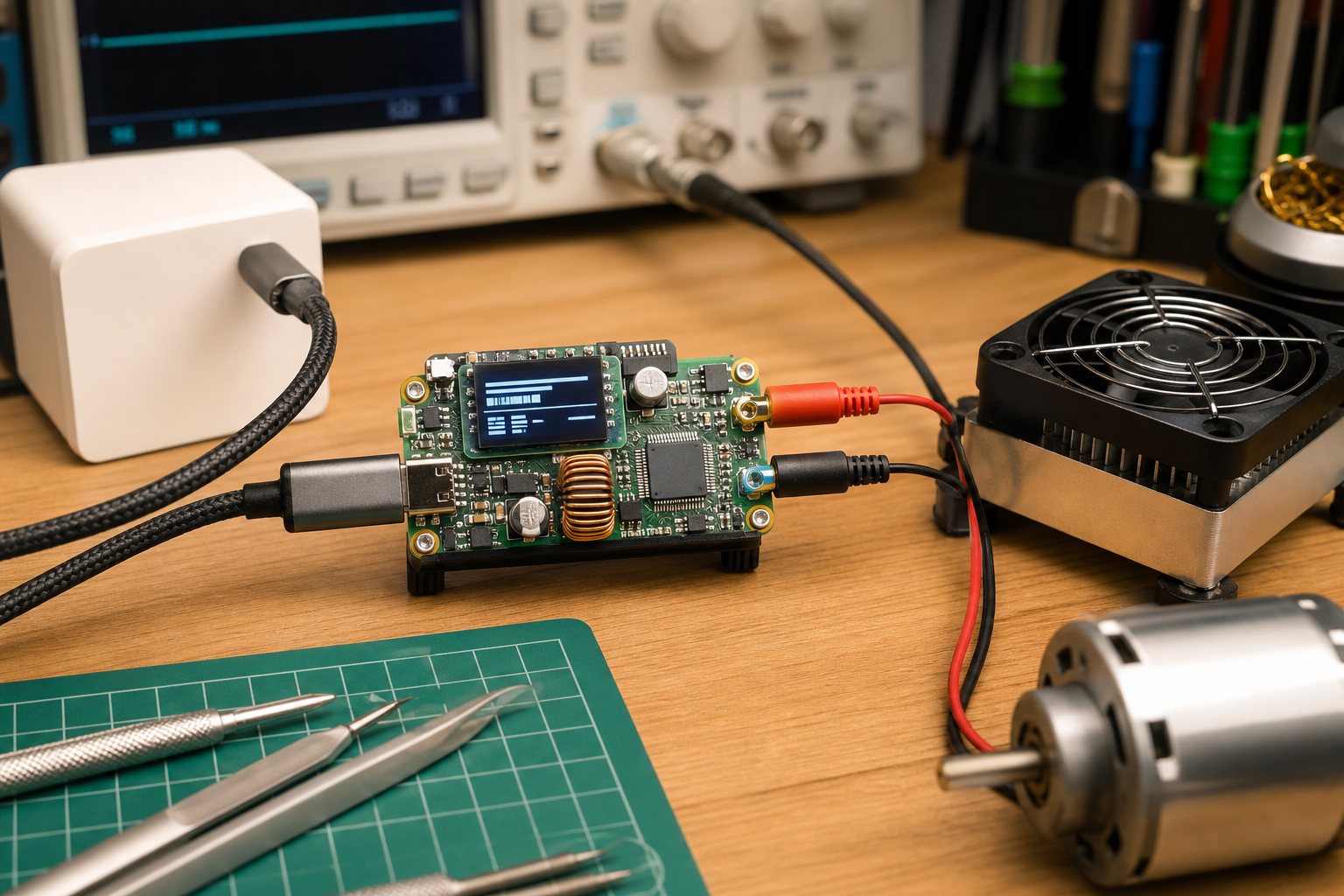
A new maker project making the rounds this week shows how far USB-C Power Delivery has moved into the small-lab toolbox. PowerPD is an ESP32-based programmable bench supply and USB-C PD/PPS analyzer that turns a compatible charger into a compact adjustable power source for electronics work.
Why it matters
For many STEM labs and maker benches, the classic bench supply is still useful but bulky, expensive, and not always portable. USB-C PD and PPS chargers are now common, and projects like PowerPD show a practical path for turning that existing power ecosystem into a controlled development tool.
The project write-ups describe a compact system built around an ESP32 microcontroller, an AP33772S USB-C PD sink controller, and an INA226 power monitor. That combination lets the device negotiate a voltage profile from a charger, measure voltage/current/power in real time, and expose telemetry locally or over Wi-Fi.
Technical breakdown
PowerPD is not just a passive breakout. The AP33772S handles USB-C PD negotiation, while the INA226 measures electrical output. The ESP32 acts as the control and interface layer, managing selected output behavior and reporting live measurements. The Hackster write-up notes tests with a 12V cooling fan and a high-power BLDC motor, with the OLED display showing voltage, current, and calculated power while an Adafruit IO dashboard updated remotely.
That architecture is useful because it separates three jobs that are often confused in quick bench hacks:
- Negotiation: selecting an allowed charger voltage/current profile instead of blindly drawing power.
- Measurement: monitoring voltage, current, and power during real loads.
- Control and logging: using the ESP32 for UI, wireless telemetry, and project integration.
Adafruit’s earlier USB-C Power Delivery Monitor guide follows the same general educational direction: use a USB-C PD interface and microcontroller-based measurement to make modern chargers visible and useful on the bench.
Builder and STEM impact
For robotics clubs, classroom labs, and small electronics teams, the takeaway is not that every bench supply should be replaced. It is that USB-C power is becoming programmable enough to be treated as part of the test setup. A compact PD/PPS supply can support quick motor tests, sensor boards, LED experiments, charger analysis, and portable demos when a full lab supply is not available.
It also creates a teaching opportunity. Students can see negotiation, current sensing, thermal limits, load behavior, and telemetry in one project instead of treating power as a black box.
Risks and unknowns
Power projects demand caution. USB-C PD/PPS still depends on charger capability, cable quality, thermal design, fusing, connectors, and firmware behavior. A maker build should not be treated as a certified lab supply, and motor loads can create transients that require protection. Builders should test gradually, add appropriate fuses or current limits, and avoid using unknown chargers or cables for high-power experiments.
TVG Take
PowerPD is a strong example of the maker ecosystem maturing around infrastructure, not just flashy end devices. The interesting engineering lesson is the control loop: negotiate power correctly, measure it continuously, and make the data visible enough that students and builders can reason about what the hardware is doing.