ASUS used Computex 2026 to frame AI as a full deployment stack rather than a single PC feature. In a June 2 press release, the company said its “Ubiquitous AI. Incredible Possibilities” strategy now spans enterprise AI infrastructure, on-prem systems, industrial edge hardware, creator workstations, and consumer devices.
Why it matters
For builders, the interesting part is not the marketing phrase. It is the direction of travel: AI workloads are being split across rack-scale compute, local inference boxes, business PCs, industrial systems, and endpoint devices. That is the architecture many robotics, automation, and edge-AI teams are already forced to design around.
ASUS separately announced AI factory infrastructure work around NVIDIA’s DSX platform, describing rack-scale systems, POD architectures, storage for context memory, and deployment services intended to reduce the time from blueprint to operating AI capacity. That matters because the bottleneck for many organizations is no longer just model access; it is provisioning, power, storage, networking, observability, and secure operations.
Technical breakdown
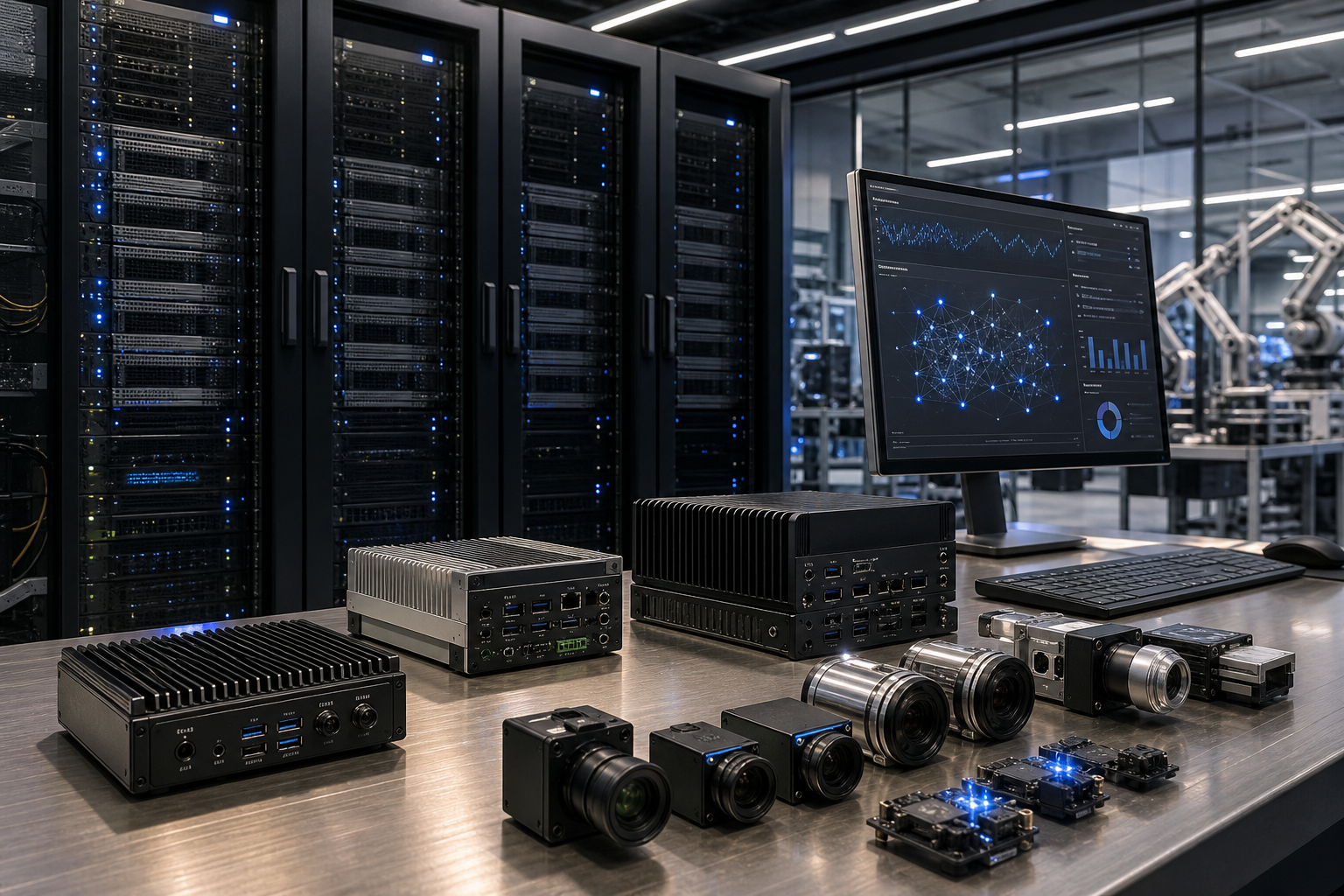
The Computex announcement groups ASUS hardware into several layers. At the top are rack-scale AI infrastructure and “AI factory” systems. In the middle are NUC, Mini PC, ExpertCenter, and industrial edge systems meant for local or near-local workloads. At the endpoint are notebooks, creator devices, and business systems that can run smaller AI tasks close to users.
For a robotics or automation deployment, that maps cleanly to a practical architecture:
- Training and fleet analytics: centralized GPU systems for model development, synthetic data, logs, and evaluation.
- Site-level inference: industrial edge systems near cameras, robots, inspection stations, or production lines.
- Operator workflow: business PCs and local agents that handle dashboards, documentation, and exception review.
- Governance: controlled agents, identity, data handling, and deployment rules rather than open-ended chatbot access.
The second ASUS announcement is also notable for its emphasis on “time to first token.” That phrase sounds like an AI-infrastructure metric, but it points at a broader deployment issue: teams need a repeatable path from purchased hardware to measurable inference throughput.
Builder, STEM, and industry impact
For makers and STEM labs, the lesson is architectural. Even small teams can borrow the same pattern: keep large model training and storage centralized, run latency-sensitive perception or control locally, and give students or operators a clear interface rather than dumping raw model outputs into a project.
For industrial users, the enterprise-to-edge framing reinforces that AI pilots need hardware planning early. Camera count, thermal envelope, network topology, storage retention, and model update cadence all determine whether a prototype becomes a maintainable system.
Risks and unknowns
ASUS announced a broad ecosystem, not a single standardized edge-AI reference design. Buyers still need to evaluate software support, accelerator compatibility, long-term availability, security updates, and whether the promised “AI agent” workflows fit their own compliance model. Teams should also avoid assuming that a rack-scale AI factory automatically solves data quality, evaluation, or site-integration work.
TVG Take
The useful signal from ASUS at Computex is that edge AI is becoming a deployment discipline. The winners will not be the teams with the biggest demo; they will be the teams that can connect infrastructure, local inference, operations, and maintenance into one predictable workflow.