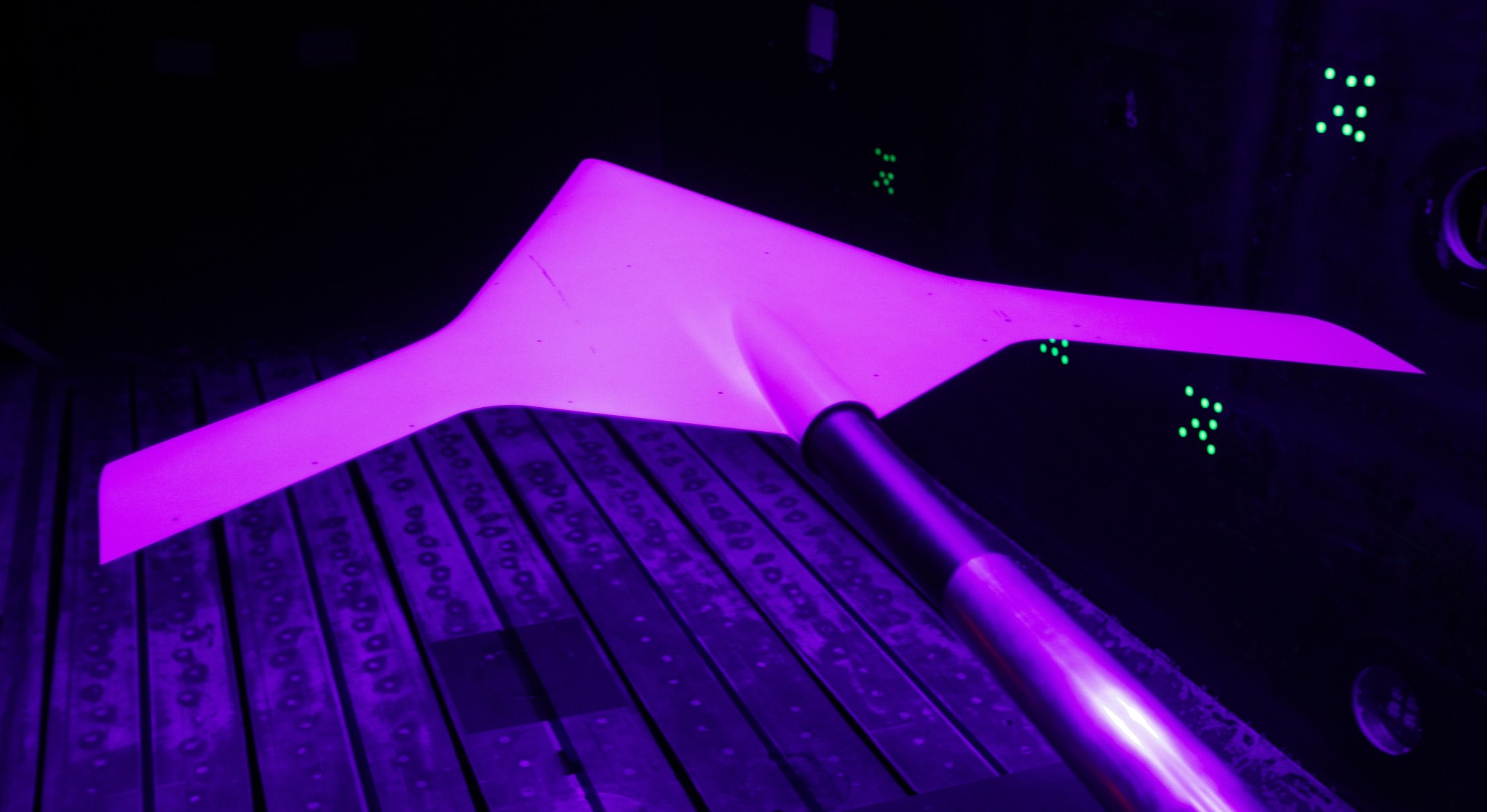
NASA has used unsteady pressure-sensitive paint on a large, freely moving wing model inside Langley Research Center’s Transonic Dynamics Tunnel. The October 2 announcement matters because the setup turns an entire painted surface into an optical pressure measurement, while the model is allowed to respond to aerodynamic loading rather than remaining rigidly fixed.
The test used NASA’s Benchmark Supercritical Wing, a standard research article meant to compare wind-tunnel measurements with computational models rather than represent one production aircraft. NASA says this was the first use of the technique on a large-scale, freely moving model in the tunnel’s low-oxygen environment. The agency’s report does not publish sampling rate, pressure uncertainty or test-condition tables, so those remain important limits on what can be concluded from the announcement.
The pink glow is a pressure signal
Pressure-sensitive paint contains luminophores whose emitted light changes with oxygen concentration. Ultraviolet illumination excites the coating; cameras record brightness across the surface; calibration converts intensity into pressure. In a conventional pressure tap, each port returns one local reading. An optical coating can instead supply a dense field, although its accuracy still depends on illumination, camera calibration, temperature correction and a usable oxygen response.
NASA describes the system as unsteady pressure-sensitive paint because high-speed imaging resolves changing pressure rather than only a steady average. That distinction is important for buffet, flutter and other aeroelastic behavior: the useful output is a time history at many surface locations, not merely a colorful still frame.
Why motion and low oxygen make this harder
A freely moving model changes position and shape while the camera is collecting intensity data. Image registration must keep each pixel associated with the correct location on the wing as it moves. The tunnel environment adds another constraint. Because the paint’s response depends on oxygen quenching, a low-oxygen test medium reduces the available optical signal and complicates calibration.
NASA’s 2025 overview of the paint program describes a broader workflow that combines faster coatings, high-speed cameras and supercomputer processing. The new test brings that chain to a moving benchmark model, where synchronized surface pressure can be compared with model motion and numerical predictions.
What the announcement establishes
The result establishes feasibility in this tunnel and test configuration; it does not yet establish a universal replacement for taps or pressure transducers. Conventional sensors remain valuable for calibration and independent checks, while paint can add spatial coverage where drilling many ports is impractical.
NASA says the work prepares for tests of flexible aircraft models that bend and adapt in flight. The next evidence to watch is quantitative: frequency response, uncertainty through the motion envelope, spatial resolution after registration and agreement with embedded transducers. Those numbers will show how much the glowing surface improves aeroelastic model validation beyond making the pressure field visible.