Disclosure: TVG has not received a review unit for this article; this analysis is based on manufacturer specifications, official product information, public documentation, and TVG’s engineering review criteria. TVG has not performed hands-on seal, humidity, feed-force, or drying tests on the PolyDryer Box XL.
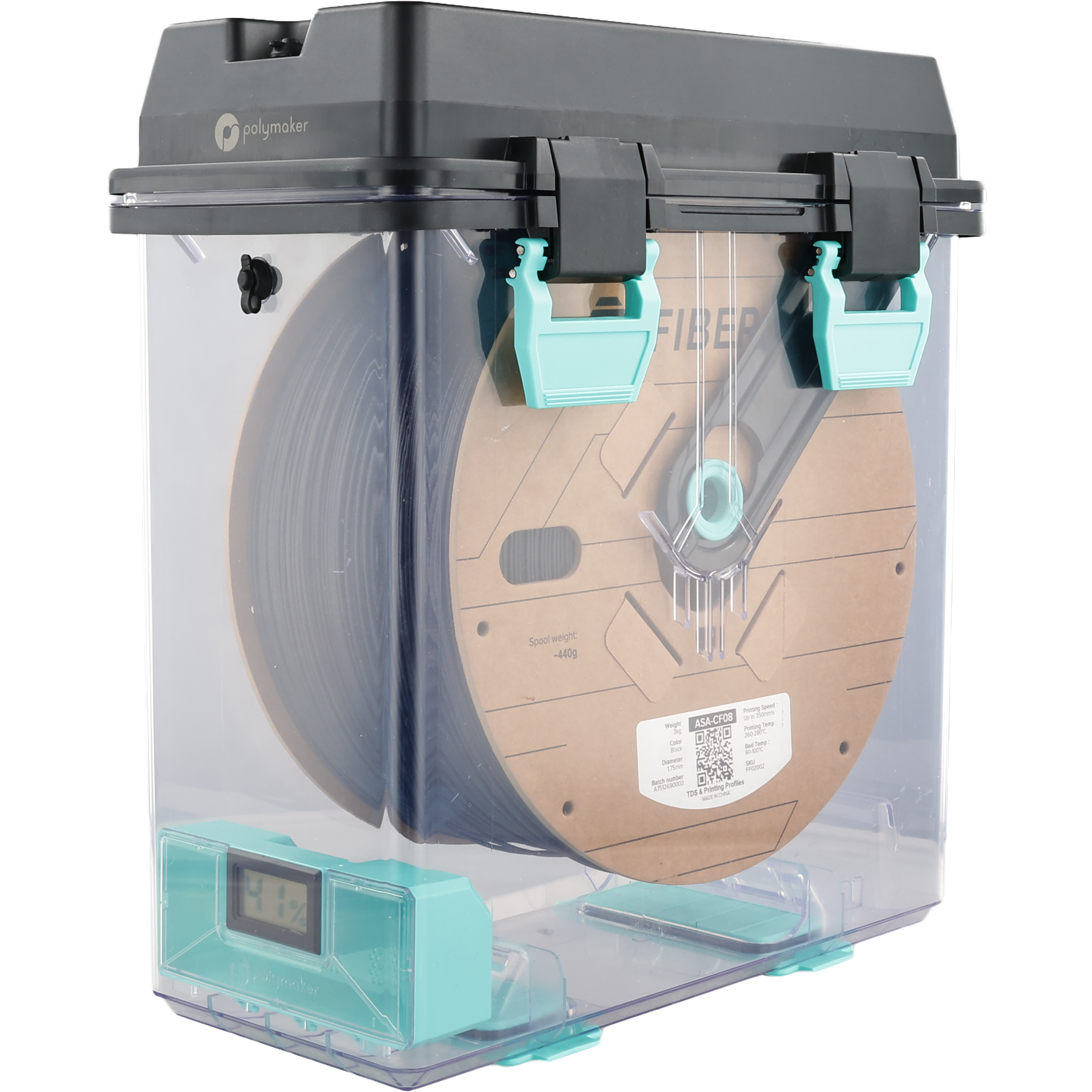
Large-format printers and print farms create an awkward filament-storage problem: a 3 kg spool can reduce changeovers, but its material value and long exposure time make poor moisture control more expensive. Polymaker’s PolyDryer Box XL is positioned as a sealed storage and print-through enclosure for that job. It supports spools up to 3 kg, adds a built-in hygrometer and color-changing desiccant, and can connect to the existing PolyDryer Dry Dock through an optional adapter.
The important qualification is in Polymaker’s own FAQ: the Box XL is not a standalone filament dryer. Its default role is to help already-dry material stay dry. Active heating requires a separate Dry Dock and adapter, and Polymaker cautions that the larger box may dry less efficiently than its standard 1 kg setup. That distinction makes this a useful engineering buyer evaluation rather than a simple “bigger dryer” story.
Product summary
The PolyDryer Box XL expands Polymaker’s modular dry-storage concept around large spools. According to the official product page, it accepts spools up to 300 mm in diameter and 118 mm wide, with a maximum stated spool mass of 3 kg. It supports 1.75, 2.85, and 3.00 mm filament and routes material through sealed outlets so a printer can draw from the enclosure without repeatedly opening the lid.
Polymaker lists the single storage box at $69.99 and the Dock Adapter at $7.99 on its U.S. store as checked October 7, 2026; price and availability can change. The box includes a built-in hygrometer and up to 110 g of color-changing silica-gel desiccant. A carry handle and revised latch system are sensible design signals because a loaded 3 kg spool makes both handling and seal compression more demanding than on a desktop-sized dry box.
Who it is for
The clearest audience is a print farm, fabrication lab, school, or prototyping shop that routinely buys large spools and runs long jobs. It may also suit an individual using moisture-sensitive engineering materials who wants to condition a spool, move it into protected storage, and print without exposing it to room air.
It is harder to justify for someone who mostly buys 750 g or 1 kg spools. A smaller box occupies less bench space, may condition material faster on the Dry Dock, and costs less to replicate across several colors. The XL’s value rises when fewer spool changes and support for a true 3 kg reel solve an actual workflow problem.
Technical specs and design signals
- Spool envelope: up to 3 kg and 300 × 118 mm, according to Polymaker.
- Filament compatibility: 1.75, 2.85, and 3.00 mm diameters.
- Moisture monitoring: built-in hygrometer plus up to 110 g of color-changing silica-gel desiccant.
- Print-through path: sealed filament outlets are intended to preserve the internal environment while material feeds to a printer.
- Active drying: requires a separate PolyDryer Dry Dock and optional Dock Adapter; the Box XL alone provides passive dry storage, not heat.
- Adapter options: Polymaker sells the adapter and also publishes an official printable design through its Printables listing. The company recommends ABS, ASA, or another material with similar heat-deflection capability for a printed adapter.
The modular approach is the strongest design signal. A lab can theoretically share one heater among several storage boxes instead of paying for electronics in every enclosure. That separation can lower fleet cost and reduce idle powered hardware. It also creates a workflow dependency: drying capacity is limited by the number of Docks, while storage capacity is limited by the number of boxes.
Polymaker says its larger enclosure achieved sealing performance comparable to the standard Box in water-leak, smoke-leak, and long-duration humidity tests. Those are useful manufacturer claims, but they are not substitutes for an independent humidity-decay curve, especially after months of latch cycles and repeated filament-outlet changes.
What TVG would test
- Humidity recovery: condition a 3 kg spool, close the box in a controlled room, and log indicated relative humidity for 24 hours. Repeat after opening the lid for one minute to measure recovery time.
- Long-term sealing: compare internal and ambient humidity over one to two weeks, then repeat after dozens of latch cycles. We would inspect the perimeter gasket and feed-through seals for compression set or leakage.
- Hygrometer accuracy: compare the built-in display against a calibrated reference at multiple humidity points. A convenient display is only useful if its offset and response time are understood.
- Feed resistance: measure pull force at the beginning, middle, and end of a full 3 kg spool. The test should include direct, angled, and overhead filament routes because friction can show up as under-extrusion before it looks like a storage problem.
- Spool compatibility: test cardboard and plastic reels near the stated 300 × 118 mm limit, checking side clearance, roller tracking, wobble, and whether warped flanges rub the enclosure.
- Desiccant service interval: weigh or monitor the desiccant through repeated cycles in a humid shop to estimate practical regeneration frequency.
- Dock-assisted drying: with the official adapter, map temperature and humidity at several points around a loaded reel. Polymaker’s PolyDryer documentation says the standard Dock uses a 68 W PTC heater and can reach a highest internal range of 68–73°C, but the company separately warns that the larger XL volume may reduce drying efficiency. TVG would not assume standard-box times transfer directly.
- Handling and safety: carry the loaded enclosure, inspect latch security, verify stable placement, and examine the printed-adapter interface after a high-temperature cycle.
Failure points, risks, and unknowns
The name can create the wrong expectation. A “PolyDryer Box” sounds powered, but the XL box by itself is passive storage. Buyers who need to rescue a wet spool must budget for a compatible Dry Dock and adapter or use another controlled drying method.
Three kilograms magnifies friction. A heavy reel has greater bearing and roller demands, and the feed path may see changing tension as the spool empties. Maximum physical fit does not guarantee smooth delivery in every printer layout.
One humidity number does not describe the entire spool. Hygrometers report air near the sensor, not moisture concentration inside the polymer. A low display reading can indicate a healthy storage environment without proving that a saturated nylon spool has been fully dried.
Dock performance is a key unknown. Polymaker explicitly says the XL is optimized for storage and is not designed for high-power drying. The shared-Dock concept is appealing, but buyers should expect longer or material-dependent conditioning until independent testing establishes repeatable times.
Consumables and seal wear matter. Desiccant must be regenerated, feed-through plugs can be misplaced, and a large lid places more leverage on latches and gaskets. Replacement-part availability would be part of a long-term review.
Who should consider it
Consider the Box XL if 3 kg spools are already part of your production plan, long prints make mid-job changes costly, or your material sits near a machine for days. It is especially interesting for teams that already own a PolyDryer Dry Dock and want to extend that ecosystem.
Skip or postpone it if most of your inventory is 1 kg, you need rapid active drying more than storage, or your printer’s filament path cannot tolerate added feed resistance. A sealed tote with measured desiccant may be more economical for passive storage, while a purpose-built heated dryer may be better for frequent wet-spool recovery.
TVG Take
The PolyDryer Box XL addresses a real gap: large spools deserve more than an oversized plastic bin, particularly when nylon, TPU, or other moisture-sensitive materials feed through multi-day jobs. Its 300 × 118 mm spool envelope, print-through seals, hygrometer, desiccant capacity, and shared-Dock strategy form a coherent system.
But the engineering case depends on details that specifications cannot settle: humidity leakage after repeated use, hygrometer error, loaded-spool drag, and temperature uniformity when the standard Dry Dock heats a much larger volume. Our provisional verdict is promising for high-throughput users who need protected 3 kg spool handling, but not a substitute for a verified drying process. This is exactly the kind of product TVG would want to test with a review unit because seal decay and full-spool feed force are central to the buying decision.
Sources
- Polymaker — PolyDryer Box XL official product page (capacity, spool dimensions, filament diameters, hygrometer, desiccant, price, adapter, and manufacturer FAQ)
- Polymaker — PolyDryer Box XL product overview
- Polymaker Wiki — PolyDryer documentation and FAQ (Dock heater, temperature range, and XL integration)
- Polymaker — official printable Box XL Dock Adapter