InMachines is crowdfunding Piccola CNC, a desktop mill combining Gerber-based PCB preparation with surface-height compensation. Basic and Pro probe the board through the cutting tool; Ultimate adds a laser. For PCB builders, the useful choice is how to map uneven copper-clad material before routing traces.
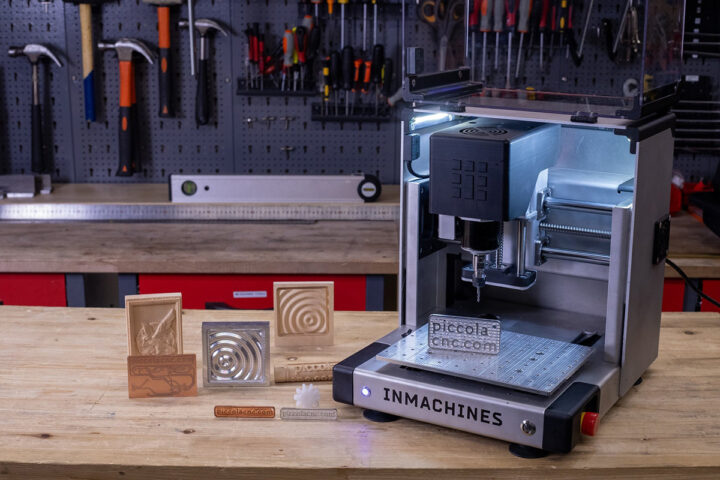
Photo: InMachines, via CNX Software.
What the height map changes
According to CNX Software’s coverage, Piccola’s integrated CAM prepares isolation-routing, drilling and board-outline operations from Gerber and drill files. Height mapping then compensates for surface variation so the cut can follow an uneven board rather than assuming the copper lies on a perfectly flat plane.
Basic and Pro use conductive contact through the milling tool to measure that surface. Ultimate’s non-contact laser distance sensor supplies another way to build the map and adds edge and center finding. The laser is also offered as an upgrade for the other models, so choosing contact probing initially does not rule out adding it later.
This compensation addresses board unevenness, not every source of machining error. Tool runout, rigidity and setup still matter; InMachines’ stated 0.0025 mm motion resolution is not a finished-board accuracy guarantee.
From PCB files to machine control
InMachines integrates EasyTrace5000 for PCB CAM and Kiri:Moto for general machining. The upstream EasyCAM5000 project documents EasyTrace’s Gerber, Excellon and SVG conversion to isolation-milling G-code, including drilling and tabbed board cutouts. It runs client-side in a browser, giving builders a separate route to explore the PCB preparation tools.
Kiri:Moto’s CAM documentation describes arranging models, generating toolpaths, inspecting them and exporting G-code. It also makes a useful workflow point: changing machine or tool settings requires re-slicing. These upstream projects explain the software foundations; they do not establish which revisions Piccola will ship.
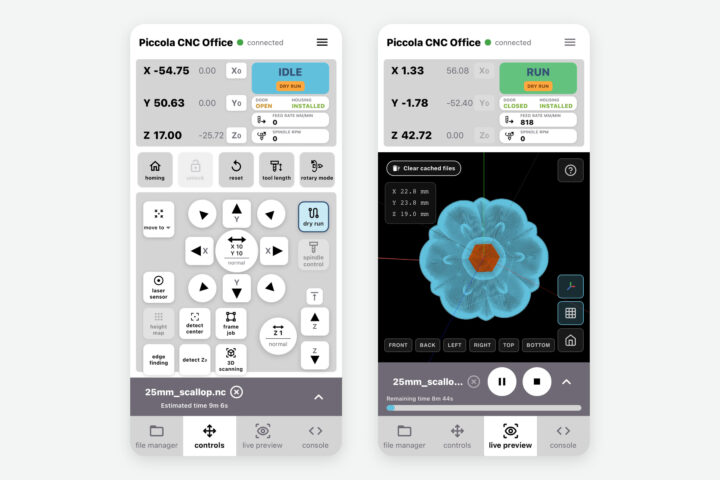
Inside the machine, two RP2350 microcontrollers divide the work. CNX reports that one runs grblHAL for real-time motion, while the other handles spindle control, safety monitoring, height compensation and communication with desktop and mobile applications.
What the higher pledges buy
All three versions list a 150 × 150 × 70 mm work area. Basic pairs an open frame with a 100 W brushed spindle. Pro adds an enclosure and a 200 W brushed spindle; Ultimate combines the enclosure with a 200 W brushless spindle and the laser sensor.
For the enclosed models, InMachines describes a door interlock that physically cuts spindle power and an independent emergency-stop circuit. CNX lists CE conformity assessment as ongoing, rather than completed certification.
The manufacturer’s displayed Super Early Bird prices, including VAT, are €1,279 for Basic, €1,679 for Pro and €1,979 for Ultimate. CNX separately quotes Early Bird pledges of €1,091, €1,511 and €1,679, respectively, excluding applicable VAT and shipping. Those differently labelled offers should not be treated as interchangeable checkout totals.
CNX reports deliveries are expected to begin in July 2027. This remains a crowdfunding purchase, and InMachines explicitly promises the machine’s source files at delivery; their release is a future commitment, distinct from the upstream CAM code already available.