
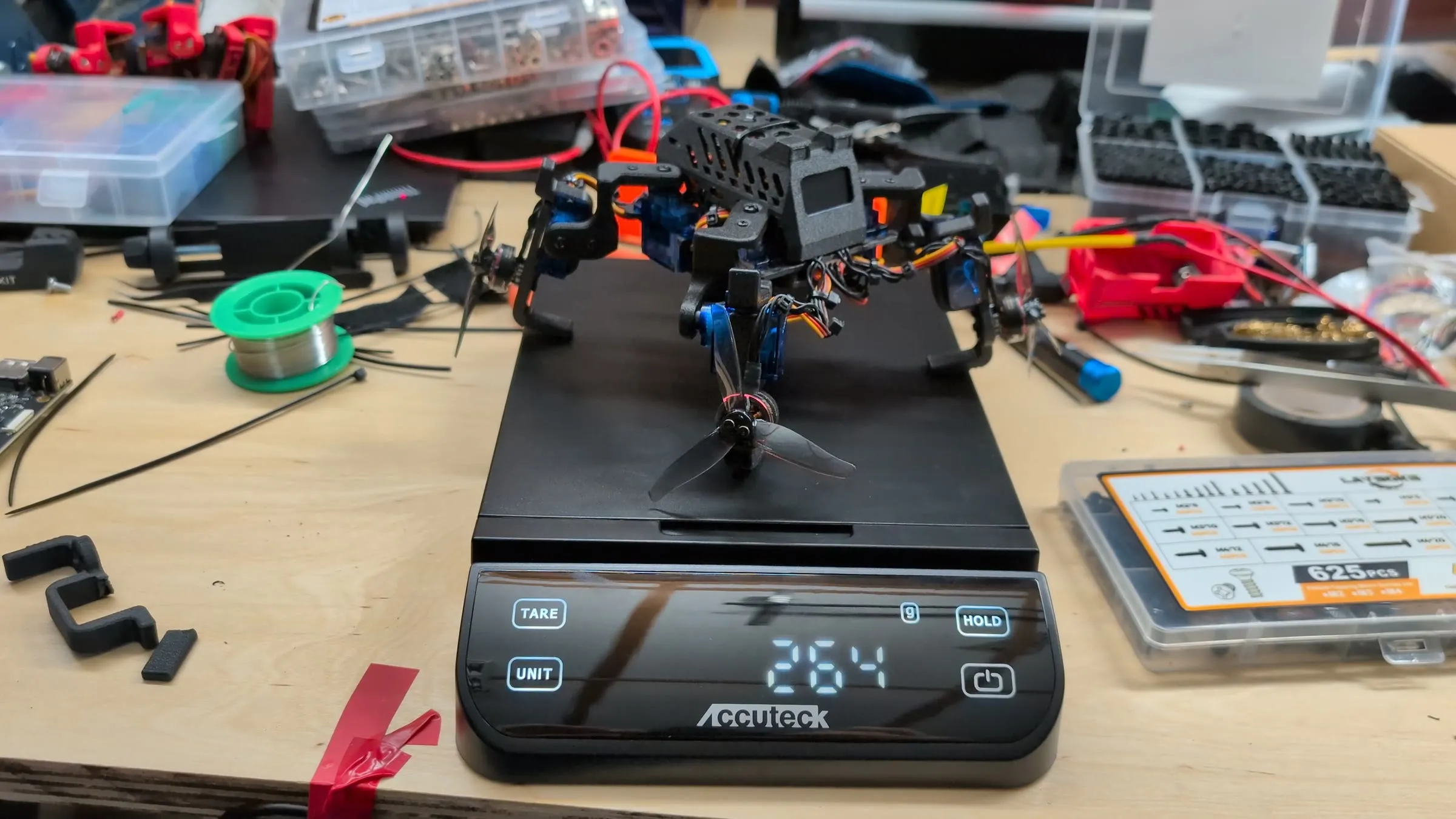
Dorian Todd’s 264-gram Sesame Drone prototype turns its walking feet into propeller arms. Its key trick is a printed stop at each knee: upward thrust presses the extended foot into that stop, giving a movable leg the stiffness needed to carry flight loads.
Photo: Dorian Todd (original image).
A hard stop instead of a stronger servo
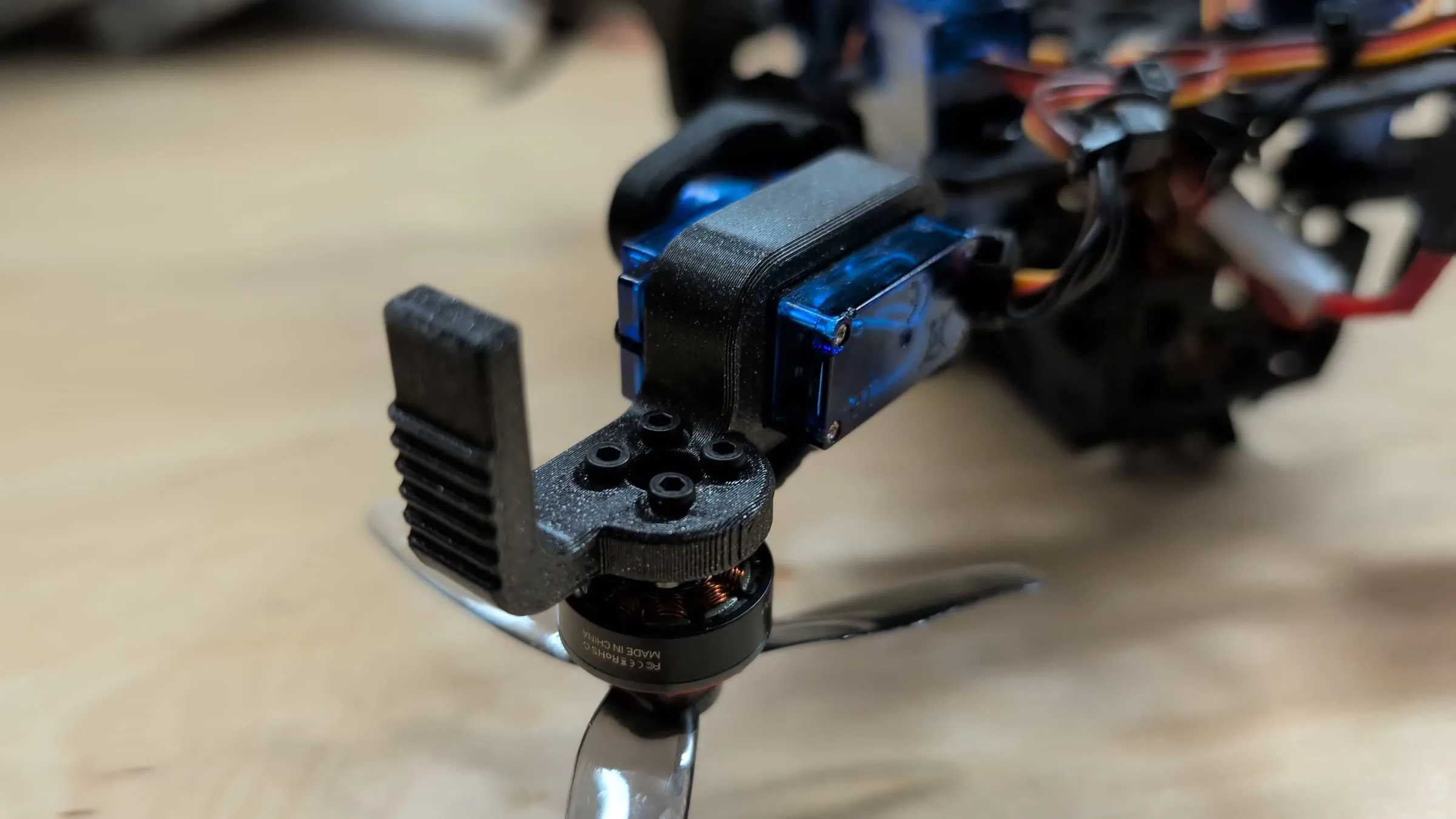
Each leg has a hip servo and a knee servo, with a brushless motor and propeller mounted on the foot. For flight, all four knees move to 90 degrees, folding the feet out flat against stops printed into the upper legs.
The distinction is stiffness, rather than lifting strength. Todd identifies servo dead band, plastic-gear backlash and 50 Hz position updates as reasons an unsupported arm can droop or vibrate. That tilts the thrust, leaving the flight controller to fight an unwanted sideways push.
The stop changes the load path. Because propeller thrust pushes the foot upward into it, a one-sided stop can carry that load without asking the knee servo to keep correcting the joint angle. The servo positions the foot; the printed structure supports it under thrust.
Walking and flying get separate controllers
A Lolin S2 Mini, based on the ESP32-S2, handles the eight servos, animated face and Wi-Fi control page. A BETAFPV F4 all-in-one flight board handles stabilization, radio reception and the four motor controllers.
Todd says the walking firmware already occupied all eight LEDC channels; trying to add motor-controller outputs exhausted timers and broke its Wi-Fi portal. A dedicated flight board avoided that conflict in his implementation. The two controllers have no command link, but share a battery—separate software loops are not complete electrical fault isolation.
Weight savings leave a thin flight margin
The weight-saving conversion covered by Hackster replaces the walking robot’s metal-geared servos with lighter SG90 plastic-geared units. Todd reports saving about 35 grams, accepting gears more vulnerable to crash damage. The flying structure uses carbon-fiber-reinforced nylon prints and a CNC-cut carbon-fiber plate, rather than the standard walking build’s PLA parts.
Even so, Todd reports little spare thrust at hover. If the low-side motors cannot accelerate further to correct a tilt, the controller must slow the high side instead, losing altitude as it levels out. His test log includes a low, wobbly hover and a backyard walk–takeoff–landing–walk sequence in which the hard landing broke a leg.
This remains an experimental flying conversion. The public Sesame repository provides the walking platform’s CAD, firmware and build guides; it should not be mistaken for a complete, ready-to-build flying kit.
The immediate safety gap is leg control during flight. Drone mode locks inputs in the web controller, but the ESP32 still accepts commands from other senders. Todd plans to enforce the interlock in firmware and add an “armed” signal from the flight controller so the walking side can lock the legs automatically. Neither protection is implemented yet.