NASA’s experimental roamx-0201 rotor airfoil delays a sharp aerodynamic drag increase and improves stall behavior under studied conditions, the agency reported on October 20. The thinner blade cross-section offers a route toward longer Mars helicopter flights by addressing two limits on how fast—and at what angles—a rotor can work effectively.
Researchers at NASA’s Ames Research Center are developing the design with Imperial College London and Nagoya University. Their approach combines high-fidelity computer simulations with wind-tunnel tests. NASA’s announcement describes a thinner, asymmetrical shape selected through simulations and algorithms tuned to Mars conditions, followed by tests of its aerodynamic behavior.
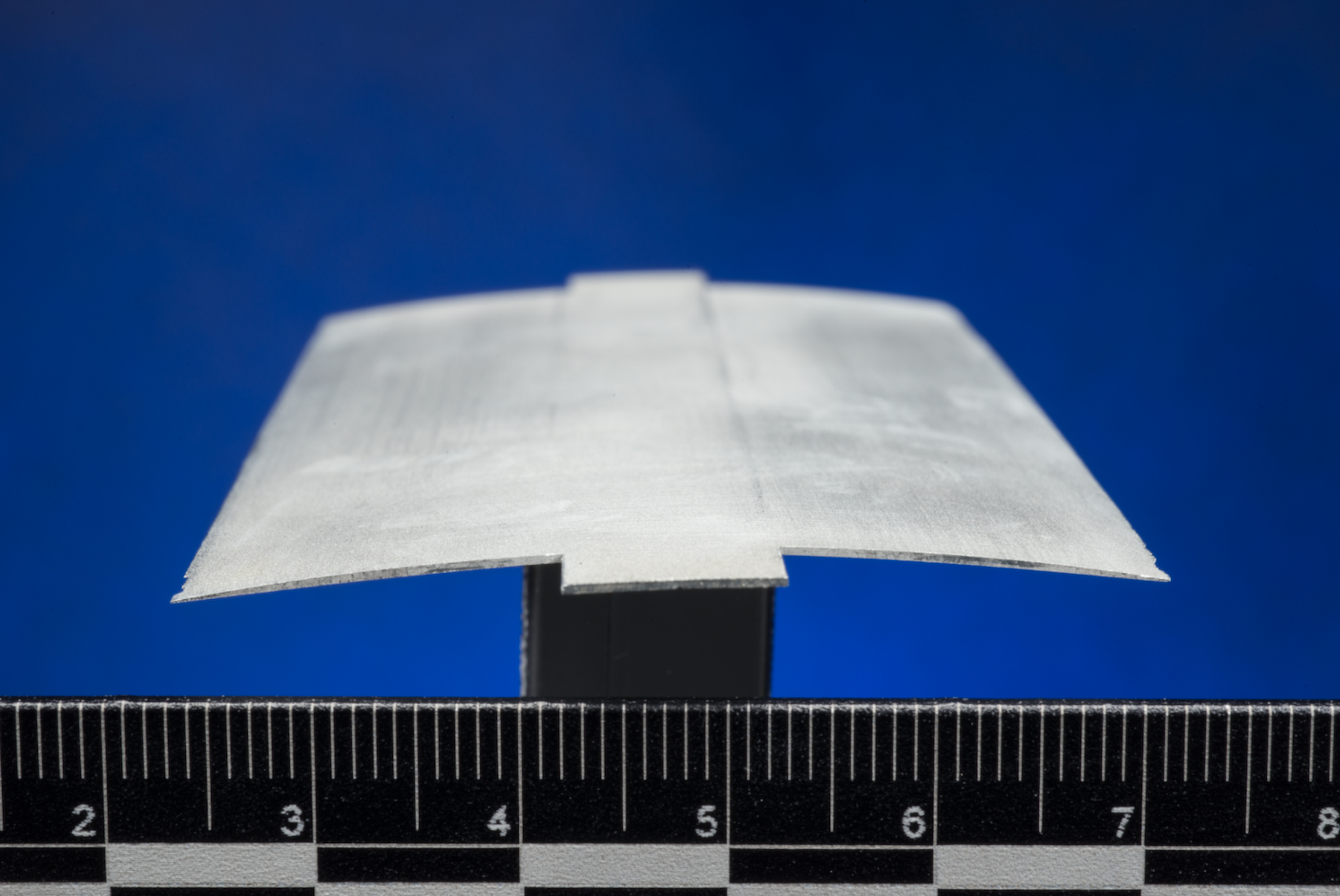
Hero image: NASA, roamx-0201 experimental airfoil. NASA media guidelines.
Why the thinner profile matters
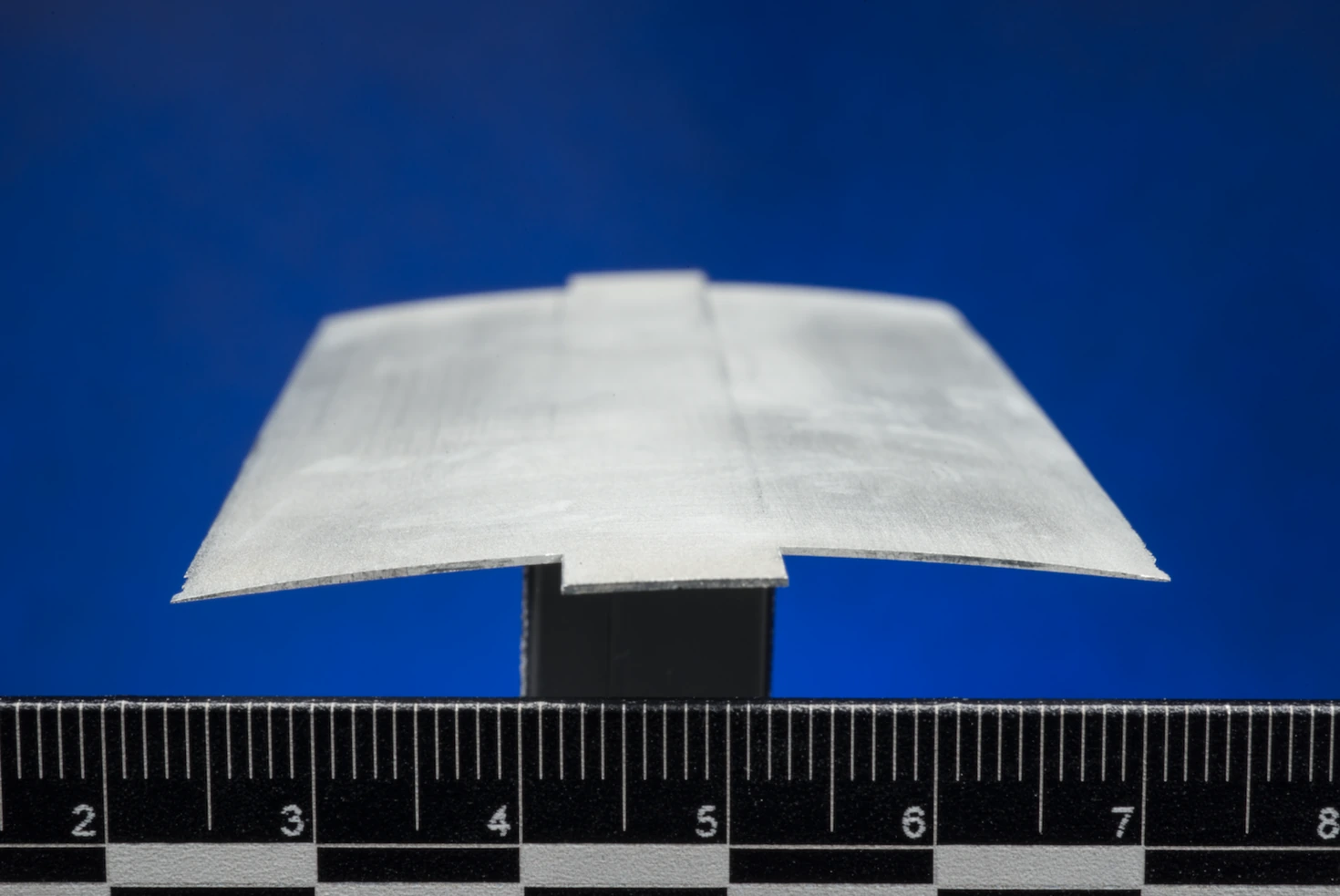
An airfoil is the cross-sectional shape of a blade. Here, the engineering change is visible in a physical sample: a thin gray profile supported above a ruler, rather than a complete helicopter or a flight demonstration. NASA contrasts the new geometry with the more rounded profile used by Ingenuity.
One target is drag divergence. As a rotor approaches the speed of sound, aerodynamic performance can deteriorate sharply. Sound travels more slowly on Mars than on Earth, making that limit particularly relevant to a Mars rotor design. NASA says roamx-0201 could operate at higher speeds for longer before encountering this drop in performance.
The design also changes how air behaves immediately next to the blade. This thin region of flow is called the boundary layer. At the leading edge, roamx-0201 deliberately disturbs that flow in a way NASA says helps generate lift. The useful result comes from this particular geometry and flow behavior; it is not a general rule that adding turbulence improves a rotor.
A gentler response to stall
Speed is only one constraint. A change in the angle of airflow can trigger stall, sharply reducing aerodynamic performance and making flight unstable. NASA reports that Ingenuity’s blade design suffered steep performance degradation at stall, while roamx-0201 showed significantly improved behavior under the conditions studied.
That could let future helicopters operate safely across a wider range of flight angles. For the research team, the attraction is a combination: delaying the high-speed drag penalty while improving how the blade responds when airflow angles become challenging.
Longer range is still a projection
NASA’s simulation analysis suggests a future helicopter using redesigned blades could potentially cover as much as 18.7 kilometers in one uninterrupted flight while carrying scientific instruments. That is a modeled future vehicle capability, not a distance flown on Mars or a measured range gain attributable to this airfoil alone.
The work is aimed at missions after SkyFall, rather than an announced change to SkyFall’s blades. Aero-News’s October 26 coverage relays NASA’s account of that development path and the simulation-and-wind-tunnel program.
NASA explicitly says the technology is not ready for Mars. Tests are still helping researchers resolve discrepancies between computational predictions and real-world performance. The next useful milestone is closer agreement between those results: evidence that the promising blade geometry behaves as expected beyond the simulation.