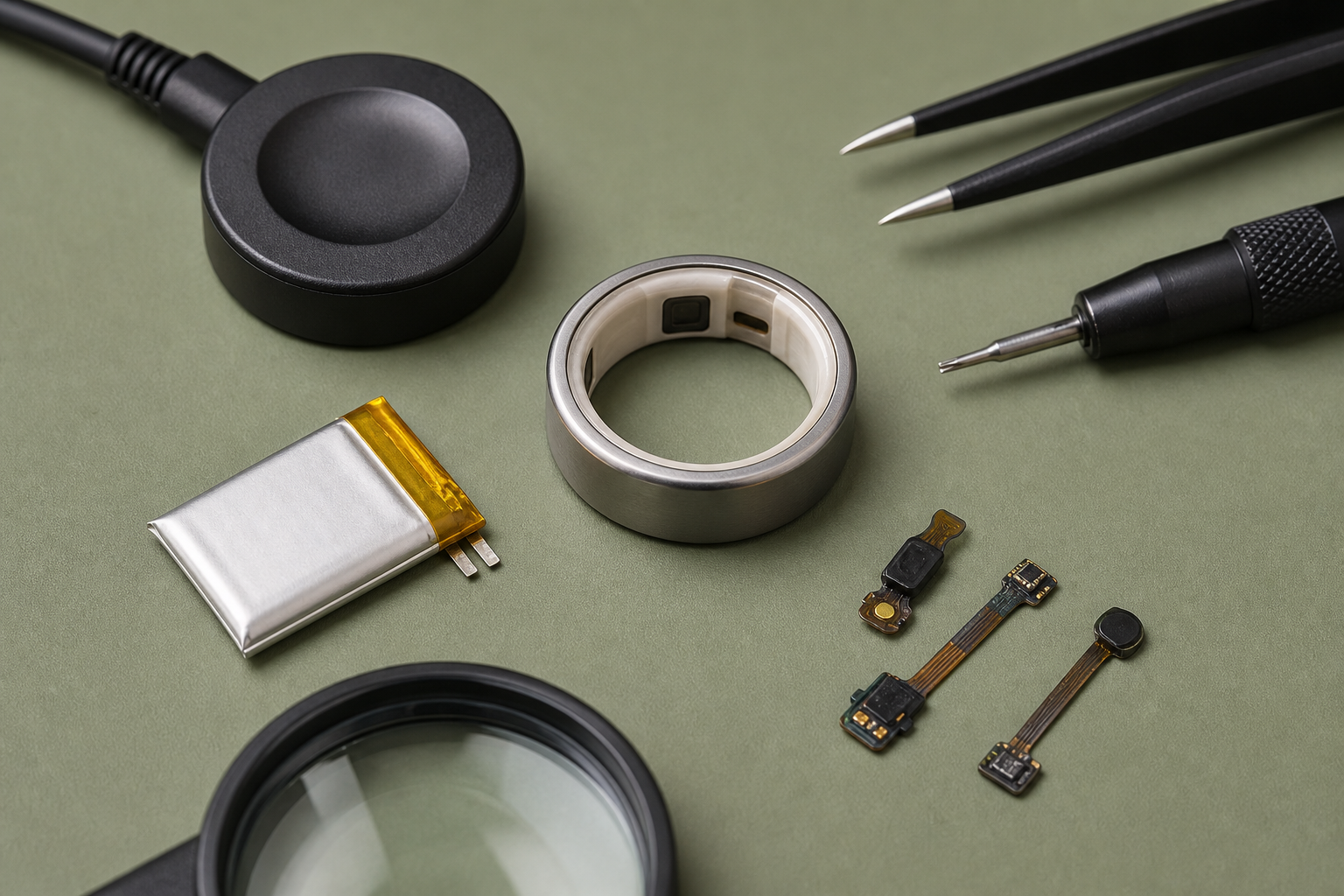
Smart rings are becoming the quietest wearable category: no screen, no large case, no obvious notification surface, and no bulky strap. That simplicity is the appeal. It is also why buyers should ask harder repairability questions before treating a smart ring like a smaller smartwatch. A sealed ring is a tiny embedded system wrapped around a battery, sensors, antennas, charging contacts, firmware, cloud software, and a subscription or app layer. If one part fails, the whole product may become e-waste.
Hackaday’s recent discussion of the repair problem around smart rings is a useful reminder that miniaturization changes ownership. Oura’s own product materials emphasize sleep, readiness, activity, temperature, heart-rate, and app-based analysis. Samsung’s Galaxy Ring support pages show the category moving into mainstream consumer electronics. Those sources point in the same direction: smart rings are not jewelry with an app; they are sealed sensor nodes with health-adjacent data flows and limited physical service options.
For TVG readers, this is the same buyer-readiness logic behind our field storage spec review and action camera stabilization guide. The spec sheet is only a starting point. The real question is what happens after months of sweat, charging cycles, firmware updates, travel, and daily wear.
1. Battery replacement is the first ownership test
The most important smart-ring component is the least visible one: the battery. A smartwatch can sometimes be opened by a repair specialist, even if the process is unpleasant. A ring has far less room, a curved sealed body, and little tolerance for swelling, moisture, or mechanical damage. Once capacity drops, the user may have no practical path other than replacement.
Buyers should look for explicit battery-capacity retention language, warranty duration, replacement policy, recycling policy, and whether the company offers discounted replacement when battery aging becomes the limiting factor. A claimed multi-day runtime is useful, but it does not answer the ownership question. A better review test is: after 500 charge cycles, what support path exists?
Teams evaluating wearables for students, field crews, or pilots should treat the battery as a consumable. If the ring is purchased for a one-year program, that may be acceptable. If it is expected to last like conventional jewelry, the economics are different.
2. Sealing and water resistance cut both ways
Smart rings need strong sealing because they sit through handwashing, sweat, rain, dust, and daily knocks. Water resistance is a real benefit. The tradeoff is that better sealing usually makes repair harder. Adhesives, molded housings, potting compounds, and tiny charging assemblies protect the electronics, but they also make disassembly destructive.
A good buyer checklist asks what the water-resistance rating means, whether the company covers water damage under normal use, and what happens if the charging contacts corrode. Marketing phrases such as “daily waterproof” are not enough. Look for documented ratings and support terms.
3. Sensor claims need context
Smart rings commonly advertise heart-rate tracking, heart-rate variability, skin temperature trends, sleep stages, activity estimates, cycle-related temperature trends, and readiness scores. The engineering challenge is that a ring has a different sensor location than a watch. It may get strong optical contact in some conditions and poor results in others depending on fit, skin temperature, motion, hand position, and sensor placement.
That does not make the data useless. It means buyers should prefer trend-based claims over precise one-off readings. A ring can be useful for sleep consistency, recovery trends, and habit feedback. It should not be treated as a lab instrument unless the vendor provides validation data and the use case matches the test conditions.
4. Sizing is a technical issue, not just comfort
Unlike a watch strap, a smart ring cannot be adjusted hour by hour. Finger size changes with temperature, hydration, exercise, altitude, and time of day. A loose ring can hurt sensor quality. A tight ring can be uncomfortable or unsafe. Buyers should use the vendor’s sizing kit and wear it across multiple days, including sleep and exercise, before committing.
For educators, makers, and small teams buying multiple units, sizing logistics can become the hidden cost. A classroom or field program may need spare sizes, hygiene procedures, and a plan for reassignment. Rings are harder to share than watches.
5. Privacy and subscriptions matter more because the device is invisible
A smart ring collects intimate routine data while staying out of sight. Sleep timing, temperature trends, activity levels, location-adjacent app use, and readiness scores can reveal daily patterns. Buyers should read the privacy policy before purchase, not after setup. Look for data export, deletion, third-party sharing, research use, account recovery, and what happens when a subscription lapses.
The subscription question is also a repairability question. If core insights require a paid cloud service, the product’s useful life depends on the company’s business model as much as the hardware. A ring with good offline summaries and clear export options is more resilient than one that turns into a decorative battery when the service changes.
6. Charging hardware should be boring and replaceable
Because rings are so small, their chargers are often proprietary docks or cases. Buyers should check replacement charger availability, cable standard, travel durability, and whether charging contacts are easy to clean. A lost charger should not make the ring unusable for weeks. If the vendor does not sell spare chargers or hides them behind support tickets, that is a warning sign.
7. Firmware support is part of the product
Wearables depend on firmware and mobile apps for sensor tuning, battery management, security, and integrations. A ring that ships with incomplete features may improve, but buyers should not purchase based only on a roadmap. Look for update history, security posture, and whether the company documents known issues.
For product teams designing small wearables, the lesson is clear: publish support commitments early. Customers will accept tiny sealed hardware if they understand replacement terms, data handling, firmware cadence, and recycling. Vague “premium wellness” language is not enough.
Buyer checklist
- What is the warranty period, and does it address battery degradation?
- Is there a paid or discounted replacement path when the battery ages?
- Are spare chargers sold directly?
- Does the vendor publish a real water-resistance rating and support policy?
- Can users export and delete their data?
- Which features require a subscription?
- How long has the company supported prior hardware generations?
- Does the sizing process account for multi-day finger changes?
- Are sensor claims framed as trends or precise diagnostics?
- Is there a recycling or take-back path?
TVG Take
Smart rings are impressive embedded systems, but buyers should treat them as sealed electronics with a finite service life, not as jewelry that happens to charge. The best products in this category will be the ones that make replacement, privacy, data export, and support policies as clear as the sleep score. If a vendor cannot explain what happens when the battery ages, the spec sheet is incomplete.