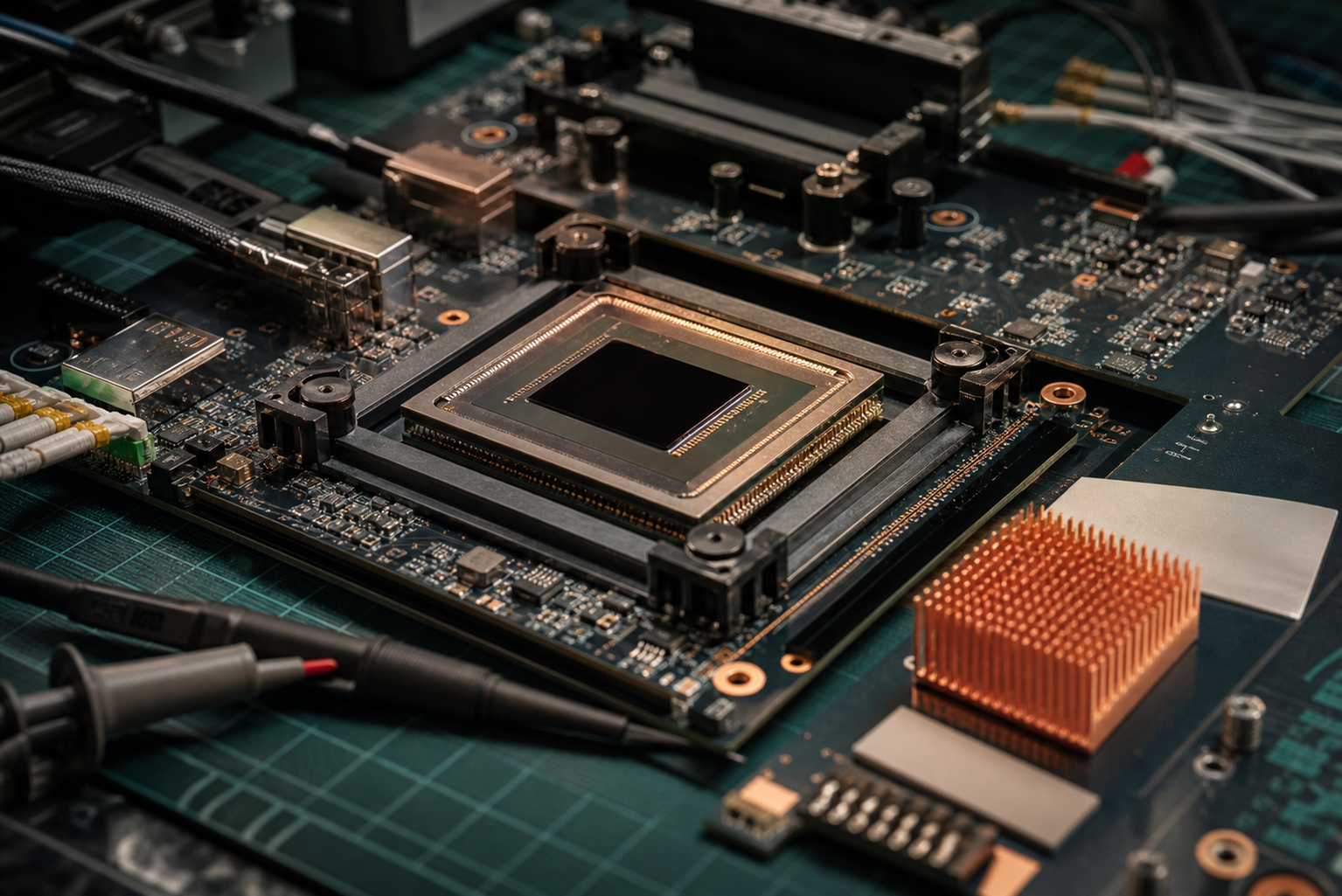
OpenAI and Broadcom have put a name on OpenAI’s first custom inference processor: Jalapeño. Broadcom’s investor release says the companies unveiled the accelerator on June 24, 2026, describing it as an LLM-optimized intelligence processor and the first chip in a multi-generation compute platform for OpenAI.
The news matters because inference is where AI products become a daily cost and reliability problem. Training creates the model; inference is what happens every time a user asks for a response, a coding agent runs a tool, or a product routes a prompt through a model. A custom chip does not automatically make those systems cheaper or faster, but it gives OpenAI and Broadcom a tighter place to tune memory movement, scheduling, power draw, and model-serving behavior than a general-purpose accelerator stack alone.
According to Broadcom, Jalapeño is architected around OpenAI’s view of future LLM inference. Broadcom’s release frames the processor as a joint design rather than an off-the-shelf component. OpenAI’s announcement page positions the project around AI system scale and efficiency. Coverage from The Verge and Engadget also identifies the part as an ASIC built for inference rather than a general GPU replacement.
What is known so far
The public material is still light on the engineering details that would let buyers, developers, or infrastructure operators compare Jalapeño directly with GPUs, NPUs, or cloud TPU-style accelerators. OpenAI and Broadcom have not published a full spec sheet, process node, memory configuration, interconnect details, board-level design, software stack, or deployment schedule in the material TVG reviewed today.
That makes this a platform signal more than a benchmark story. The point is not that one named chip changes AI overnight. The point is that a major model provider is moving more of its serving stack toward custom silicon, likely because token cost, latency, availability, and power density are now product features.
Why it matters for builders
For developers using OpenAI APIs, the near-term effect may be invisible. If Jalapeño reaches production systems, the customer-facing change could show up as steadier latency, different pricing, larger context windows, new routing behavior, or more predictable capacity during demand spikes. None of those outcomes are guaranteed from the announcement alone.
For small AI teams, the practical lesson is to separate model quality from serving assumptions. A workflow that performs well during a demo can fail when response time, queueing, tool calls, and memory-heavy tasks pile up. TVG has made the same point in our Ryzen AI Halo local-agent test bench coverage and our Windows AI dev box budget analysis: compute choices are product decisions, not just spec-sheet bragging rights.
TVG Analysis
Jalapeño is worth watching because inference hardware sits close to user experience. If the chip improves throughput per watt or reduces bottlenecks for long-running agent work, it could influence how quickly AI tools move from impressive demos to dependable everyday systems. If the software stack is narrow, supply is constrained, or latency gains appear only for certain workloads, the impact will be more limited.
The missing pieces are the important ones: benchmark transparency, deployment timing, supported model families, system design, and whether developers see any measurable change in cost or reliability. TVG will treat this as a silicon-program milestone until OpenAI and Broadcom publish more implementation detail or users can observe production behavior.
For now, the safest reading is conservative: the announcement confirms direction, not field performance. Developers should watch for API-level changes, region availability, reliability notes, and any public data about which workloads benefit. Hardware only matters to customers when it changes the service they can build on.
What to watch next
For readers following this topic as an engineering problem, these related TVG Report pieces are the best next context:
- OpenAI Broadens Voice-App Tools as Custom Voices Move Toward Production Use
- OpenAI Releases GPT-5.1 for Developers With Faster Reasoning and New Coding Tools
- OpenAI Codex Remote Reaches GA With QR Pairing for Mobile Supervision