Disclosure / review-unit status: TVG has not received a review unit for this article; this analysis is based on manufacturer specifications, official product information, public documentation, and TVG’s engineering review criteria. This is a spec review and buyer evaluation, not a hands-on verdict.
Product summary
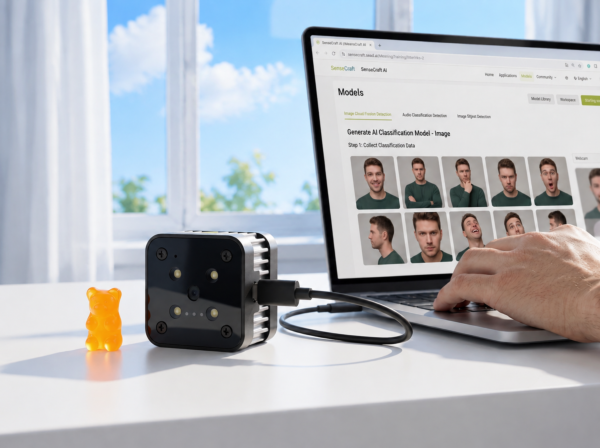
Seeed Studio’s reCamera 2002w 8GB is a compact, Linux-based edge-AI camera built around the SG2002 system-on-chip. It combines a 5MP camera, 1 TOPS of INT8 AI acceleration, wired and wireless networking, local storage, and a browser-accessible Node-RED workflow in a roughly 40mm-square enclosure.
That combination targets a useful gap between a simple vision sensor and a Raspberry Pi-class vision computer. A basic sensor module may be easy to wire but rigid about models and outputs. A single-board computer offers more freedom but adds board selection, camera cabling, storage, power, enclosure, and software integration. reCamera packages those pieces as a small programmable appliance while still exposing Linux, custom-model support, modular hardware, and open repositories.
Seeed’s public product page listed the 8GB 2002w at $99.99 during this evaluation. Price and availability can change, so buyers should verify the current listing rather than treat that figure as permanent.
Who it is for
The clearest audience is makers, robotics teams, STEM labs, and small automation developers who need local object detection without building a complete camera computer from separate parts. It could suit a benchtop inspection demonstrator, a robot-mounted detector, a classroom edge-AI lesson, or an early proof of concept where cloud video is undesirable or unavailable.
The 2002w version is particularly relevant when a project needs both Ethernet and Wi-Fi. Seeed’s documentation describes AP and station modes for onboarding, while the quick-start guide covers browser access and Node-RED. Those features may reduce the time between powering the device and showing a working vision flow.
This is not automatically the right camera for high-resolution machine vision, safety-rated inspection, or workloads that require broad framework compatibility and abundant memory. Its value depends on whether the constrained edge stack matches the model, camera, latency, and integration requirements.
Technical specs and design signals
According to Seeed’s official hardware specifications, the reCamera 2002 series uses an SG2002 SoC with two C906 RISC-V CPU cores listed at 1GHz and 700MHz, an 8051 microcontroller, 256MB of memory, and 1 TOPS of INT8 AI performance. The 8GB version uses eMMC storage and supports removable TF-card expansion. The 2002w adds 2.4/5GHz Wi-Fi and Bluetooth alongside 100Mbps Ethernet and USB Type-C 2.0.
The standard sensor board uses an OV5647 5MP sensor. Seeed lists a 1/4-inch sensor format, F2.8 aperture, 3.46mm focal length, 65-degree field of view, and less than 1% distortion. The detailed sensor section lists still images up to 2592 × 1944 and video modes including 1080p at 30fps and 720p at 60fps. Buyers should distinguish the 5MP sensor resolution from the documented encoded-video modes rather than assume every pipeline runs full-resolution video at 30fps.
The device measures 40 × 40 × 36.5mm and is specified for 5V/1A input. Its sensor board also includes fill lights, a microphone, a speaker, and status indicators. These are practical integration signals: a prototype can add illumination or basic audio interaction without immediately requiring another peripheral board, although the public documentation does not establish their image, audio, or electrical performance.
Software is central to the product pitch. Seeed’s quick-start documentation describes browser onboarding, Node-RED, and a default YOLO11n detection workflow. The company also publishes an open-hardware repository and a separate reCamera OS repository. Public design and OS resources are positive signals for buyers who want to inspect the platform before committing to it.
Failure points / risks / unknowns
The first constraint is memory. With 256MB listed in the official specifications, model size, preprocessing, Node-RED flows, logging, and concurrent services may compete for limited resources. The 1 TOPS figure is useful for positioning, but it does not by itself establish which real models can run at acceptable latency.
The second risk is toolchain friction. RISC-V plus a dedicated NPU can offer strong efficiency, but it also means buyers should verify supported model formats, operators, quantization paths, and conversion tooling. A model that runs on a desktop framework is not automatically deployable on this camera without changes.
The third unknown is optical fit. A fixed 65-degree field of view and the standard OV5647 module may work well for general detection, but close inspection, long working distances, low light, fast motion, or unusual mounting angles can demand different optics and lighting. The modular design is promising, but buyers should verify alternate sensor availability, mechanical fit, configuration support, and calibration requirements before choosing it for specialized inspection work.
Finally, wireless onboarding needs security scrutiny. Default access-point behavior is convenient in a lab, but production users should change defaults, isolate devices appropriately, review exposed services, and define an update policy. TVG has not performed a security audit and would not treat a quick-start configuration as a deployment-ready security posture.
Who should consider it
Consider the reCamera 2002w 8GB if you want a compact, review-accessible edge-AI platform with local inference, a browser workflow, Ethernet and Wi-Fi, and unusually visible hardware and OS resources. It looks especially relevant for classroom vision projects, maker robots, proof-of-concept inspection rigs, and teams that value a packaged camera more than the expansion range of a full SBC.
Look elsewhere if your application needs large models, substantial RAM, interchangeable high-end optics, synchronized multi-camera capture, certified industrial interfaces, or guaranteed performance under a formal machine-vision specification. Those requirements need a different class of hardware or, at minimum, a hands-on validation program before purchase.
TVG Take
Based on its published design and documentation, the Seeed Studio reCamera 2002w 8GB is a credible compact edge-AI platform for buyers who accept its memory and toolchain limits. Its strongest design signals are the small integrated package, wired and wireless connectivity, modular boards, accessible Node-RED path, and public hardware and OS repositories. Its biggest question is not whether a curated YOLO demo works; it is how predictably developers can move from that demo to their own model and recover when deployment goes wrong.
TVG has not tested a unit, so this article does not assign a score or make a hands-on recommendation. Based on published specifications alone, reCamera occupies an interesting middle ground for builders who need more freedom than a fixed smart sensor and less integration work than a camera attached to a general-purpose computer.
Sources
- Seeed Studio — reCamera 2002w 8GB official product page
- Seeed Studio Wiki — reCamera 2002 Series hardware and specifications
- Seeed Studio Wiki — reCamera quick-start guide
- Seeed Studio GitHub — OSHW reCamera Series
- Seeed Studio GitHub — reCamera OS
- Seeed Studio — reCamera 2002w 8GB official product datasheet