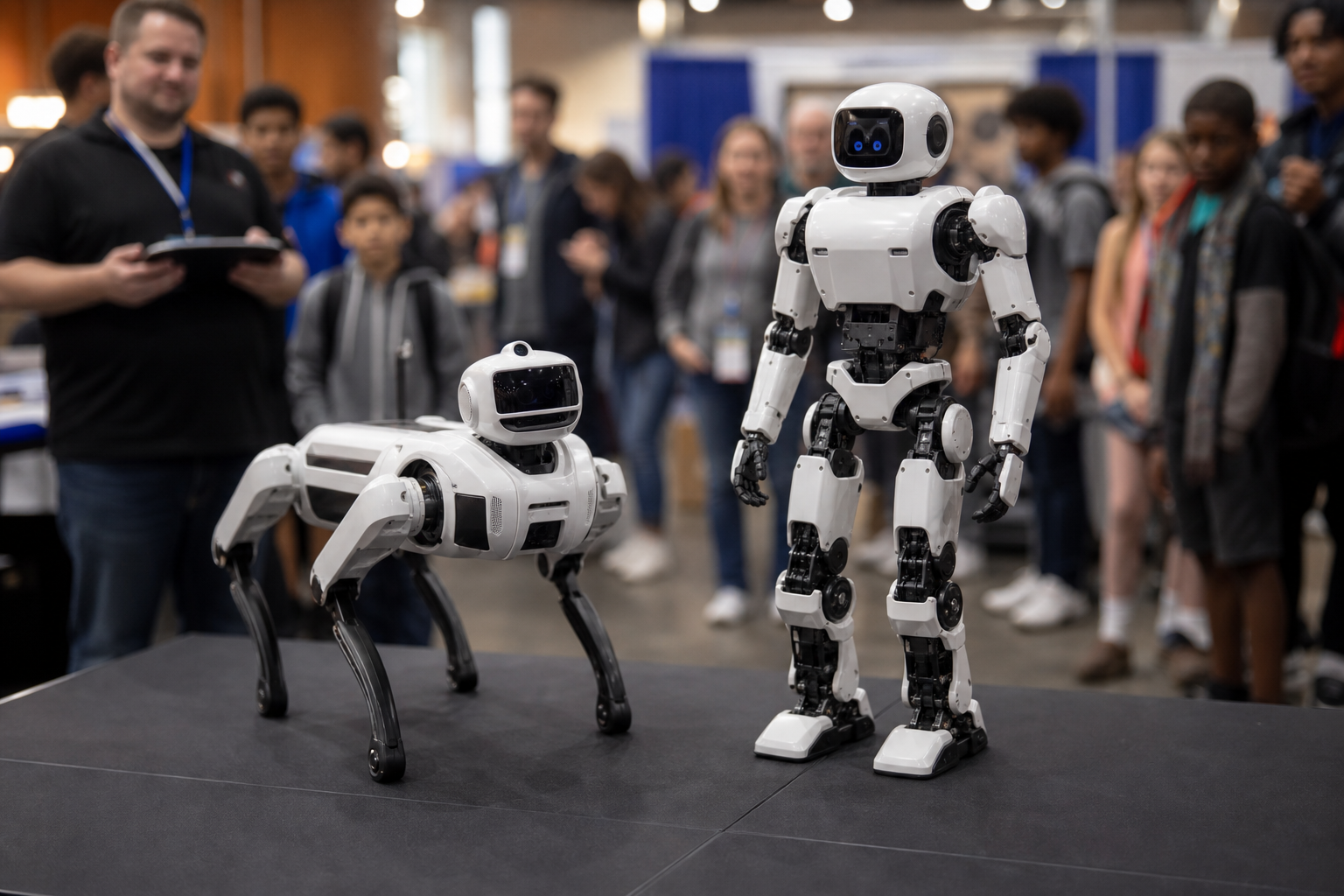
Faraday Future used the Orange County Maker Challenge award ceremony to put its “EAI” robotics products, Master and Aegis, in front of students, educators, and local STEM partners. The company described the robots as mystery award presenters and positioned the appearance as part of a deeper connection with California’s STEM and STEAM education ecosystem.
That makes the story interesting, but it also calls for restraint. A staged robotics appearance at an education event is not the same as a proven classroom platform. The useful question for TVG Report is what a system like this could teach students—and what claims still need evidence.
Why it matters
STEM robotics has moved beyond simple line-following kits. Students now see humanoids, quadrupeds, agent interfaces, machine vision, and voice-driven interaction in the same media environment as industrial automation. That can be motivating, but it also raises the bar for educational value.
A good educational robot should expose concepts students can reason about: sensors, actuation, state machines, path planning, human-machine interaction, safety limits, and debugging. A robot that only performs a scripted stage routine may inspire attention, but it does not automatically build technical understanding.
What was shown
According to Faraday Future’s release, its Master and Aegis products appeared on stage as AI-powered interactive presenters. The company frames the products under “EAI,” or Education AI, and links the showcase to K-12 engagement around robotics and intelligent systems.
That positioning fits a broader trend: companies are using robotics as a public-facing bridge between AI hype and tangible machines. For schools, the opportunity is to turn that interest into hands-on learning rather than passive spectacle.
What educators should ask next
The key details are not yet the stage photos. Educators should ask whether the platform includes curriculum materials, safe operating modes, repairable hardware, clear privacy practices, and programming access appropriate for students. A classroom robot must survive handling, battery cycles, software updates, and multiple skill levels.
Cost also matters. Many schools already struggle to maintain robotics kits, laptops, and competition equipment. If EAI robots are positioned as serious STEM tools, the vendor should be able to explain total cost of ownership, teacher training, replacement parts, and how students move from interaction to building.
Risks and unknowns
The biggest risk is that “AI robot” becomes a branding phrase rather than an instructional system. There is also a credibility issue for any vendor using education events to promote technology: the value should be measured by what students can learn and create, not by how futuristic the robot looks on stage.
TVG Take
Faraday Future’s OC Maker Challenge appearance is worth watching because it reflects where STEM outreach is headed: AI is becoming embodied, social, and event-ready. But TVG would like to see the next layer—developer access, curriculum structure, safety documentation, and real student projects. That is what separates a memorable demo from a useful educational robotics platform.
What to watch next
The next useful milestone would be a classroom pilot with published lesson plans, student build artifacts, and teacher feedback. If Master and Aegis are meant to be more than event presenters, Faraday Future should show how students can program behaviors, inspect sensor data, or design extensions around the platform.
TVG would also look for clear data policies. Any AI-enabled educational robot that interacts with students should be explicit about microphones, cameras, cloud processing, account requirements, and retention of student data. That is not a side issue for schools; it is part of whether the technology is deployable.