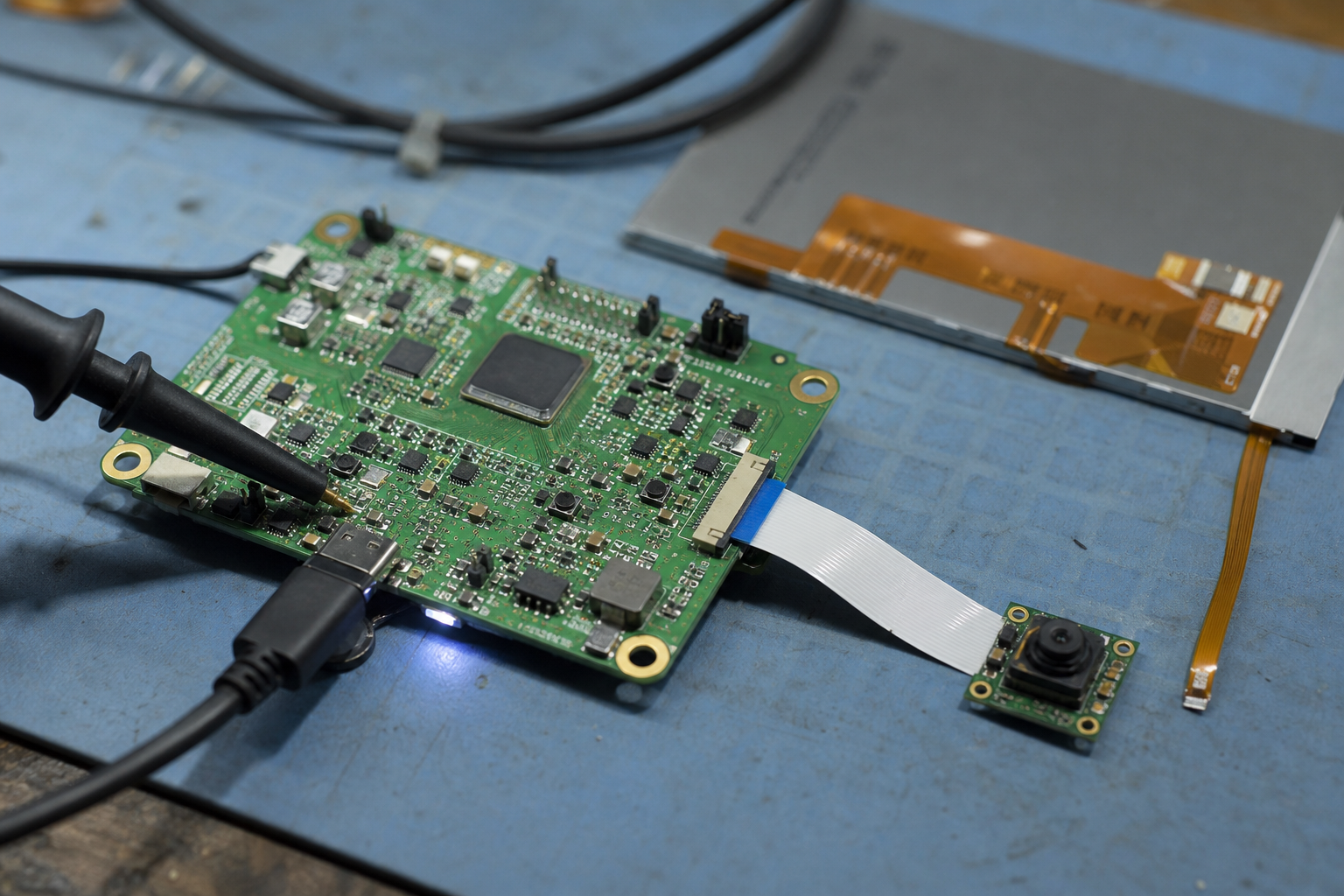
The ESP32-P4 is finally giving the maker community a different kind of Espressif part: less focused on “add Wi-Fi to a sensor,” and more focused on displays, cameras, USB, HMI work, and local multimedia control.
Recent ESP32-P4 development boards, including compact boards exposing the chip’s I/O through dense headers, show why this part is attracting attention. It uses dual-core RISC-V processing up to 400 MHz and adds the peripheral mix needed for interfaces that earlier ESP32 projects often had to fake, simplify, or offload.
Why it matters
Most ESP32 projects are small connected devices: sensors, relays, LED controllers, data loggers, and simple dashboards. The P4 opens a different lane. With camera and display support, USB capability, and more processing headroom, builders can start thinking about local control panels, machine interfaces, vision-adjacent projects, robotics dashboards, and smart instruments.
That does not turn an ESP32-P4 board into a Raspberry Pi replacement. It is still a microcontroller-class platform. But that is exactly why it is useful: fast boot, deterministic embedded behavior, lower overhead, and closer control of hardware than a Linux SBC provides.
Technical breakdown
Espressif describes the ESP32-P4 as a high-performance MCU with dual-core RISC-V CPU cores up to 400 MHz, support for a single-precision FPU, AI-oriented instructions, and a wide set of peripherals. Board vendors are using that silicon to expose camera, display, USB, Ethernet, and GPIO-heavy layouts.
The tradeoff is wireless. The P4 is not simply a bigger ESP32-S3 with everything included. Many designs pair it with a companion ESP32-C6 or another wireless module when Wi-Fi or Bluetooth is needed. That adds board complexity, but it also lets the P4 focus on local compute and I/O.
Builder impact
For makers, the most interesting use cases are projects that need a real interface: a resin-printer monitor, small CNC pendant, camera-enabled lab instrument, local automation controller, or interactive robotics panel. The P4 makes those builds feel more like embedded product design and less like a pile of workarounds.
For educators, it is also a useful bridge between Arduino-style microcontrollers and Linux boards. Students can work with real-time constraints, memory limits, display pipelines, and peripheral setup without jumping straight into a full operating system.
Risks and unknowns
The biggest practical risk is software maturity. New boards are only as useful as their examples, drivers, documentation, and community support. Builders should check ESP-IDF support, display libraries, camera examples, and whether a specific board’s pinout matches the project before ordering hardware.
TVG Take
The ESP32-P4 is not important because it is “faster.” It is important because it gives makers a credible embedded path for screens, cameras, and richer interfaces. The best P4 projects will not be benchmark demos; they will be small tools and devices that feel finished enough to live on a bench, robot, or machine.
What to watch next
The most important short-term signal will be example quality. If board vendors ship reliable display, camera, USB, and wireless-bridge examples, the ESP32-P4 can become a serious platform for bench tools and embedded interfaces. If examples remain fragmented, many builders will retreat to Linux boards despite the extra overhead.
TVG would also watch enclosure-ready designs. The P4’s value grows when it appears in finished-feeling modules with connectors, mounting holes, power protection, and documented thermal behavior. That is where maker hardware starts crossing into small-batch product development.