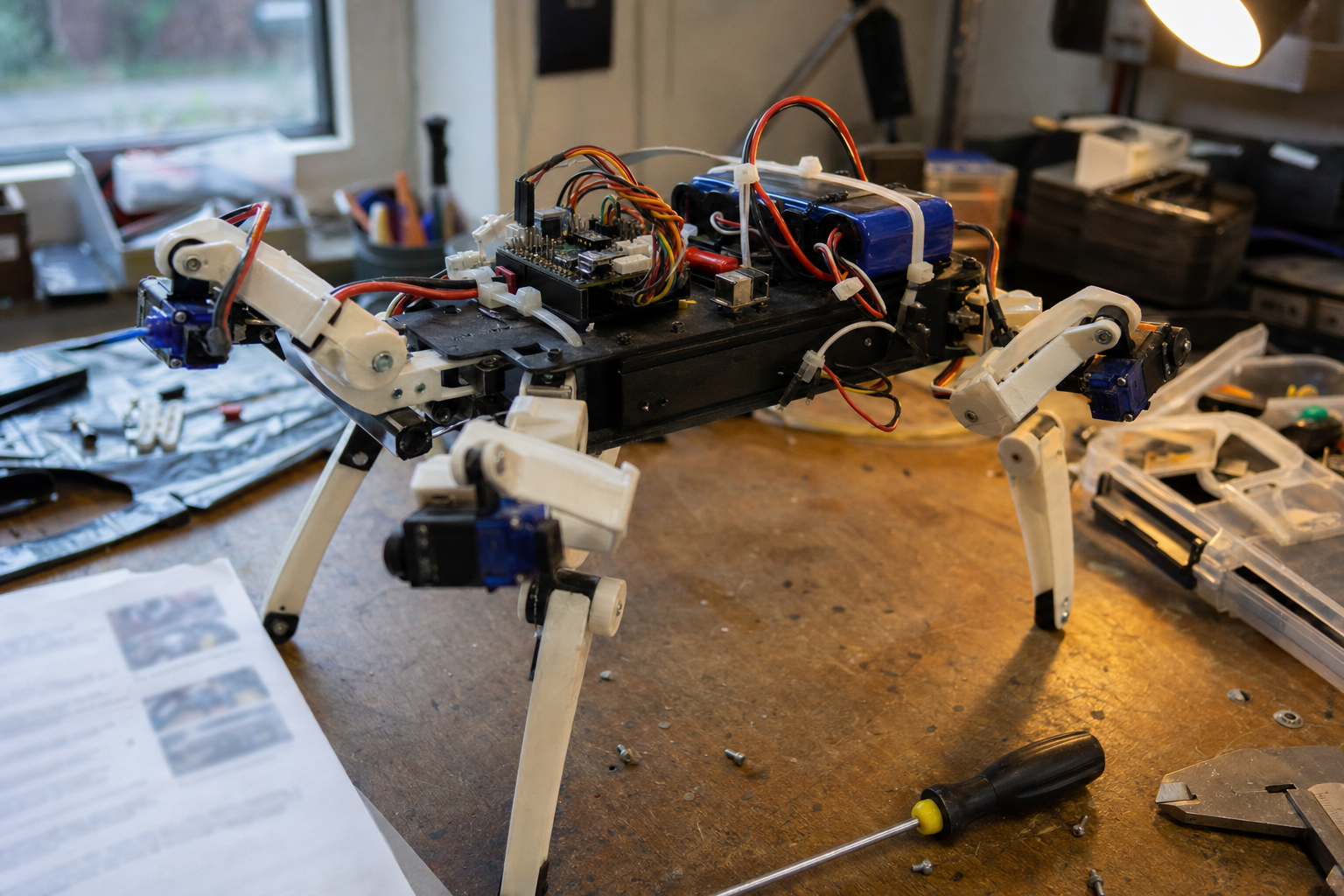
Albert, a low-cost open-source quadruped robot highlighted by Hackster, is the kind of maker project that deserves more attention than its price tag alone. The headline number—under $50—is useful, but the real value is that it gives students and hobbyists a physical platform for learning gait, mechanical compromise, and control logic.
Quick answer
A sub-$50 quadruped robot can be useful for learning gait, balance, servo limits, assembly tradeoffs, and basic control ideas. It should not be treated like a serious research robot or durable classroom platform unless a team verifies documentation, spare parts, battery safety, programming access, and how well the legs survive repeated testing.
Key takeaways
- Cheap quadrupeds are best for learning concepts, not proving advanced autonomy.
- The important checks are servo quality, frame stiffness, battery safety, code access, and replacement parts.
- Teachers and maker clubs should use low-cost robots with clear expectations and a safety/testing plan.
Cheap robot dogs can easily become toys. Albert is more interesting because the project is framed as a buildable, modifiable platform with published files and firmware rather than a sealed gadget.
Why it matters
Quadruped robotics is usually expensive because it combines mechanical design, motors, power, embedded control, kinematics, and motion planning. Industrial and research platforms can cost thousands of dollars before a student writes a single line of code.
A low-cost quadruped changes the learning path. Instead of starting with simulation only, builders can watch a real mechanism wobble, stall, slip, and recover. Those failures are not distractions. They are the lesson.
Technical breakdown
Based on the public project coverage, Albert uses inexpensive parts, 3D-printable mechanical components, and open project files to keep the bill of materials low. The design emphasizes accessibility over polished product behavior. That is the right tradeoff for an educational robot.
The core learning topics are gait sequencing, servo control, center of mass, leg geometry, battery behavior, and how software choices show up as mechanical motion. A robot like this will not match the smooth control of a commercial quadruped, but it can teach why those expensive robots are hard to build.
Builder and STEM impact
For makers, Albert is a practical weekend-to-classroom platform. It lets a builder print parts, assemble joints, wire servos, flash firmware, and then tune behavior. Each step exposes a different engineering layer.
For classrooms, the strongest use is not simply “build the robot.” The strongest use is comparison: change a leg length, adjust a gait pattern, move the battery, or tune servo timing, then document how the robot changes. That turns a cheap build into a real experimental system.
Risks and limits
The low price also sets limits. Servo quality, frame stiffness, battery sag, printed-part tolerances, and wiring reliability will affect performance. Teachers should expect debugging time. Builders should also be cautious about overclaiming autonomy if the platform is primarily demonstrating motion control.
The project would be stronger with clear documentation around parts sourcing, calibration, safe current limits, and example lessons. Those details determine whether a low-cost robot is repeatable for more than one enthusiastic builder.
TVG Take
Albert’s value is not that it makes a robot dog “cheap.” Its value is that it makes quadruped failure modes visible and fixable. For TVG’s maker and STEM lane, that is exactly the kind of project worth covering: small enough to build, open enough to inspect, and messy enough to teach real engineering.
What to watch next
The strongest next step for Albert would be a documented curriculum path: basic assembly, servo calibration, static poses, crawl gait, trot experiments, and then sensor-driven behavior. That sequence would help teachers and clubs turn an impressive low-cost build into repeatable lessons.
TVG would also like to see failure documentation. Cheap quadrupeds fail in useful ways: stripped servo gears, flexing printed joints, loose fasteners, unstable battery placement, and gait timing that looks fine in code but fails on the floor. Publishing those lessons would make the project more valuable, not less.