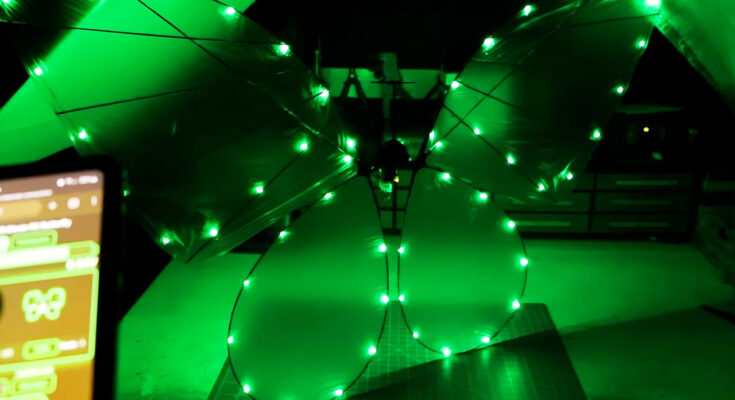
ESP-FLUTTER pairs a XIAO ESP32-C3 controller with two independently driven wing servos, letting builders tune a robotic butterfly’s strokes and steer by changing their amplitude. Max Imagination’s DIY aircraft puts wing motion under software control, but its “Hover” setting is a tuning profile—not automatic stabilization or position holding.
ESP-FLUTTER on the workbench. Credit: Max Imagination, via TechEBlog.
TechEBlog covered the project on November 2. That dates the report, rather than an original launch: the creator’s documentation does not establish a release date.
Steering through unequal wing strokes
The useful distinction is how the wings are driven. Hackster contrasts ESP-FLUTTER with ornithopters that use one motor and a mechanical linkage to move both wings. Here, each wing has its own servo. The firmware turns by varying the left and right flapping amplitudes, with adjustable steering sensitivity and turn compensation.
That gives builders separate controls over the wing strokes instead of mechanically linking their movement. The creator’s README lists frequency, amplitude, upper and lower travel, and sine or triangle waveforms as configurable parameters. Neutral position and individual servo trims can also be adjusted.
One setting matters when interpreting the controls: the documented current configuration uses fixed-amplitude test mode, so throttle changes flapping frequency. The presence of an amplitude adjustment does not mean throttle currently varies both frequency and amplitude. Cruise, Sport and Hover save individual motion and steering settings.
The browser interface supplies an on-screen joystick and configuration controls after a phone or computer joins the butterfly’s Wi-Fi network. For a radio-controller setup, the README documents ESP-NOW transmitters or an ExpressLRS receiver using CRSF. These are alternative input paths to the same tunable wing mechanism.
Plastic-bag wings, carefully chosen electronics
Hackster reports a 70-gram aircraft built around a PETG frame, flexible TPU servo guards and carbon-fiber wing rods. Thin produce-bag plastic forms the wing membranes, secured with flexible adhesive; lightweight kite fabric is another option. It describes both a modular build and a more compact version using a custom four-layer PCB.
The same report specifies high-speed coreless digital servos and a custom two-cell LiPo pack, warning that ordinary hobby servos are not fast or powerful enough. The lightweight materials are accessible; that does not make the actuators interchangeable with whatever is already in a parts drawer.
Power integration also needs the aircraft’s actual wiring. Seeed specifies a 3.7 V lithium battery for the XIAO’s BAT input, so the reported two-cell aircraft pack is not an instruction to connect it directly there. Seeed’s voltage-monitoring example uses an allocated ADC pin and an external divider: the project’s battery display is not a built-in, wiring-free battery gauge.
What to check before building
The Arduino/PlatformIO firmware targets the XIAO ESP32-C3; S3 and DevKit V1 profiles are experimental. The documented prebuilt flashing route uses Chrome and the online ESP Tool over USB. It assumes a compatible bootloader is already installed and says to leave Erase All Flash disabled to preserve it. Before flight, the creator calls for checking wing clearance, servo alignment and control direction.
For budgeting, TechEBlog estimates roughly $86 for the modular components, excluding tools and delivery. That is secondary cost context, not a verified current kit price or complete landed quote. The coverage describes creator demonstrations, not independent replication or a comparative efficiency test.
Finally, the firmware is licensed under PolyForm Noncommercial 1.0.0, with prior written permission required for commercial use. It is source-available noncommercial firmware, not permissively licensed open source. For a hobby or educational build, the draw is the combination of independently adjustable wing strokes, lightweight construction and browser-accessible tuning.
If the controller resets when the wing servos move, follow the servo power-path troubleshooting guide to investigate rail sag before changing PWM, while keeping the aircraft’s documented wiring and voltage limits.