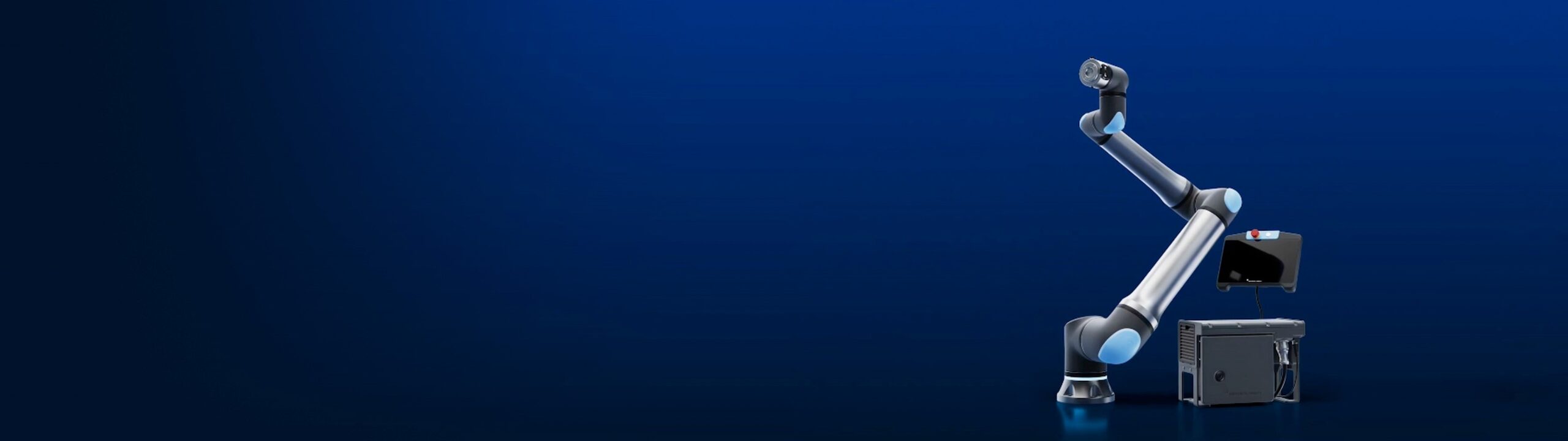
Universal Robots has introduced Gen 7 with three g-Series arms and an AI-ready tool flange that carries data, power and safety connections directly to the wrist. The new UR10g-1750, UR17g-1300 and UR18g-950 pair their payload in kilograms with reach in millimeters, making the model names unusually informative.
Featured image: Universal Robots.
The September 14 launch is broader than an arm refresh. Universal Robots also announced the CB7 Core controller, TP7 Core teach pendant, SP7 Smart Panel and PolyScope X software as one platform.
The model names expose the first sizing decision
The UR10g-1750 is rated for 10 kg across a 1,750 mm reach, the UR17g-1300 for 17 kg at 1,300 mm, and the UR18g-950 for 18 kg at 950 mm. That creates three different cell-design priorities: long reach with lighter tooling, a midrange payload-and-reach balance, or higher payload in a compact envelope.
Those headline ratings are not complete application limits. Tool mass, center of gravity, acceleration, wrist orientation and safety settings still determine the usable payload at a particular pose. Integrators need the detailed load diagrams before replacing a rail or resizing a fixture.
The wrist becomes an integration boundary
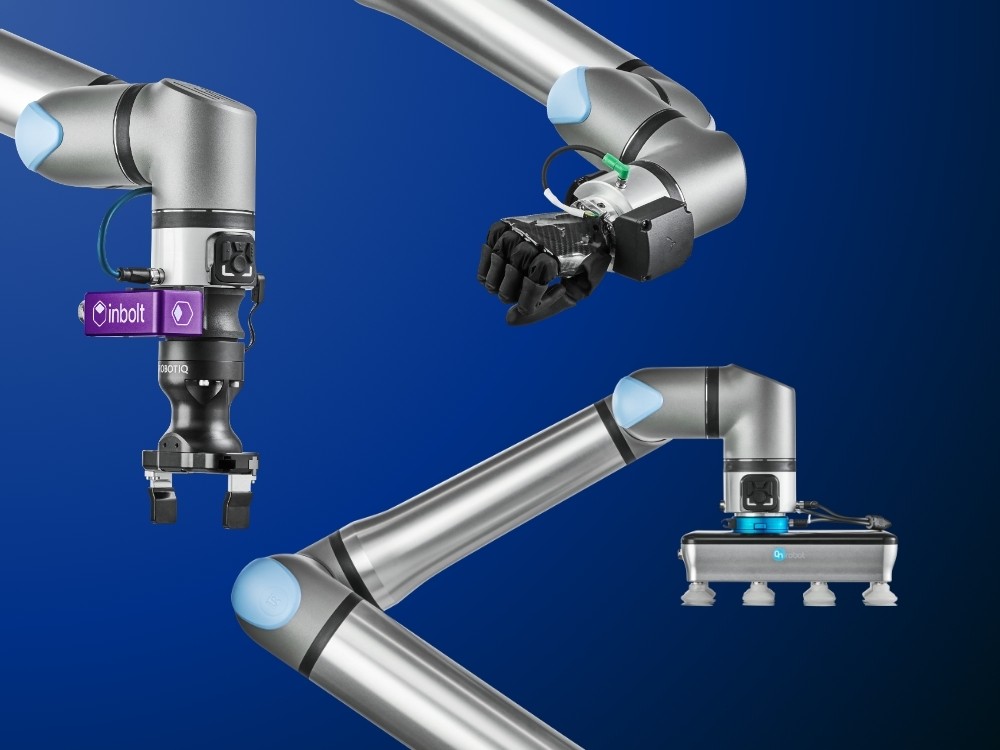
Universal Robots says the g-Series tool flange supplies data, power and safety connectivity at the wrist. That can reduce external cable runs for cameras and high-bandwidth sensors, where repeated flexing and large bend loops complicate dress packs. The platform also includes built-in force-torque sensing, impedance control and RTDE, or Real-Time Data Exchange.
The useful engineering question is which tool-side devices can use those connections without adapters, external switches or separate safety wiring. “AI-ready” does not by itself establish protocol compatibility, bandwidth, power budget or deterministic timing. Those interface limits matter more than the label when a camera and end effector share the flange.
CB7 changes cabinet planning
The CB7 Core controller is claimed to provide 40% more compute power in a 30% smaller footprint than earlier generations. It is offered as a standalone control box and in a compact form for automation-cabinet integration. Universal Robots also says CB7 is compatible with e-Series and UR Series arms.
More compute does not translate directly into a cycle-time percentage. The launch does not publish a benchmark workload, CPU allocation or latency result. The smaller enclosure is easier to use only after checking cooling clearance, connector access and electrical installation requirements. Automation World’s report confirms the platform specifications without adding independent performance measurements.
Operator hardware and safety are part of the platform
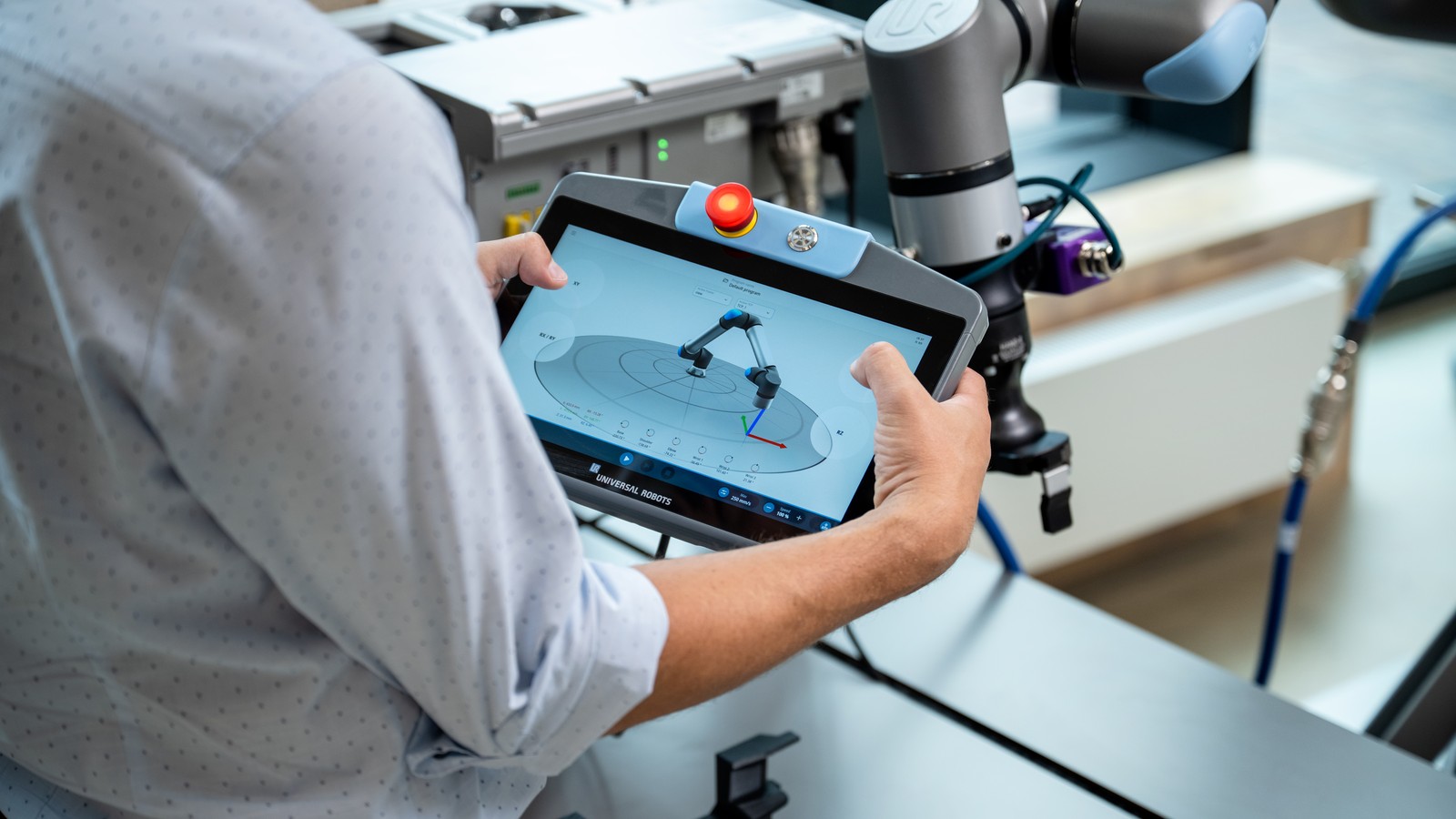
The TP7 Core pendant is more than 20% lighter and adds a full-HD display, configurable buttons and a virtual joystick. The SP7 Smart Panel moves freedrive control, LEDs and three configurable inputs to the tool flange. That could reduce trips between the task and pendant during teaching, especially in high-mix work.
Universal Robots states that the g-Series has a PLd, Category 3 architecture under ISO 13849-1 and that the robots are TÜV certified to ISO 10218-1 and UL 1740. Those certifications support component-level safety claims; they do not certify the completed cell or remove the need for an application risk assessment.
TVG’s report on conveyor tracking and linear rails for cobots shows the same integration boundary from another direction: useful robot capability depends on coordinated motion, tooling and cell controls, not on arm reach alone.