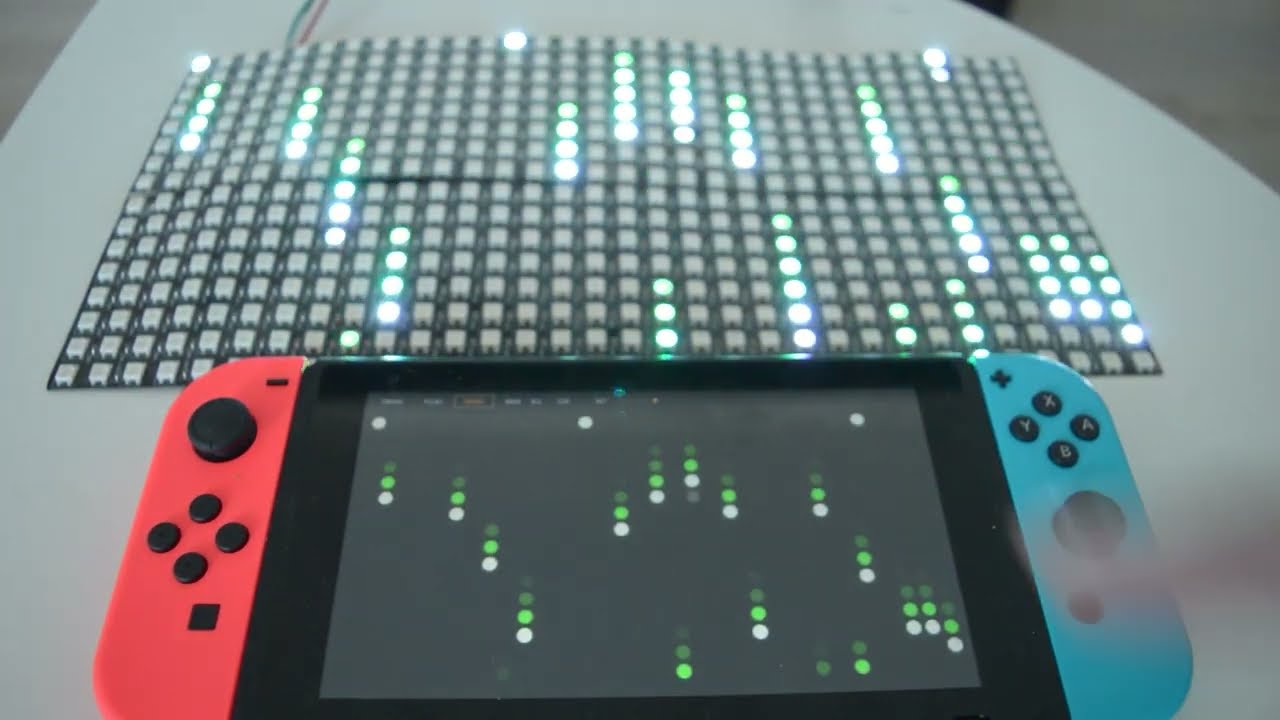
A newly demonstrated Brewser app turns a modded Nintendo Switch into the drawing surface for a 512-pixel WS2812 LED panel. Matrix Studio 1.0.13 renders its canvas in WebGL, converts that image into the panel’s physical LED order, and streams binary frames over USB serial to an ESP32.
Featured image: Brewser/YouTube video thumbnail.
The September 13 demonstration is more interesting as a control split than as a display stunt. The console handles the user interface, fluid simulation and animation. The microcontroller receives already prepared pixel data and drives the timing-sensitive LED chain. Brewser says the app also runs in modern desktop and mobile browsers, but its runtime gives the Switch access to Web Serial on supported CH340 and CP2102 adapters.
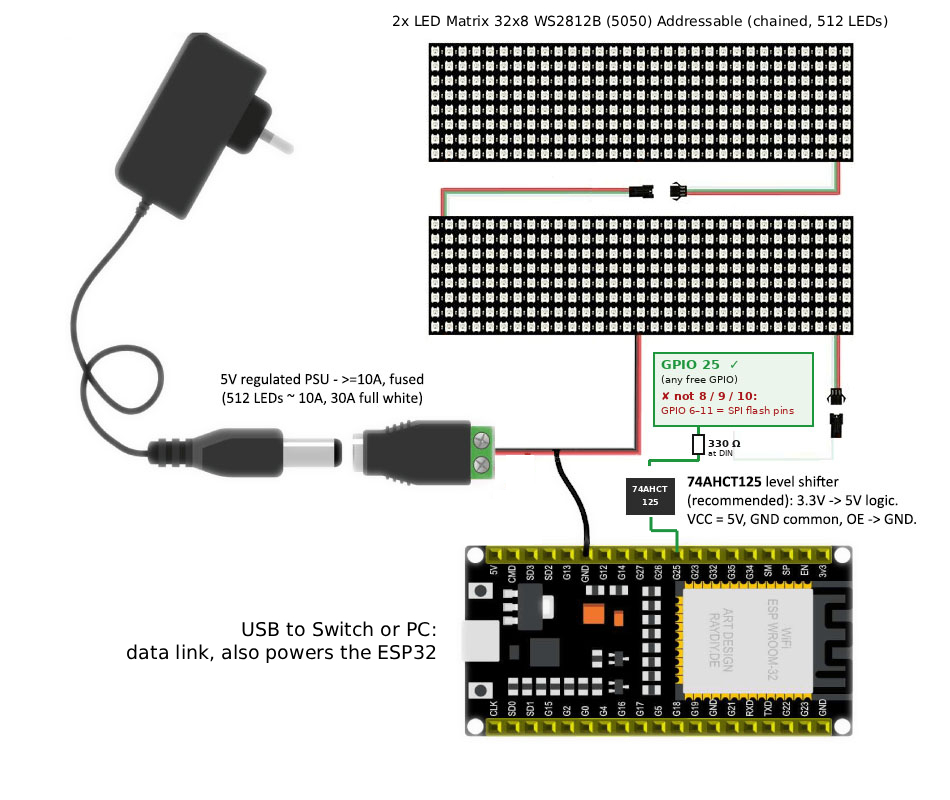
Source: Brewser Matrix Studio project documentation.
The wiring map is part of the software
LED matrices rarely share one physical order. Strips may run by rows or columns, reverse direction on every line in a serpentine pattern, or be mounted with an axis flipped. Matrix Studio asks for panel width, height, per-panel height, row-or-column order, serpentine wiring and X/Y flips. It then maps each WebGL pixel to an LED index.
An IDENTIFY sequence makes that mapping visible: red marks the top-left corner, green the top-right and blue the bottom-left, followed by a left-to-right sweep. That is a useful commissioning tool because a wrong mapping can look like corrupt animation even when every byte reaches the ESP32.
Frames and configuration use different messages
Brewser’s project page says each frame is packed into a compact binary packet. The ESP32 data pin, LED count and brightness travel in a configuration packet when the link opens and whenever settings are saved. Keeping topology out of every frame reduces repeated metadata and lets the sender focus on pixel updates.
Over USB Web Serial at a high baud rate, Brewser describes 30–60 frames per second as comfortable. Bluetooth is also listed as a connection path, but the showcased 512-pixel setup uses USB serial. The stated performance is a project claim, not a guarantee for every adapter, cable or panel layout.
The power number is the real engineering limit
Matrix Studio warns that 512 LEDs at full white can draw about 30 A. That figure is consistent with the familiar worst-case planning scale of roughly 60 mA per RGB package when all three channels are driven hard: 512 × 0.06 A is 30.72 A. Actual patterns may consume less, but software brightness control should not replace correctly sized wiring, fusing and power injection.
USB serial is the data path, not the panel’s bulk supply. A large matrix needs an external supply matched to the LED voltage, short low-resistance distribution paths, and a common signal reference between the ESP32 and LED supply. Long chains also need power injection so voltage drop does not turn distant white pixels orange or cause resets.
What remains unmeasured
The public material documents the architecture and setup fields but does not publish packet timing, dropped-frame data or end-to-end latency for USB versus Bluetooth. Those details will determine whether Matrix Studio remains smooth when animations, serial transfer and LED refresh all compete for time.
TVG Analysis: The project’s reusable idea is the boundary between a rich WebGL editor and a small hardware endpoint. It lets a console or browser own interaction while the ESP32 owns deterministic output. The colored topology check and explicit current warning are what make that split practical rather than merely flashy.