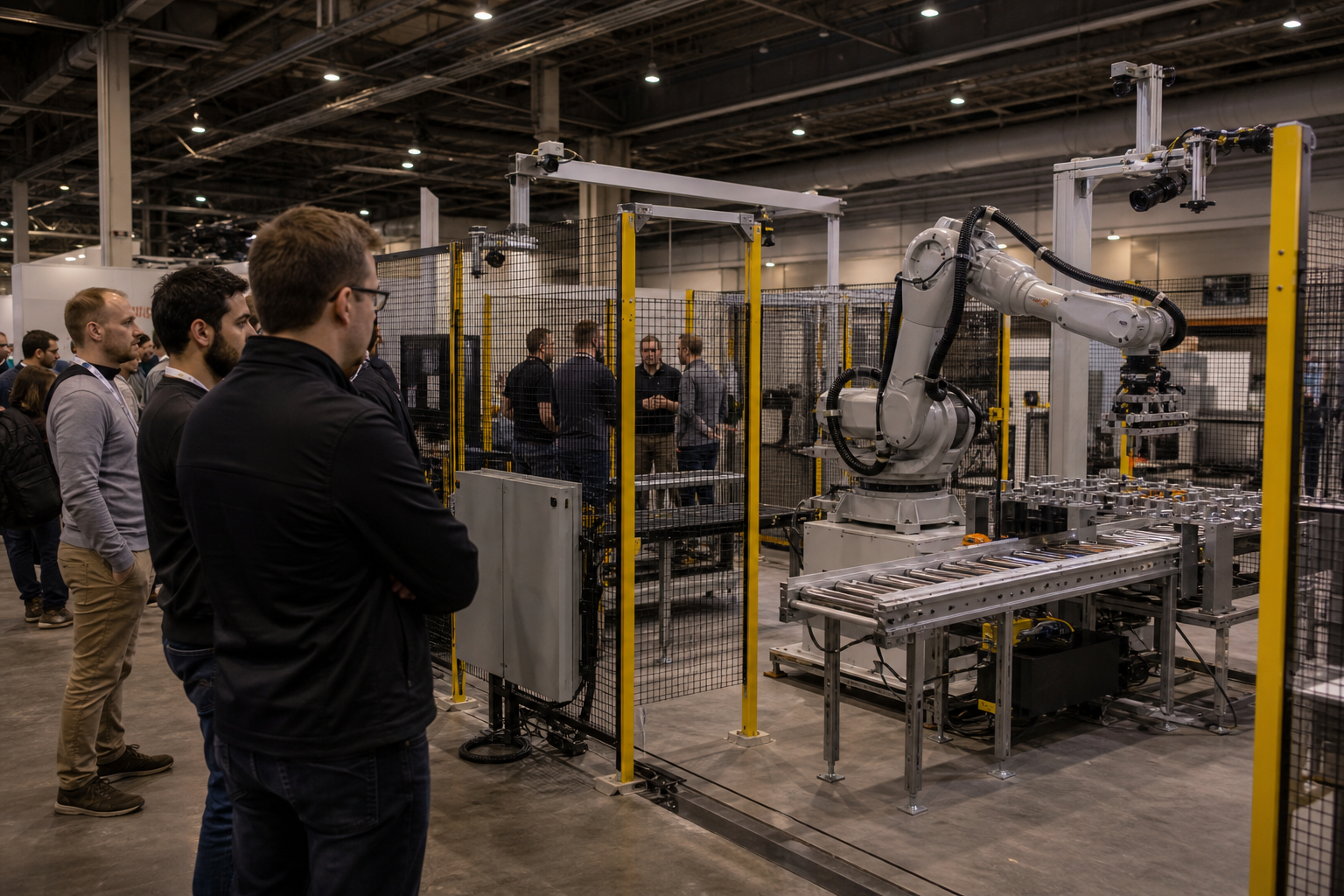
FANUC America is using Automate 2026 in Chicago to frame its latest robotics story around “physical AI” and AI-enabled automation demos. The company’s event page says it will show physical AI, cobot and “Go” automation solutions at Booth #1401 and #1001, while its May announcement through PR Newswire says the demos are meant to show robots perceiving their environment, making decisions and acting in real time.
For factory teams, that language matters less as a slogan than as a signal about where integration work is moving. The next useful robot cell is not just a faster arm. It is a stack: robot controller, safety system, 2D or 3D vision, part presentation, model training or configuration, PLC integration, network security, recovery logic and maintenance workflow. If one layer is brittle, the AI label will not rescue the deployment.
The timing also fits the broader Automate 2026 agenda. The Automate Show describes the floor as covering automation solutions from AI and robotics to motion control and vision systems. The ARM Institute is separately promoting work on low-code interoperable interfaces across robot hardware and controllers, data curation practices, and shared libraries of manufacturing datasets and early robotic skill algorithms. In other words, the interesting part is not a single booth demo. It is the industry’s attempt to turn robotics AI from custom science project into repeatable production method.
Why it matters
Industrial automation buyers have heard promises about flexible robots for years. The practical change in 2026 is that perception hardware, edge inference and robot software are becoming common enough that mid-sized manufacturers can start asking better questions. Can a cell handle part variation without constant reteaching? Can a vision model fail safely when lighting changes? Can operators recover the cell without a specialist? Can the integrator explain how data from failed picks, missed detections and stopped cycles will improve the system over time?
Those are engineering questions, not marketing questions. A robot that adapts to a tote of irregular parts still needs fixture assumptions, lighting control, sensor calibration, cycle-time limits and a clear fallback path. A cobot demonstration that looks smooth in a booth still needs risk assessment, guarding decisions, end-effector validation and a maintenance plan for grippers, cameras and cables.
Technical breakdown
FANUC’s public Automate messaging points to a few important layers. First is perception: robots need cameras, sensors or external machine-vision systems that can identify parts, estimate poses and detect exceptions. Second is motion adaptation: the controller or surrounding software has to translate perception into paths that remain within speed, reach, payload and safety constraints. Third is integration: the robot cell has to exchange status, faults and commands with PLCs, MES systems or operator stations. Fourth is validation: the system needs repeatable tests that show how it behaves outside the perfect demo condition.
The ARM Institute’s focus on interoperable interfaces and data curation is especially relevant here. Physical AI systems need examples of real manufacturing variation, not only polished training data. They also need common ways to move skills, models and process datasets between cells and vendors. Without that, every deployment becomes a custom island.
TVG has recently covered the same direction from other angles, including CODESYS at Automate 2026 and JetPack 7.2’s push toward agentic edge AI workflows. The common thread is that automation is shifting from fixed logic alone toward software-defined, sensor-rich control stacks.
Risks and unknowns
The biggest risk is overgeneralizing from demos. Booth environments are curated: lighting is controlled, parts are selected, safety zones are managed and recovery paths are rehearsed. Production cells face dust, vibration, operator shortcuts, mixed batches, damaged packaging and maintenance drift. If a physical AI system cannot explain its failure modes or provide useful logs, it may become harder to support than a simpler deterministic cell.
There is also a procurement risk. Teams may buy the AI feature before they know what process data they can capture, who will own model updates, and how changes will be validated. That is a governance problem as much as a technical one.
Engineering Takeaway
FANUC’s Automate 2026 message is worth watching because large robot vendors are now presenting perception and adaptive behavior as mainstream production tools, not lab extras. The winning deployments will not be the ones with the flashiest AI demo. They will be the cells with disciplined lighting, controlled data capture, transparent recovery states, safe motion limits and operators who can diagnose what happened when the robot hesitates.