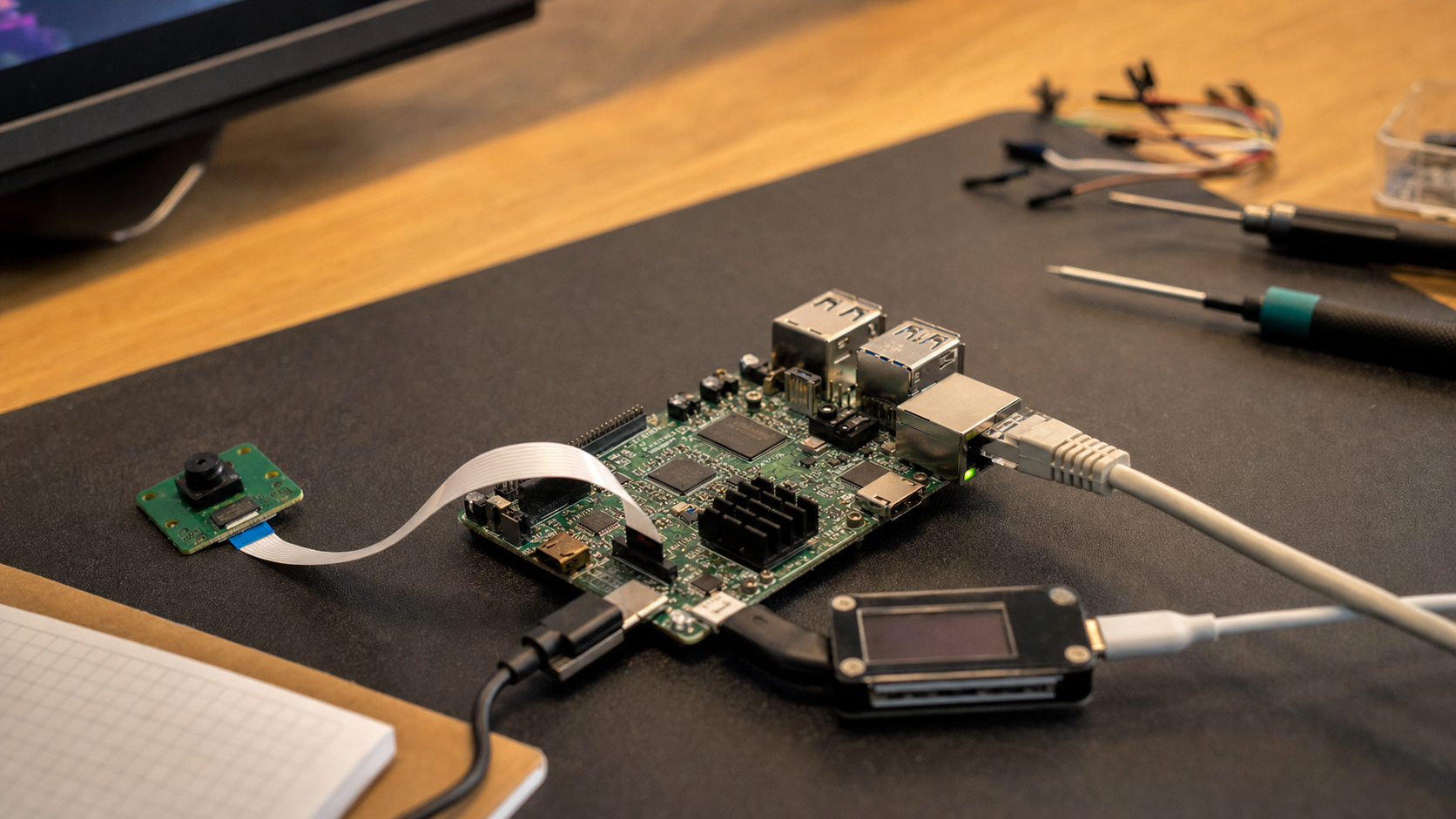
A new ESP32-P4 IP-KVM proof of concept is drawing attention in the maker hardware community because it asks a useful lab question: how much remote console access can a microcontroller-class board provide before a team reaches for a full Raspberry Pi?
Hackaday highlighted the project on July 3, noting that Jonathan Rowny’s build uses an ESP32-P4 and a commercial adapter board to translate HDMI into the board’s camera input. The accompanying Hackaday.io project page describes it as an IP KVM built around an ESP32-P4 module rather than a more expensive single-board computer.
What the build shows
An IP KVM is a remote keyboard-video-mouse bridge. In practical terms, it lets a developer or lab operator see a machine’s display and control it without being physically present. That matters for home labs, robotics benches, small server closets, and classroom test rigs where the target device may be headless, wedged under a table, or in a locked cabinet.
The interesting part is not that this proof of concept replaces commercial KVM gear tomorrow. It does not. The interesting part is that the ESP32-P4 has a media and interface mix that makes the experiment plausible. Espressif’s product page says the ESP32-P4 supports MIPI-CSI with an integrated ISP, MIPI-DSI, parallel display and camera interfaces, and up to 1080p resolution for both display and camera paths. That gives builders enough I/O vocabulary to try video capture and display workflows that were previously more natural on Linux SBCs.
Rowny’s project page also documents the current limits. The notes say the ESP32-P4 should be capable of 1080p/30 streaming with built-in H.264 encoding, but the available module/revision situation pushed the proof of concept toward MJPEG instead. That is exactly the kind of detail that separates an eye-catching build from a deployable tool.
Why it matters for maker labs
Remote console access is one of those unglamorous lab capabilities that becomes valuable only after something goes wrong. A robot controller stops booting after a kernel update. A mini PC driving a vision pipeline loses network access. A student team needs to power-cycle and reconfigure a machine before practice. In each case, the device may still have video output even when SSH, VNC, or the web dashboard is unavailable.
TVG has covered adjacent lab workflow questions before, including home-lab hardware sizing and portable monitor specs for field dashboards. The ESP32-P4 KVM experiment fits that same practical lane: smaller boards are being tested not just as sensors or toys, but as support equipment for maintaining bigger systems.
What remains unproven
The current project should be read as a proof of concept. A production-ready remote-access device needs predictable latency, secure authentication, keyboard/mouse reliability, update handling, power behavior, enclosure design, and a recovery path when the KVM itself crashes. Video quality is only one part of the job.
There is also a security boundary to treat carefully. A KVM can see boot screens, BIOS menus, recovery shells, and passwords typed into attached machines. If a low-cost IP KVM becomes common in labs and classrooms, it should be designed like privileged access equipment, not like a casual Wi-Fi gadget.
TVG Analysis
The ESP32-P4 project is a useful signal for embedded builders: the next wave of microcontroller boards will keep absorbing tasks that once required Linux SBCs. That does not mean every lab should swap a Pi-based KVM for a microcontroller build. It means teams should watch the interface stack: CSI bridges, hardware encoding, USB HID behavior, Ethernet stability, and firmware update safety will determine whether this idea matures beyond a clever bench build.
TVG will keep watching for follow-up logs, open firmware, measured latency, and revision-3 ESP32-P4 availability. Those details will decide whether this becomes a dependable remote-lab tool or remains a strong demonstration of what the chip can almost do today.