
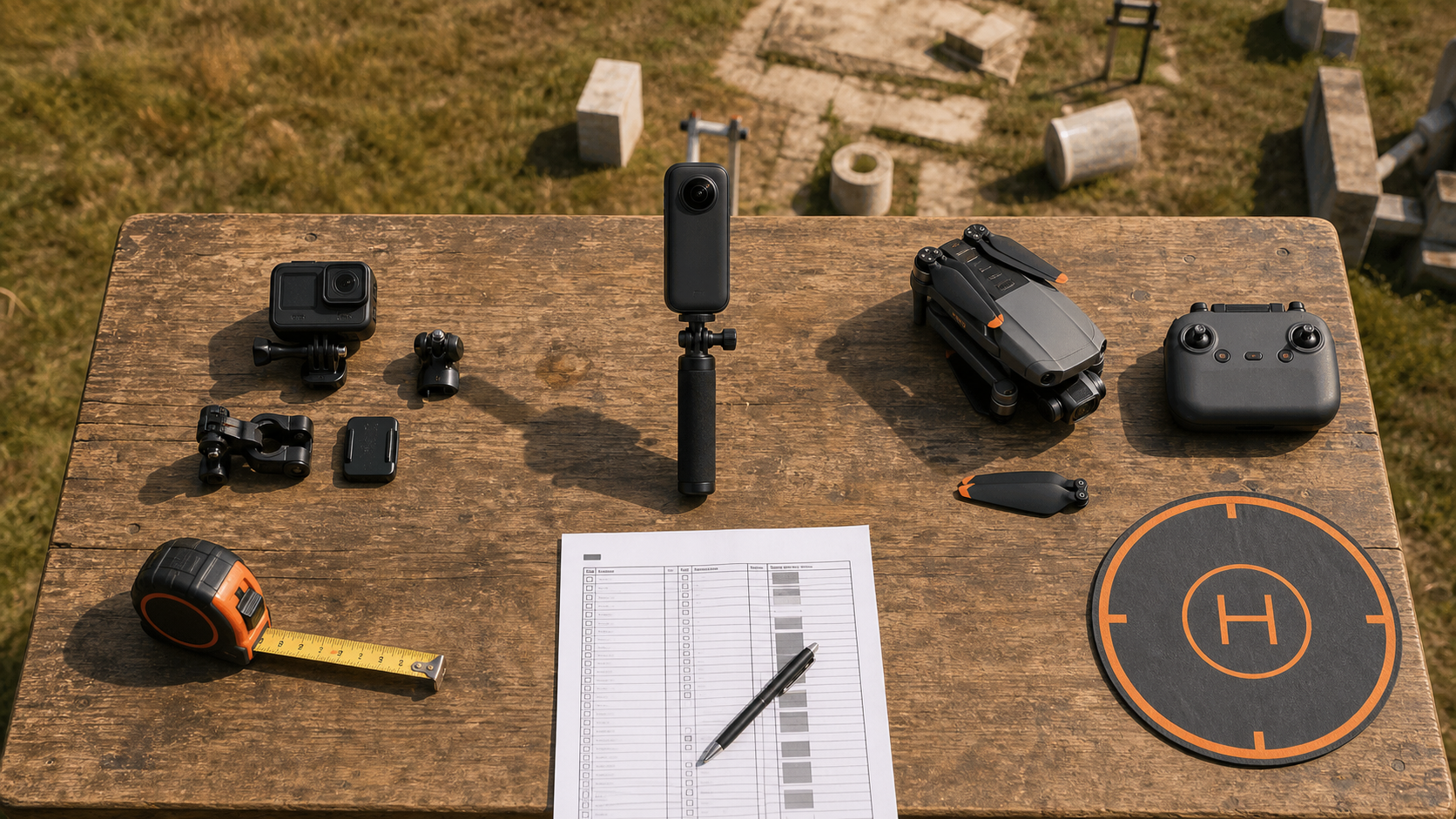
Robotics teams, maker labs, and field crews often reach for the same answer when they need better documentation: buy another camera. The harder question is which kind of camera actually fits the job.
An action camera, a 360 camera, and a compact drone can all record useful field footage. They solve different problems. An action camera is usually the easiest way to capture a rugged first-person or mounted view. A 360 camera is better when the team cannot predict where the important action will happen. A drone can document site context, path planning, outdoor tests, and scale, but it adds safety, battery, and regulatory responsibilities.
This is a buyer evaluation, not a hands-on review. TVG has not tested every current model in this category. The goal is to help teams decide what to test before spending money. For related workflow planning, see TVG’s guides to memory-card specs for drones and action cameras and camera sensor size for robotics and creator field documentation.
Start with the shot you keep missing
The best tool depends on the failure in the current workflow. If the team keeps missing close-up robot behavior, an action camera or small fixed camera may be enough. If field footage never shows the whole test area, a 360 camera may solve more problems than another front-facing camera. If the team needs an overhead view of a course, terrain, roofline, trail, or outdoor deployment area, a drone may be the only practical option.
Do not buy based only on resolution. A 5.3K action camera, an 8K 360 camera, and a 4K drone are not directly comparable because they use their pixels differently. A 360 camera spreads resolution across the full sphere, so the reframed output may be much lower than the headline number. A drone may deliver cleaner context, but it may not be usable indoors or near crowds.
Action camera: rugged, simple, and mountable
Action cameras are usually the safest first upgrade for teams that need repeatable documentation. They can mount to a robot frame, tripod, helmet, cart, goal structure, or test fixture. The most useful specs are not only resolution; they include stabilization, field of view, battery behavior, heat limits, mounting ecosystem, waterproofing, and whether the camera can run from external power.
GoPro’s HERO13 Black spec page advertises 5.3K video options, lens-mod support, a 1900 mAh Enduro battery, and waterproof operation without a housing. Those specs are useful examples of what teams should compare across action cameras: capture mode, mounting, battery, and stabilization rather than headline resolution alone.
The weak point is context. A mounted action camera shows what it sees. If the robot exits frame, an important collision happens behind the camera, or a human operator makes a mistake out of view, the recording may not answer the post-test question.
360 camera: best when action is unpredictable
A 360 camera makes sense when the team repeatedly says, “We should have pointed the camera the other way.” It can sit near a field, on a robot cart, above a bench, or in the middle of a test area and record the whole scene. Reframing later can be valuable for match review, safety analysis, build logs, and educational clips.
Insta360’s X5 page highlights 8K30 360 video, low-light features, waterproofing to 49 feet, and replaceable lenses. Those features show why 360 cameras are attractive for dynamic field documentation: they reduce the aiming burden and can produce multiple edits from one capture.
The tradeoff is workflow cost. 360 footage takes more storage, more editing time, and more careful mounting. Lenses are exposed. Stitch lines can matter. If a team only needs one fixed angle, a 360 camera may add complexity without improving the final video.
Drone: context, overhead views, and extra responsibility
A compact drone is the strongest choice for outdoor context. It can show course layout, traffic flow, inspection routes, construction progress, field-robot paths, or environmental constraints that a ground camera cannot see.
DJI’s Mini 4 Pro specifications list a weight under 249 g with the standard battery, 4K/60fps HDR vertical shooting, omnidirectional obstacle sensing, ActiveTrack 360, and long-range video transmission claims. Those specs illustrate the modern small-drone value proposition: stabilized aerial footage in a compact package.
The tradeoff is operational friction. A drone needs a trained pilot, safe launch and landing space, weather checks, charged batteries, firmware management, local rule awareness, and a plan for people nearby. It can be the most useful documentation tool outdoors and the least appropriate tool indoors.
Decision matrix for small teams
- Choose an action camera if the main need is rugged mounted footage, robot-eye views, workbench shots, or quick setup.
- Choose a 360 camera if the main need is post-event reframing, full-field review, classroom capture, or unpredictable action.
- Choose a drone if the main need is outdoor context, route overview, site scale, or aerial inspection-style footage.
- Choose none yet if the real blocker is audio, lighting, storage, or editing time.
What TVG would test before buying
For an action camera, TVG would test heat, battery runtime, vibration, stabilization, low-light behavior, and whether the mounting point survives the robot’s normal motion. For a 360 camera, we would test reframed output quality, stitch-line placement, lens protection, storage size, and editing time. For a drone, we would test pilot workflow, geofencing constraints, wind tolerance, battery logistics, and whether aerial footage actually improves the engineering review.
Storage deserves special attention. High-bitrate action, 360, and drone footage can outgrow the team’s current card-reader and backup workflow. A camera purchase may require faster cards, a better field backup plan, and clearer file naming. Otherwise the team gets better footage and worse media management.
TVG Take
The most reliable field-documentation setup is usually a small system, not a single hero device. An action camera captures the machine, a 360 camera captures the surrounding event, and a drone captures outdoor context when it is safe and allowed. Most teams should buy the device that fixes their biggest missing angle first, then test the storage and editing workflow before adding more cameras.
If TVG had to set a default order for a robotics or maker group, it would be action camera first, 360 camera second when reviews keep missing context, and drone only when aerial perspective is genuinely part of the work. That order keeps the buying decision tied to evidence instead of gadget appeal.

That’s a really helpful breakdown of the key differences. It makes sense that the specific needs of the team would really drive which option is best.
Thanks for reading — that team-fit question is exactly where the decision usually gets made. An action camera, 360 camera, and drone can all document field work well, but the right choice depends on whether the team needs close-up process capture, wider context, or overhead site awareness.