
E-bike battery storage needs a garage safety plan before the first cold-weather charge. The important choices are location, charger control, inspection habit, and what sits near the pack.
That combination deserves a plan. Public safety guidance from groups such as NFPA and CPSC emphasizes certified products, correct chargers, safe charging locations, and avoiding unattended or exit-blocking charging. TVG’s angle is narrower: how should a technically minded household or maker garage turn those warnings into a repeatable setup?
Quick answer
Store and charge e-bike batteries on a stable surface, away from exits and combustible clutter, with the manufacturer’s charger, within the temperature range recommended by the battery maker. Do not treat a garage outlet, extension cord, or smart plug as a substitute for product certification and supervision.
The maker-garage problem
A maker garage tends to accumulate power systems. There may be USB-C supplies, tool batteries, RC packs, lead-acid chargers, 3D printer power supplies, and an EV charger nearby. Adding one or more high-capacity e-bike packs increases the need for physical separation and routine.
The first design step is not buying a fireproof-looking box. It is choosing a charging location that does not block an exit, sit under flammable shelving, or share a tangled extension-cord chain with other loads.

A practical storage checklist
- Use the matched charger. A charger that fits the connector is not automatically correct for the pack.
- Keep exits clear. A battery should not be charged in a hallway path, doorway, stair area, or behind the only garage exit.
- Avoid unattended routines. Overnight charging may be convenient, but it removes the human from early fault detection.
- Inspect the pack. Swelling, damage, odor, heat, corrosion, or crash history should pause use.
- Control temperature. Cold or hot storage can reduce performance and may conflict with manufacturer guidance.
- Reduce clutter around charging. Paper, cardboard, solvents, fabric, and wood scraps should not surround a battery station.
This complements TVG’s previous maker-garage power coverage, including EV charger load management for maker garages and e-bike torque versus cadence sensor diagnostics.
Charging workflow for shared spaces
A shared garage needs a simple rule set that everyone can follow. Charge when someone is nearby. Unplug when the battery reaches the intended state of charge. Keep the charger paired with the bike or battery it belongs to. Do not stack batteries under coats, cardboard boxes, or tool bags. If a pack was dropped, submerged, involved in a crash, or begins to smell or swell, remove it from normal use and follow local guidance for damaged lithium-ion batteries.
That workflow should also consider the rest of the shop. A 3D printer running overnight, a space heater, a power-strip chain, and an e-bike charger in the same corner is not a clean electrical setup. The garage should be arranged so one charging job does not depend on a pile of unrelated adapters and cords.
What not to overclaim
TVG is not providing fire-suppression engineering or electrical-code advice. A household with damaged batteries, unusual charging loads, repeated breaker trips, or a shared garage/workshop should consult qualified local professionals and follow product documentation. The useful editorial point is that battery storage is a system habit, not a single accessory purchase.
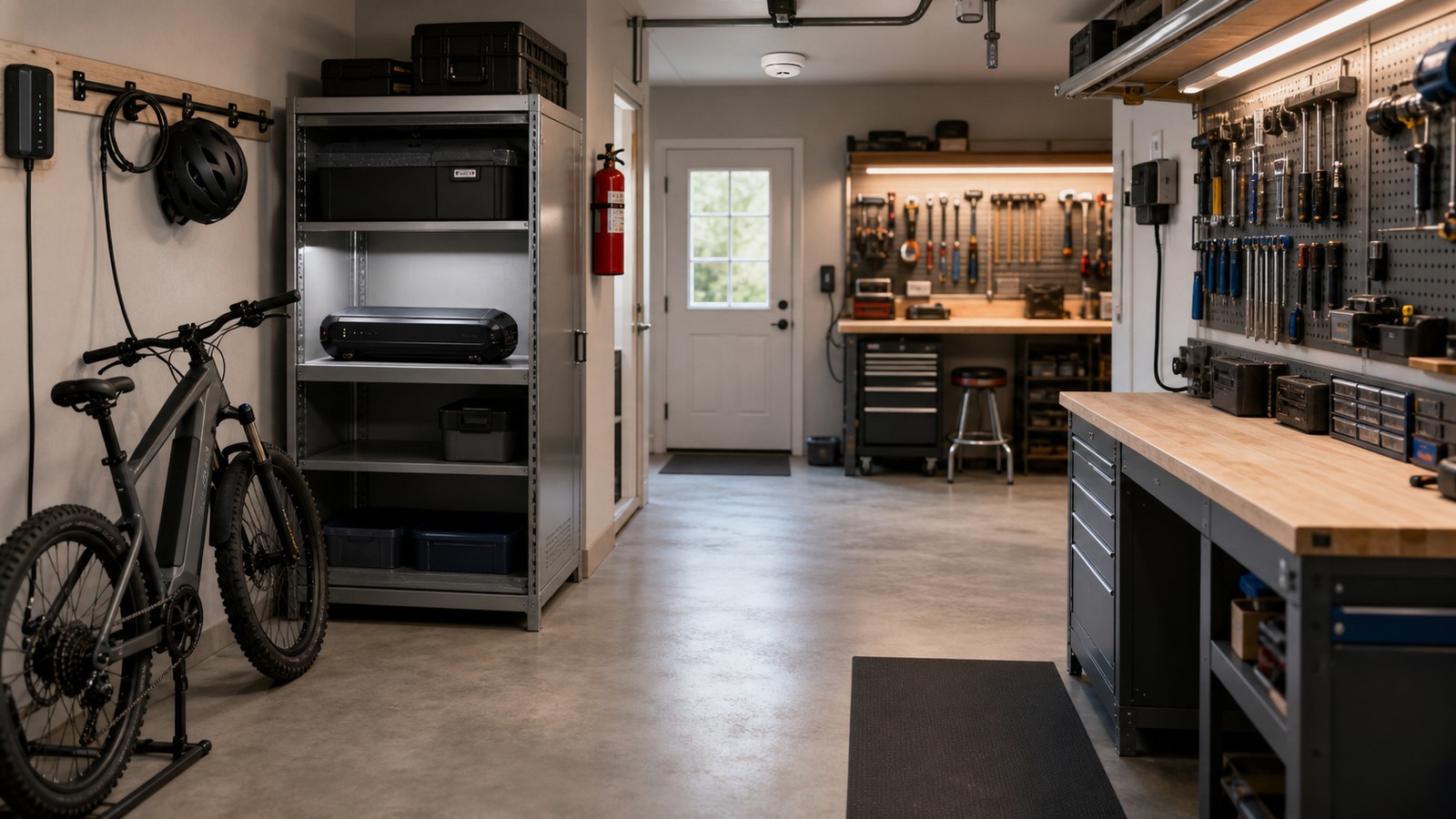
Inspection cues before plugging in
Before charging, look for cracked cases, loose charge ports, crushed corners, unusual odor, corrosion, or a pack that feels warmer than expected before use. Also check whether the charger brick has room to shed heat. A charger buried under a jacket or extension-cord pile is harder to notice when something changes. These checks are simple, but they create a habit: observe first, energize second.
TVG Take
A safe e-bike charging setup should be boring: known charger, visible location, clean surroundings, clear exits, and a routine that stops when the battery shows damage or behaves differently. Maker garages already respect sharp tools and hot printers; lithium battery charging deserves the same discipline.