A drone and an action camera can both document a field test, a robotics demo, a maker build, or an outdoor product evaluation. They do very different jobs. The mistake is buying one because it looks more exciting, then discovering that the footage does not answer the engineering question you actually had.
This is a buyer evaluation, not a hands-on review. TVG Report has not run a controlled field test for the products mentioned here. Instead, this guide uses published specifications and practical workflow analysis to help teams decide what they would test before spending money.
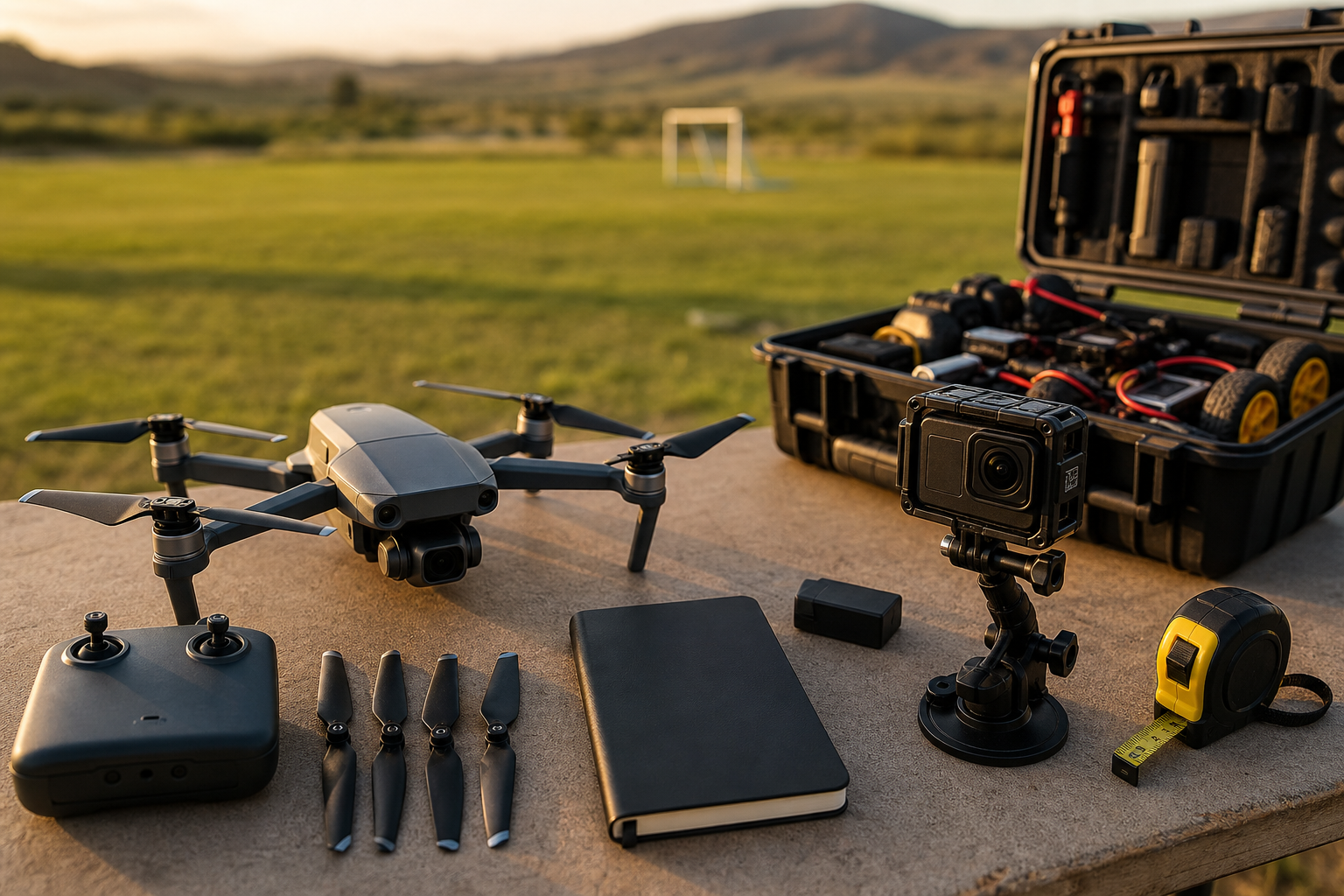
The short version: choose a drone when you need position, path, context, and repeatable overhead views. Choose an action camera when you need rugged close-range documentation, mounting flexibility, audio proximity, or footage from the point of view of a person, robot, vehicle, or tool. Many serious teams eventually use both, but the first purchase should match the failure mode you are trying to capture.
What a drone sees that an action camera cannot
A compact camera drone is strongest when the documentation question is spatial. Did the robot follow the intended route? How did a mechanism behave relative to field boundaries? Where did a vehicle lose traction? What did the whole team layout look like? Overhead or oblique footage can answer questions that helmet, tripod, and workbench cameras miss.
DJI’s Mini 4 Pro, for example, is positioned around a sub-249g airframe, omnidirectional obstacle sensing, ActiveTrack 360°, and up to 20km FHD video transmission in regions where supported. Those are not just creator conveniences. For field documentation, obstacle sensing and subject tracking can reduce operator workload, while a small airframe makes the kit easier to pack and deploy.
The limits are equally important. Drones bring regulatory constraints, weather limits, battery planning, propeller safety, noise, and location restrictions. A drone may be the wrong tool inside a school gym, near crowds, under trees, in high wind, or anywhere permissions are unclear. For student teams and small vendors, the operational burden can matter more than the camera spec.
What an action camera does better
An action camera is strongest when the documentation question is local and physical. It can mount to a robot frame, tripod, suction cup, helmet, tool chest, car, kayak, or test fixture. It can capture vibration, splashes, hand position, mechanism failures, and close-up setup details. If the goal is to understand how a part failed or how a user interacted with a device, proximity often beats altitude.
DJI’s Osmo Action 6 page emphasizes a 1/1.1-inch square sensor and variable aperture. GoPro’s HERO13 Black page highlights its 1900mAh Enduro battery and lens/mod ecosystem. Those specs point to the real buying variables: sensor behavior, mounting system, battery swaps, stabilization, field durability, and whether the camera can be placed where the failure happens.
The downside is context. A fixed action camera may capture the moment a robot tips, but not the path that caused the tip. A chest-mounted view may show what the operator saw, but not the full test field. Stabilization can also hide vibration that an engineer might actually want to diagnose. For testing, it is worth saving one “boring” fixed angle with minimal processing in addition to polished footage.
Comparison checklist: choose by documentation job
- Route or field coverage: drone advantage. Overhead footage helps map paths, spacing, and interactions.
- Close-up failure capture: action camera advantage. Mount near the mechanism, wheel, tool, or operator view.
- Indoor school or event use: action camera advantage. Drones may be restricted or unsafe.
- Outdoor site survey: drone advantage, assuming permissions, weather, and safety checks are handled.
- Audio and operator notes: action camera advantage, especially with external microphone workflows.
- Repeatability: mixed. Drones can repeat flight paths with planning; action cameras can repeat fixed mount angles.
- Training burden: action camera advantage for most small teams.
- Viewer engagement: mixed. Drone footage establishes context; action-camera footage shows process and detail.
What robotics and maker teams should test first
Before buying either category, write down three shots that would have helped during your last project failure. For a robotics team, that might be an overhead view of autonomous path drift, a close-up of a drivetrain chain skip, and a driver-station view of operator timing. For a maker vendor, it might be a product setup shot, an outdoor durability pass, and a user-perspective clip.
If most of those shots are overhead, spatial, or route-based, start with a drone. If most are close, mounted, repeatable, or operator-facing, start with an action camera. If you need both but only have budget for one, buy the tool that captures failures you cannot otherwise document with a phone.
This same logic applies to TVG’s broader field-documentation coverage. Our guide to edge AI camera latency budgets focuses on measurement and timing; our article on choosing sensors for school robotics teams focuses on matching hardware to the real job. Camera buying should be treated the same way: define the job before debating brands.
Privacy, safety, and permissions
Drones and action cameras both create media that can include students, employees, license plates, faces, locations, and unpublished product details. A school robotics team should have a media policy before posting footage. A vendor should avoid publishing customer sites or prototype work without permission. A drone operator must also follow local rules, site restrictions, and event policies.
For engineering documentation, the safest workflow is to separate internal test footage from public marketing clips. Internal footage can be ugly, fixed, and timestamped. Public footage can be edited for clarity after permissions and safety checks. Do not let social-media needs weaken the evidence you need for debugging.
Spec traps to avoid
Do not buy only by resolution. 4K footage with bad placement is worse than 1080p footage from the right angle. Do not overvalue maximum transmission distance if your work happens in a small field or workshop. Do not assume stabilization is always good; it can hide vibration and impacts. Do not ignore batteries, mounts, storage, and weather protection, because those decide whether the camera is actually used on test day.
Also watch the ecosystem cost. A drone kit may need extra batteries, propellers, a case, filters, insurance, and training time. An action-camera kit may need mounts, cages, audio adapters, lights, spare batteries, and memory cards. The cheapest body is not always the cheapest working system.
TVG Take
For most school robotics teams, maker benches, and small vendors, an action camera is the better first documentation purchase because it is simpler, safer indoors, easier to mount, and more likely to capture mechanism-level failures. A drone becomes the better first purchase when the team’s main problem is spatial: routes, site context, outdoor demonstrations, inspection paths, or field coverage.
The best setup is not the most cinematic one. It is the setup that can be repeated, reviewed, and trusted after something goes wrong. Buy the camera that answers your next debugging question.