Arduino’s UNO Q is becoming a useful reference point for a bigger maker-hardware shift: local AI agents that can sense, reason, and act without depending on a cloud round trip for every decision.
Quick answer
Arduino UNO Q matters for makers because it puts local AI-agent behavior closer to sensors, peripherals, and bench hardware instead of treating every decision as a cloud call. The useful test is not whether the board can run a demo, but whether it can handle latency, offline behavior, tool calls, and safe recovery in a real project.
Key takeaways
- Local agents are most useful when a device needs fast response, privacy, or offline operation.
- Maker teams should test latency, power draw, peripheral control, and failure recovery before building around an AI feature.
- Arduino UNO Q is best understood as a maker-bench workflow question, not only as a board-spec story.
In a June 9 post, Arduino described local AI agents on Arduino UNO Q as a next step beyond conversational assistants. The company points to projects such as QClaw and the broader OpenClaw ecosystem as examples of agents that can interact with software, hardware, sensors, peripherals, and operating-system tasks directly at the edge.
Why it matters
The maker version of AI has often meant sending sensor data to a service, getting a response, and triggering a simple action. Local agents change the design target. A device can potentially observe its environment, decide which tool or peripheral to use, generate or modify code, and adapt behavior while keeping latency, privacy, offline operation, and cost under tighter control.
That matters for classrooms, robotics clubs, and small product teams because it makes AI behavior more tangible. Instead of only building a chatbot or a dashboard, students can build systems that move, measure, log, actuate, and recover from edge-case behavior.
Technical breakdown
The important engineering pattern is the loop: sensor input, local inference or reasoning, tool call, hardware action, and feedback. On a board-class platform, that loop has to fit inside real constraints: memory, thermal headroom, power, peripheral timing, and software reliability.
Arduino’s post emphasizes that local deployment can reduce latency, improve privacy, lower operational costs, and enable offline functionality. Those are real advantages, but they also push more responsibility onto the embedded design. A local agent that controls a servo, relay, pump, or robot base needs permission boundaries, watchdog behavior, and a clear fallback state when the model or agent planner is wrong.
Builder and STEM impact
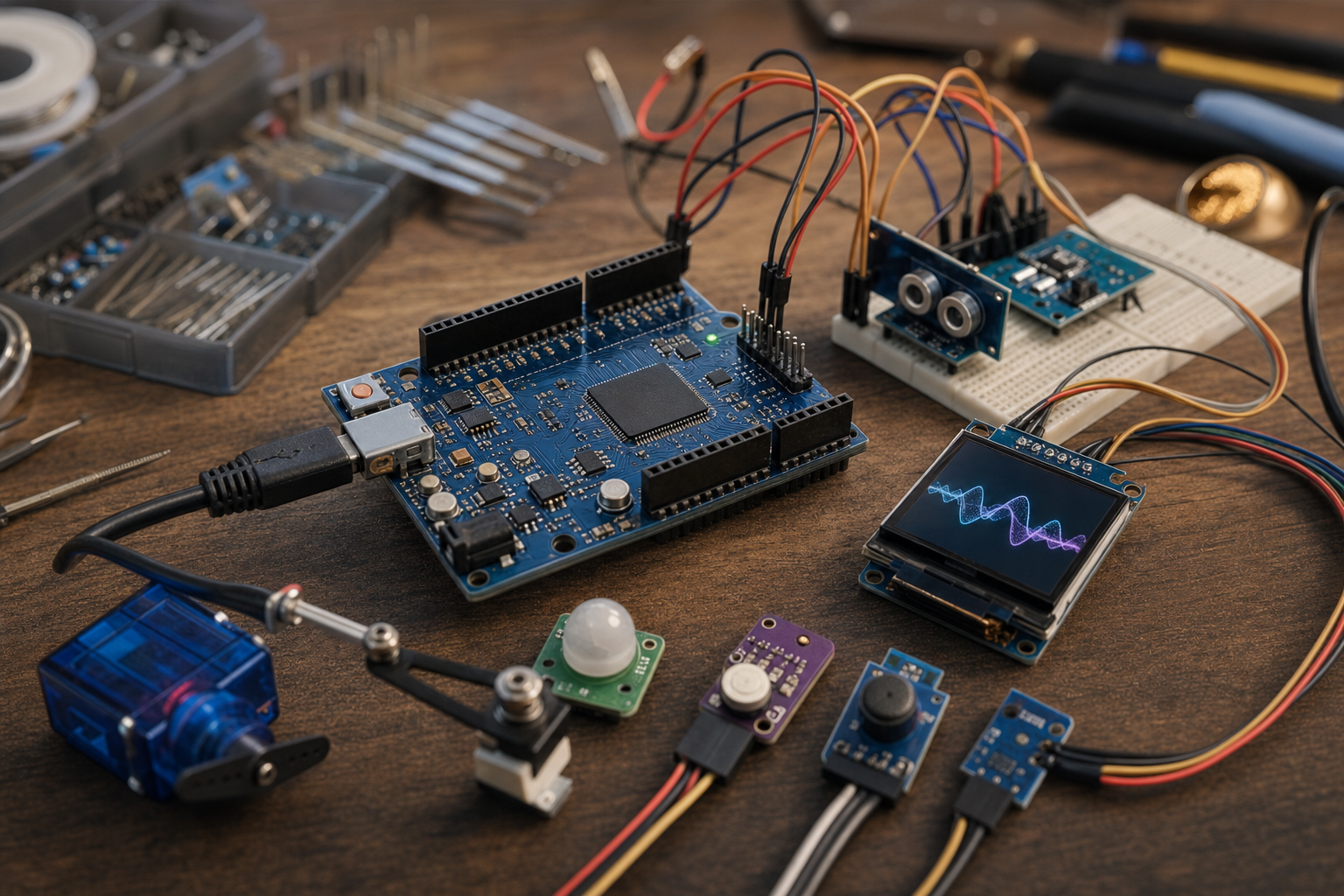
For makers, the opportunity is to move past “AI as API call” and build integrated systems. A bench prototype might combine a camera or environmental sensor, a local model, an agent layer, and a simple actuator. The learning value is high because every layer exposes a real engineering tradeoff.
For STEM programs, local agents also create better project rubrics. Teams can be judged on sensing accuracy, latency, power budget, mechanical behavior, safety interlocks, and explainable decision logs—not just whether a demo prompt worked once.
Risks and unknowns
Agentic embedded systems are not magic. They can be harder to test than deterministic firmware because the behavior may change with context. Builders should avoid giving an agent direct unrestricted control over high-power actuators, network credentials, or irreversible actions. Start with simulation, bounded commands, logging, and a physical kill switch.
The other question is ecosystem maturity. QClaw, OpenClaw, and UNO Q projects are promising signals, but the reliability bar for real products will require repeatable setup, model versioning, failure testing, and clear documentation.
TVG Take
UNO Q’s local-agent story is valuable because it forces AI back onto the workbench. The best maker projects this year will not be generic chat interfaces; they will be systems where a local agent reads sensors, chooses actions, and proves its behavior under real-world constraints. Treat the agent as one component in a safety-conscious embedded design, not as the whole product.
Arduino UNO Q FAQ for makers
Is this an Arduino UNO Q review?
No. This article is a news and analysis piece based on Arduino’s published material and TVG’s maker-hardware evaluation criteria. It does not claim hands-on testing.
What should makers test first?
Start with latency, offline behavior, power draw, peripheral control, and whether the local agent can recover safely when a sensor reading or tool call fails.
Why does local AI matter on a maker bench?
Local AI can reduce cloud dependency for robots, lab fixtures, classroom demos, and embedded prototypes where response time, privacy, or unreliable connectivity matters.
Related TVG reading
- AMD Ryzen AI Halo and local agent computers
- CAN bus robotics project guide
- Robot safety standards for maker projects