NVIDIA introduced two new Jetson Thor modules on July 15, 2026, positioning the T3000 and T2000 as smaller Blackwell-based computers for robots, visual AI systems and edge deployments that cannot rely on a remote data center for every decision.
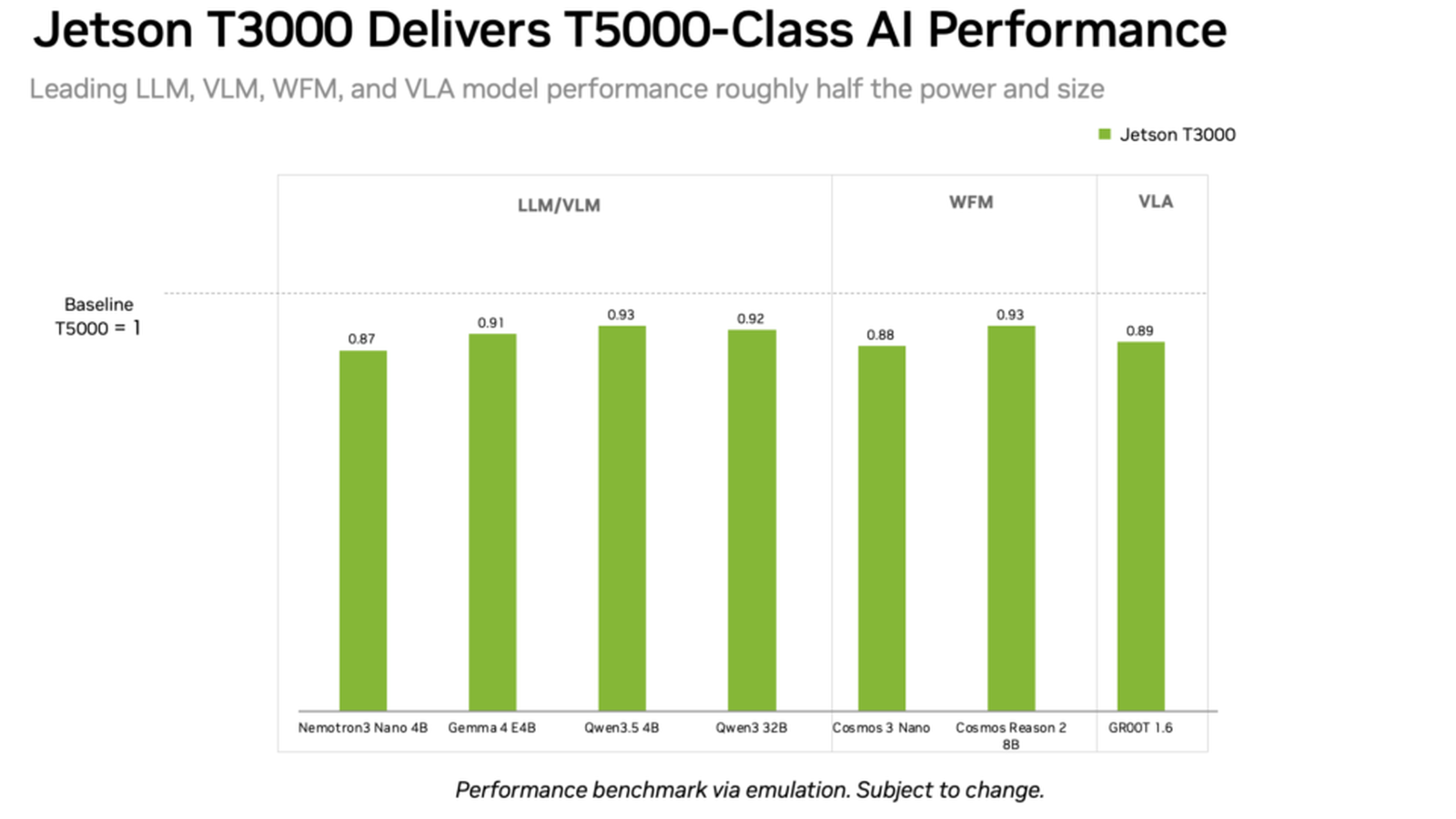
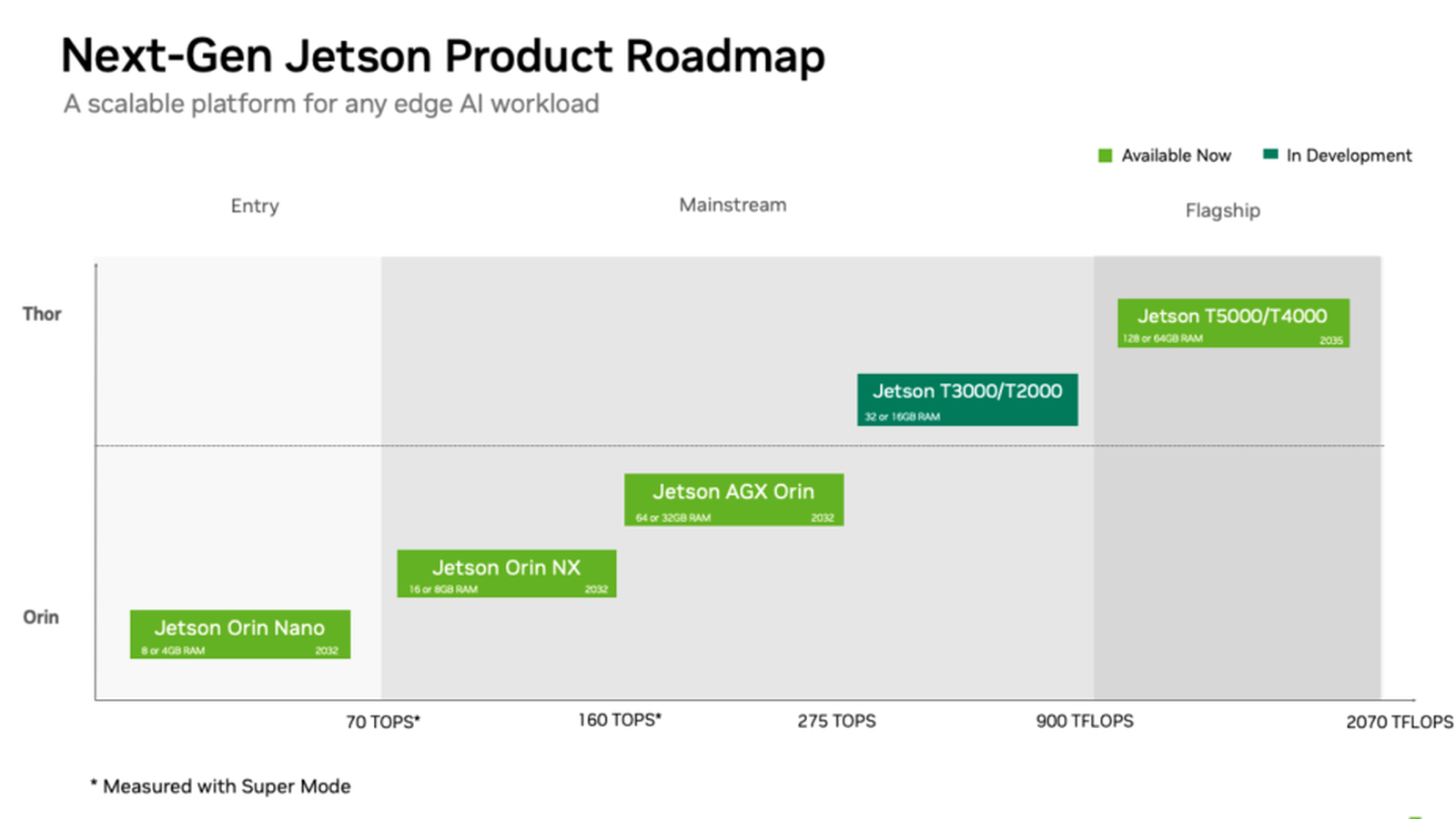
The company says the new modules are aimed at mass-market robotics and edge AI applications. In NVIDIA’s announcement, the T3000 is described as delivering 865 FP4 teraflops of AI compute in a compact module, with an eight-core Arm Neoverse CPU, 32GB of LPDDR5X memory, 273GB/s of memory bandwidth and 25GbE connectivity. NVIDIA also describes the T2000 as a lower-cost entry point for visual AI agents, autonomous mobile robots and industrial machines.
Why it matters
Robots are becoming less like single-purpose automation fixtures and more like mobile systems that need perception, language, planning and safety checks on board. That changes the hardware question. The useful spec is not only peak TOPS or teraflops; it is whether the compute module can run perception models, world-model components, robot middleware and safety monitoring inside a power, heat and service envelope that builders can actually deploy.
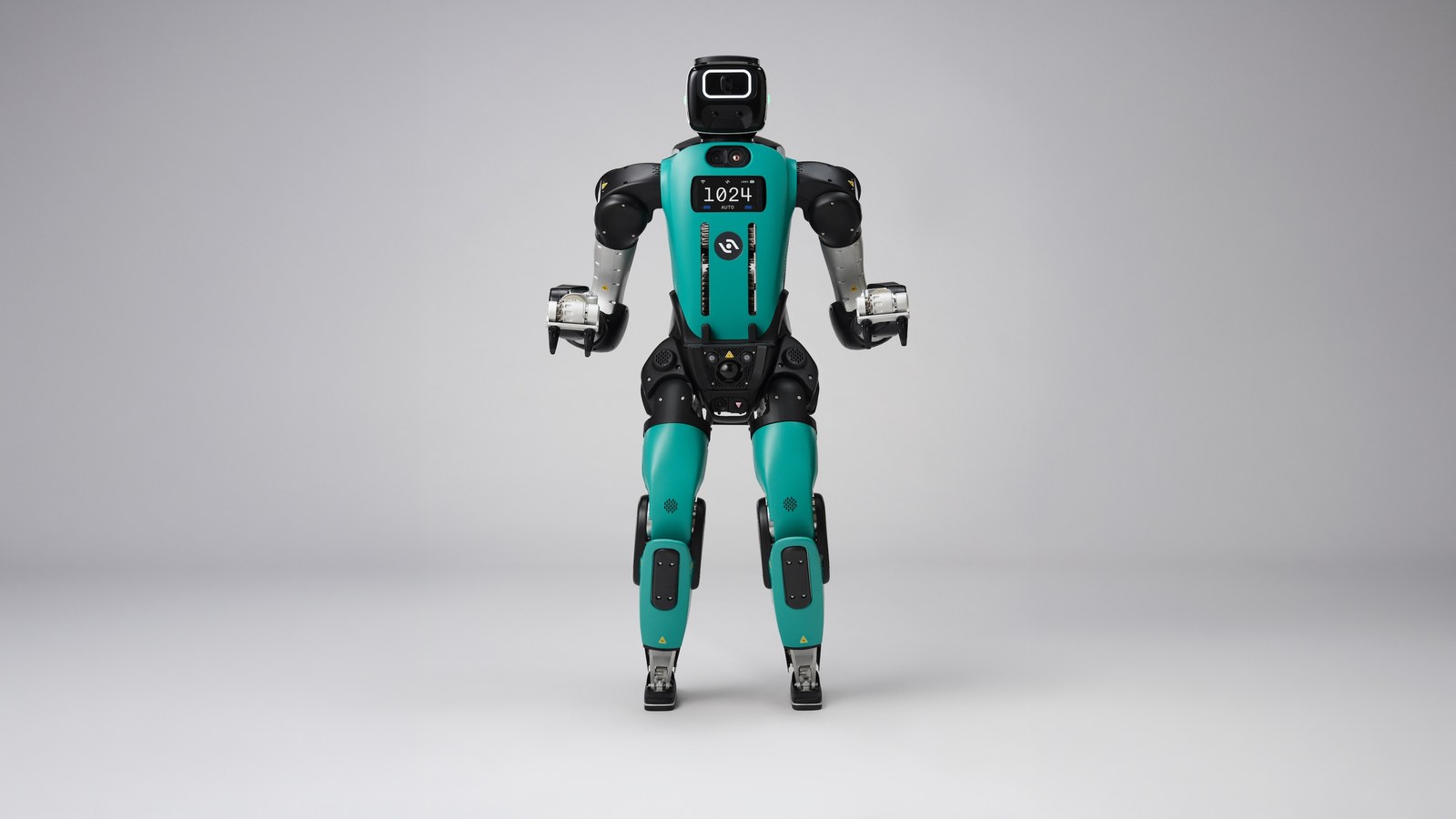
NVIDIA’s pitch is that Thor-class Jetson parts give robot makers a more compact path to that stack. The named adopter list in the company’s post includes 1X, Agile Robots, Amazon Robotics, Boston Dynamics, FANUC, Hitachi and Techman Robot, which signals that the platform is being framed for industrial and commercial robotics rather than hobby AI demos alone.
Technical breakdown
For TVG readers, the most important details are memory bandwidth, networking and software continuity. A robot that runs multimodal perception or local action models can be bottlenecked by moving camera frames and model state around the board as much as by raw math throughput. NVIDIA’s cited 273GB/s memory bandwidth on T3000 is therefore a practical part of the story, especially for multi-camera inspection, manipulation and mobile robotics workloads.
The 25GbE connectivity also matters. In a lab, developers can stream logs, simulation data and camera feeds over fast networks. In a warehouse or factory, that same connection can simplify integration with a robot cell, fleet manager or data recorder. It does not remove the need for power budgeting, thermal testing or safety validation, but it gives system integrators more headroom than a low-end embedded board.
TVG Analysis
The announcement is best read as a platform move: NVIDIA wants robotics builders to treat the Jetson line as the local compute layer for foundation-model-era machines. That is a different problem from putting a small classifier on a camera feed. It involves model optimization, deterministic I/O, recovery behavior, thermal design, fleet updates and safety boundaries.
What remains unknown is pricing in specific OEM configurations, how quickly software support lands in production-ready robot stacks, and how much real thermal headroom T3000 and T2000 modules have once they are inside sealed enclosures. TVG will watch for reference designs, developer kits and field examples that show sustained workloads rather than only launch-day peak numbers.