Robotics teams often treat cameras as an afterthought until a test fails and nobody can see why. A phone clip from the sideline may be enough for a social post, but it is not always enough for diagnosing wheel slip, arm timing, driver visibility, field interaction, or a sensor problem that only appears once per match.
This is a buyer evaluation, not a hands-on review. TVG has not tested a new camera for this article and is not ranking specific models. The goal is to help teams choose the right camera category for robot field documentation: rugged action camera, 360 camera, or phone.
The answer depends less on headline resolution than on mounting, heat, file handling, battery swaps, audio, field of view, and whether the footage helps the team learn something after the run.
What an action camera does well
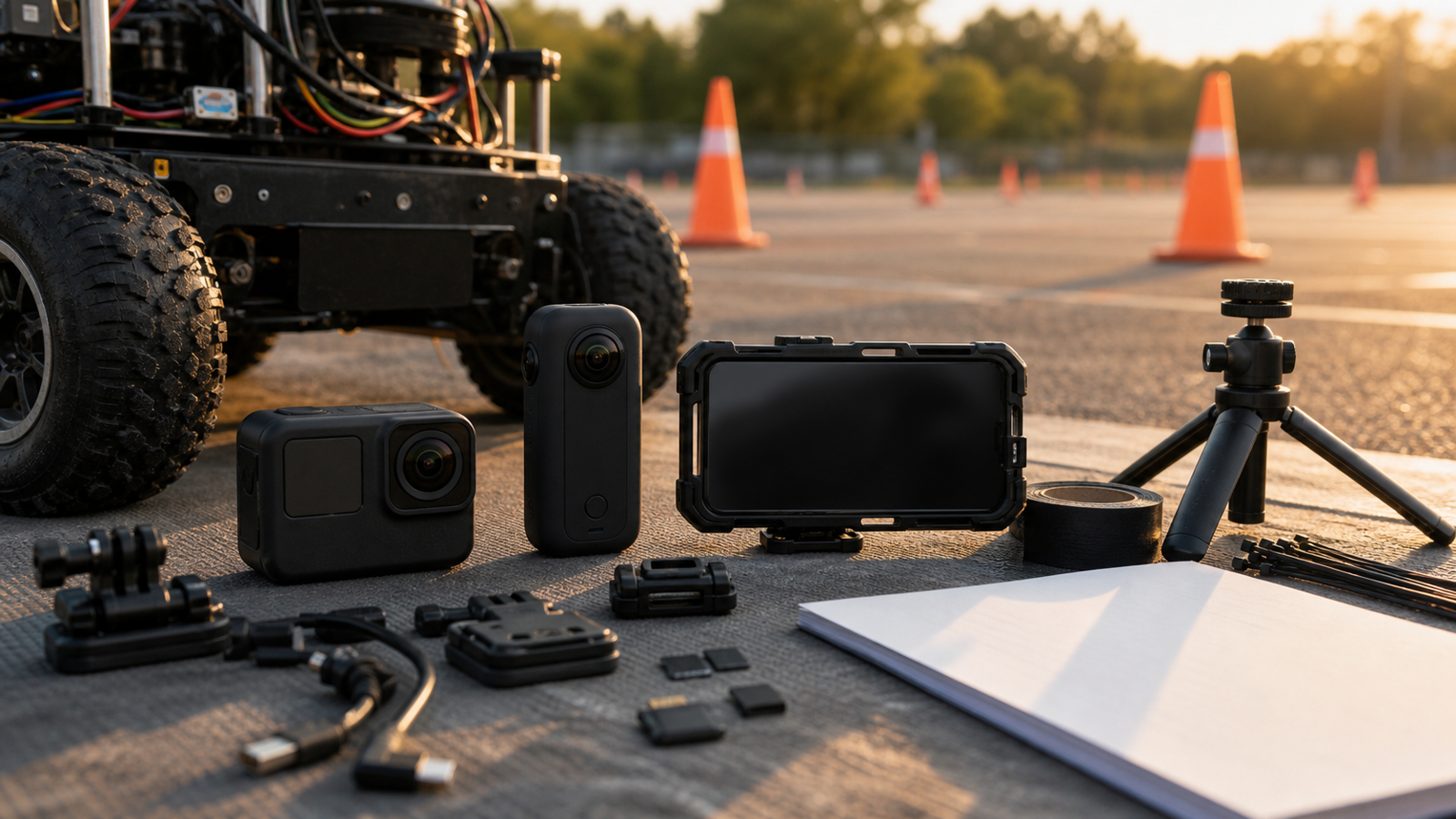
A rugged action camera is usually the best first dedicated camera for robot testing. Current models such as GoPro’s HERO13 Black class emphasize high-frame-rate video, stabilization, mounting accessories, waterproofing, and replaceable batteries. Those traits map well to robotics practice because the camera can ride on a robot, sit low on the field, or clamp to a driver-station pole.
The biggest advantage is repeatability. Teams can mark one mount location, use the same field of view every practice, and compare runs across weeks. A wide action-camera view can capture drivetrain behavior, contact, bouncing, and intake alignment better than a phone held by a moving person.
The tradeoff is perspective. A single action camera shows only one direction. If the robot leaves frame, rotates away, or blocks its own mechanism, the recording may miss the important moment. Teams using one action camera should decide whether the priority is driver view, mechanism view, side-line review, or full-field context.
What a 360 camera does well
A 360 camera is useful when the team does not know where the important event will happen. Insta360’s X5 product page, for example, highlights 8K 360 video, replaceable lenses, stabilization, and low-light improvements. DJI has also moved into the 360-camera conversation, and recent TVG coverage looked at what field teams should test first in the DJI Osmo 360 spec review.
The strength of 360 video is post-run review. A camera on a mast, tripod, or robot can capture the whole scene, then the team can reframe later to see the driver station, opponent interaction, scoring area, or mechanism timing. That is powerful for coaches and mentors who want context rather than a single cinematic clip.
The downside is workflow. 360 files can be large, editing can take longer, lens protection matters, and reframing adds another step before the footage is useful. A team with limited time after practice may prefer a simpler camera that produces ready-to-watch clips.
Where a phone still wins
A phone remains the fastest documentation tool. It is already charged, already connected, and easy to share from. Phones also have strong computational video, decent microphones, and familiar editing tools. For pit notes, quick mechanism checks, and outreach clips, a phone is often the right answer.
The problem is consistency. Phones are usually handheld, borrowed, interrupted by notifications, and hard to mount safely near a fast robot unless the team buys a proper cage or clamp. Battery and storage can also become personal-device problems rather than team-equipment problems.
For formal testing, a phone should be treated like a camera system: fixed mount, airplane mode, known storage space, screen locked, and a file-transfer plan. If that sounds too fussy, use a dedicated camera for the main view and keep the phone for secondary notes.
Specs that matter more than headline resolution
- Mounting ecosystem: Can the camera attach to bumpers, tripods, poles, helmets, carts, and field barriers without unsafe improvisation?
- Heat behavior: Does the camera keep recording during long practices, sun exposure, or high-resolution modes?
- Battery swaps: Can students replace batteries quickly, and are chargers easy to label?
- Storage workflow: Are memory cards fast enough, easy to offload, and clearly assigned to the team?
- Field of view: Does the view show the failure mode, or just create dramatic footage?
- Audio: Can the team capture spoken notes, motor noise, impacts, or field calls when useful?
- Time sync: Can footage be matched with robot logs, driver notes, or match timestamps?
- Repair risk: Are lens covers, mounts, doors, batteries, and cables replaceable?
A practical team setup
For most school and club robotics teams, the best starting setup is one rugged action camera plus one phone. Put the action camera on a repeatable mount for the technical view, and use the phone for wide context, pit notes, or quick outreach. Add a 360 camera later if the team has a real need for full-scene review and someone is responsible for the reframing workflow.
For field-heavy maker projects, the choice shifts. Drone testing, rover tests, outdoor mapping, and human-carried demos may benefit from a 360 camera because the operator cannot always predict the useful angle. Bench projects, mechanism tuning, and inspection work usually benefit more from a fixed action camera or a dedicated inspection camera.
What TVG would test first
Before recommending a specific camera, TVG would run a repeatable test: one full practice session, one long continuous clip, one mount-on-robot clip, one low-light indoor clip, one fast offload to a shared folder, and one review session where students identify three useful engineering observations from the footage.
If the camera produces beautiful clips but nobody reviews them, it failed the team workflow. If a lower-cost setup reliably shows failure points, saves time, and survives practice, it is the better lab tool.
TVG Take
Choose the camera category by the question the team needs to answer. Action cameras are strongest for repeatable technical views, 360 cameras are strongest for context and unknown angles, and phones are strongest for speed. Robotics teams should buy for review habits, mounts, batteries, storage, and student ownership before chasing the largest resolution number.
Sources
- GoPro HERO13 Black product information
- Insta360 X5 official product page
- DJI Osmo Action product information