
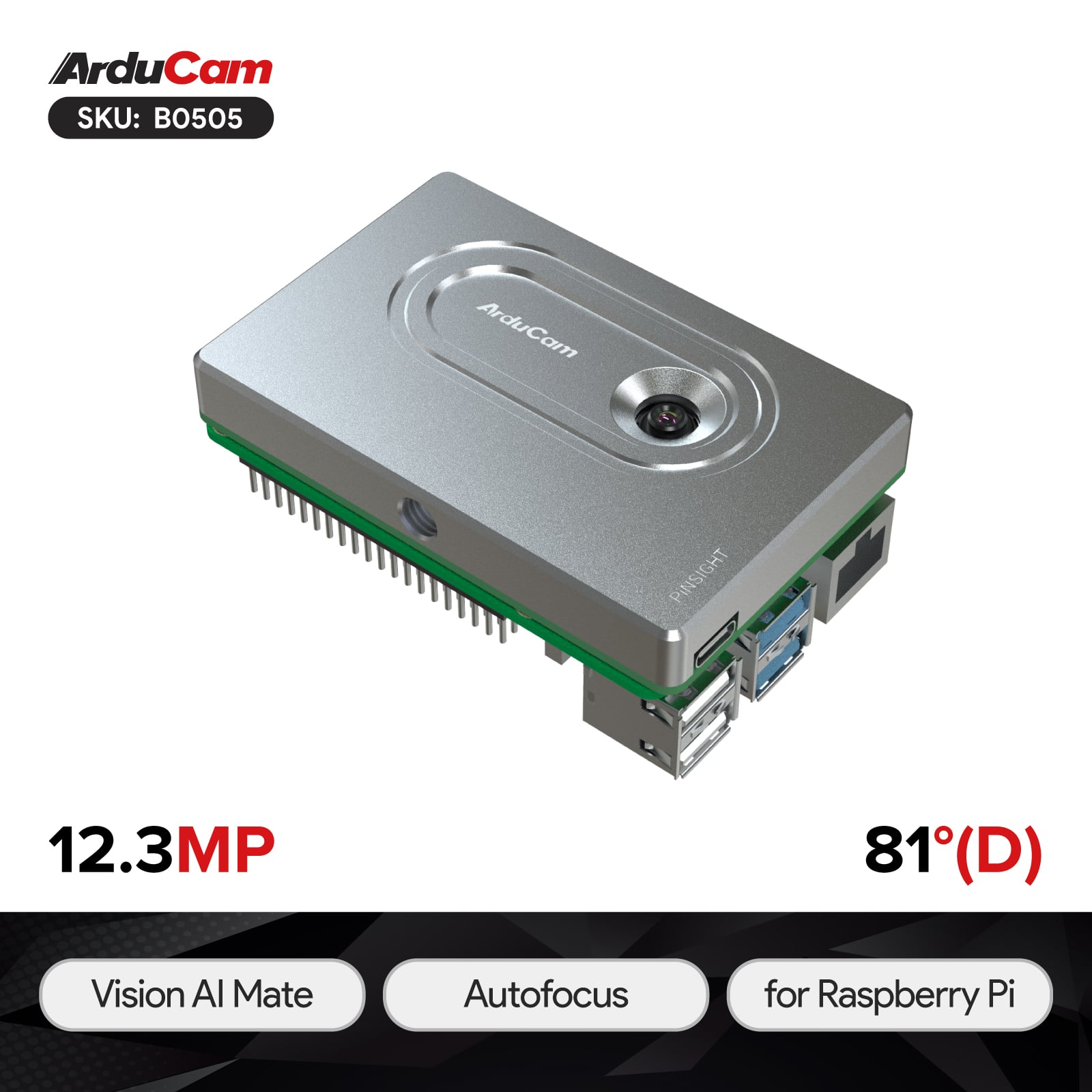
Arducam’s PiNSIGHT is a compact edge-AI camera board aimed at Raspberry Pi builders who want more than a basic image sensor. The pitch is straightforward: pair a 12.3MP camera module with Luxonis OAK-SoM acceleration, USB 3.0 connectivity, autofocus optics, and a Raspberry Pi 5-friendly form factor so maker labs can prototype local computer-vision projects without moving every inference workload to a cloud service.
A camera-and-accelerator subsystem
PiNSIGHT sits in a useful middle ground between a simple Raspberry Pi Camera Module and a larger robotics vision stack. Arducam’s product page lists the board as the B0505, describes it as a “12MP Vision AI Mate for Raspberry Pi 5,” and positions it around local intelligent-vision applications including object recognition, pose estimation, fatigue detection, anomaly detection, and face recognition. The official documentation describes the product as a Raspberry Pi 5-focused vision AI kit built around integrated camera hardware and Luxonis OAK-SoM support.
PiNSIGHT addresses a real integration problem in robotics education and maker automation: combining camera input, video encoding and local AI acceleration without asking each lab to assemble the full camera-and-accelerator stack from separate boards.
Where PiNSIGHT fits
PiNSIGHT is best matched to Raspberry Pi users building small robot perception demos, STEM lab computer-vision lessons, bench-top inspection experiments, and local AI camera projects. It is especially relevant for builders who already understand Raspberry Pi setup and want to move from still images or USB webcams into model demos, video pipelines, and edge inference.
It is probably not the first camera board a beginner should buy if the goal is simply learning Python or taking photos. The value appears strongest when the project actually needs the OAK-SoM, the higher-resolution camera module, hardware video encoding, and Arducam’s documented DepthAI-oriented workflow.
The integration advantage
Arducam’s wiki lists the PiNSIGHT SKU as B0505 with a 12.3MP sensor, RAW10/YUV/NV12/RGB output formats, USB 3.0 interface, all-in-one design, autofocus from 15 cm to infinity, an 81-degree diagonal field of view, and an integral IR-cut filter. The product page says the board uses an OAK-SoM and supports hardware-based encoding formats including H.264, H.265, and MJPEG. It also lists 4K/30FPS and 1080P/60FPS encoding support.
The strongest design signal is integration. A Pi camera, accelerator module, heatsinking, USB connection, and documentation path are bundled into a single product story. For a classroom or robotics club, that can matter as much as peak TOPS numbers because fewer loose parts usually means fewer failure points during setup.
The board still depends on the surrounding Raspberry Pi ecosystem: power quality, cabling, cooling, OS image, model compatibility and project-specific mounting remain the builder’s responsibility. PiNSIGHT is a vision subsystem, not a turnkey robotics product.
Raspberry Pi remains part of the system
The first risk is ecosystem complexity. Raspberry Pi, USB 3.0, camera drivers, DepthAI projects, pre-trained models and local storage create several independent failure points. Arducam’s public documentation provides a starting path, but it does not establish recovery behavior across OS, package and model changes.
The second unknown is sustained heat and power behavior. Arducam emphasizes high computing power with low power consumption, but a maker lab still needs real-world data under continuous inference, video encoding, and classroom handling.
The third unknown is mechanical integration. Product photos show a compact board, but robotics builders will care about mounting holes, cable strain, lens protection, enclosure compatibility, and whether the field of view works for mobile robots without awkward brackets.
The final risk is expectation mismatch. A board like PiNSIGHT can make AI camera projects more approachable, but it does not remove the need to choose models, label goals, tune pipelines, and understand false positives. STEM buyers should treat it as a capable subsystem, not a magic vision appliance.
When a simpler camera is enough
PiNSIGHT belongs on the shortlist for Raspberry Pi 5 builders who want a compact local vision stack for robotics, automation, and AI-camera experiments. It also fits educators who are comfortable maintaining Pi images and want a more ambitious platform than a basic webcam lesson.
Builders who only need simple image capture, remote video calls, or occasional machine-vision experiments may be better served by a cheaper camera module until they can justify the OAK-SoM-based workflow. The board makes the most sense when its AI acceleration and documented demo path will actually be used.
The decision boundary
PiNSIGHT’s strongest case is integration: a 12.3MP autofocus camera, USB 3.0, OAK-SoM acceleration and hardware video encoding arrive as one Raspberry Pi 5-oriented subsystem with an official setup path.
The board makes sense when a project will use local inference and encoded video often enough to justify the added DepthAI and thermal-management complexity. Simple capture, video calls or occasional vision experiments remain cheaper with a conventional camera module.

This looks really interesting, I’ve been researching options for adding AI processing to my Pi projects. The OAK-SoM acceleration seems like a key feature to explore further.