
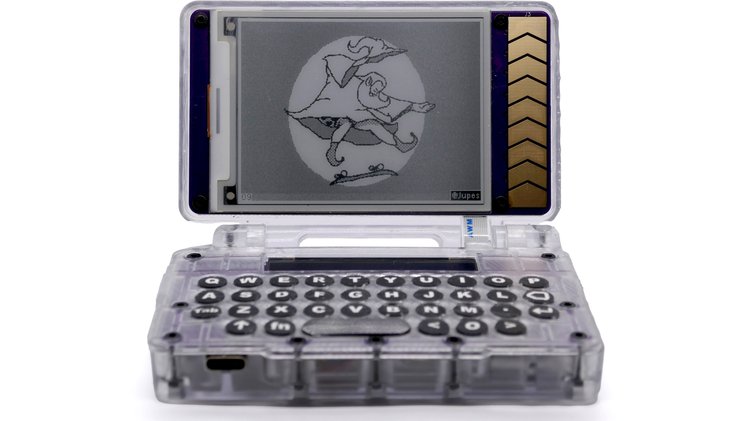
PocketMage is the kind of device that naturally attracts maker-lab attention: a small clamshell PDA with an e-paper main display, a secondary OLED strip, a physical QWERTY keyboard, and software intended for focused writing, organization, and tinkering. The project is live on Crowd Supply, where the campaign page lists an e-paper display, OLED feedback screen, tactile keyboard, scroll input, and productivity-oriented software. The project’s own site describes PocketMage as a PDA built for productivity and fun.
This is not a TVG hands-on review. It is a project watch and backer-risk analysis based on public campaign material and independent coverage, including The Verge’s report on the Crowd Supply launch and Liliputing’s overview. Crowdfunding specs, pricing, schedules, and final quality can change, so maker labs should treat PocketMage as an interesting technical preview rather than a guaranteed field tool.
Why maker labs may care
Phones are powerful, but they are not always good lab notebooks. Notifications, fragile glass, short attention loops, and app churn make them awkward for checklists, field notes, serial-console reminders, and offline reference material. E-paper devices solve some of that problem by offering readable static content and low idle power. Physical keyboards solve a different problem: entering notes without balancing a touchscreen keyboard on a bench.
PocketMage’s pitch combines those ideas in a pocketable form. If the device can store Markdown notes, quick logs, dictionaries, calendars, terminal workflows, or lab procedures, it could fit the same practical lane as TVG’s e-reader versus tablet field-manual guide. The question is not whether the concept is charming. It is whether the hardware and software will be dependable enough for real use.
What to verify first
Display behavior: The campaign emphasizes a main e-paper display plus a secondary OLED display. Labs should verify refresh behavior, ghosting, font rendering, outdoor visibility, and whether the OLED strip meaningfully improves navigation or simply adds another part to power and support.
Keyboard quality: A tiny QWERTY keyboard can make or break a PDA. Key travel, spacing, rollover behavior, modifier-key handling, and thumb-typing comfort matter more than the spec sheet. If the keyboard is tiring after ten minutes, it will not replace a notebook or rugged phone for field notes.
Software openness: The project positions PocketMage as tinker-friendly. That should be checked in practical terms: how applications are installed, whether backups are easy, what documentation exists, whether the OS can be rebuilt, and how much work is required to recover a failed update.
Battery and charging: E-paper helps idle power, but Wi-Fi, OLED, storage, and backlight behavior can change the real runtime. Maker labs should look for measured battery data, not only claims. USB-C charging behavior also matters if the device is packed with cameras, drones, robots, or portable displays that already share chargers.
Repairability: A student device or field notebook will be dropped. Before buying several units, a lab should know whether keycaps, hinges, batteries, and displays can be replaced, and whether the enclosure uses standard screws or adhesive-heavy construction.
Sync and export: A focused writing device is only useful if notes can leave the device cleanly. Maker labs should verify whether PocketMage can export Markdown or plain text without a fragile cloud dependency, whether USB transfer is supported, and whether backups can be restored onto a replacement unit. A small PDA that traps lab notes in a custom app is less useful than a simpler notebook that produces portable files.
Classroom fit: Shared devices need predictable setup. If every student account, Wi-Fi network, or application install requires manual tuning, a lab may spend more time maintaining the device than using it. The best case is a documented image or setup checklist that a mentor can repeat before workshops and events.
Backer-risk checklist
- Is the prototype shown in public videos close to the promised shipping hardware?
- Are keyboard, hinge, and display parts identified well enough to judge replacement risk?
- Does the project provide clear software images, source access, or recovery documentation?
- Are the battery-life claims tied to specific workloads such as typing, reading, Wi-Fi sync, or standby?
- Is the delivery schedule realistic for a dual-display device with custom enclosure work?
- Would the device still be useful if one promised software feature arrived late?
Who should watch it
PocketMage is most interesting for writers, hardware hackers, retro-computing fans, and labs that want a low-distraction field notebook. It is less compelling for teams that mainly need PDF annotation, camera review, CAD viewing, or web-heavy dashboards. For those uses, a small tablet or e-reader workflow may still be stronger, especially if the team already has a device-management plan.
It also belongs near TVG’s broader creator-and-field gear coverage. Just as field camera power workflows depend on boring details like dummy batteries and heat, a PDA’s usefulness depends on keyboard feel, sync reliability, battery behavior, and recovery steps. The charm gets attention; the maintenance story determines whether it survives in a shared kit.
TVG Take
PocketMage has a clear technical hook: it tries to combine the calm readability of e-paper with the responsiveness of OLED and the speed of a hardware keyboard. That is a credible idea for focused notes and lightweight hacking. But maker labs should not treat it as proven equipment until shipping hardware, software recovery, keyboard quality, and battery life are verified. If those pieces hold up, it could become more than a nostalgia device. If they do not, it may remain an enjoyable personal gadget rather than a shared lab tool.

That’s a really interesting project; the repairability aspect seems particularly important for something like this – it’s good they’re considering it.