ICRA 2026 wrapped in Vienna this month with the kind of robotics program that matters less as a product-launch calendar and more as a snapshot of where serious robot engineering is moving next: bigger evaluation sets, more contact-rich manipulation, more compute-heavy perception, and more pressure to prove that “physical AI” can survive outside a demo booth.
What happened
The 2026 IEEE International Conference on Robotics and Automation ran June 1–5 at VIECON / Messe Wien in Vienna. The public program spans papers, competitions, workshops and tutorials, technical tours, industry sessions, keynote sessions, and exhibition activity under the conference theme “Robots for all.”
NVIDIA’s official ICRA 2026 event page framed its presence around AI-powered robotics research, featured talks, workshops, and robotics solutions. Its description points directly at accelerated computing, large data pipelines, and generalist AI models as the ingredients now being pushed into robotics development.
Why it matters
For TVG readers, the important signal is not simply that robotics research is active. It is that the field is becoming more measurement-driven. As foundation-model language spreads into robotics marketing, the hard questions are shifting toward repeatable tests: Can the robot localize reliably? Can it recover from contact errors? Can it handle lighting changes, object variation, and imperfect instructions? Can a lab result be reproduced by another team?
That is a healthy direction for builders. It rewards teams that document datasets, test fixtures, latency budgets, power envelopes, and failure cases instead of relying on edited demonstration clips.
Technical breakdown
Several engineering themes stand out from the public ICRA framing and surrounding robotics ecosystem:
- Benchmarks are becoming product infrastructure. A robot stack now needs evaluation hooks for perception, planning, control, safety, and task completion—not just a final demo video.
- Compute and data are moving closer to the robot. NVIDIA’s ICRA messaging around accelerated computing and big data reinforces the trend toward edge and workstation pipelines that can train, simulate, replay, and validate robot behavior.
- Contact-rich work remains the credibility test. Grasping, pushing, sliding, inserting, and tool use expose the gap between visual recognition and physical competence.
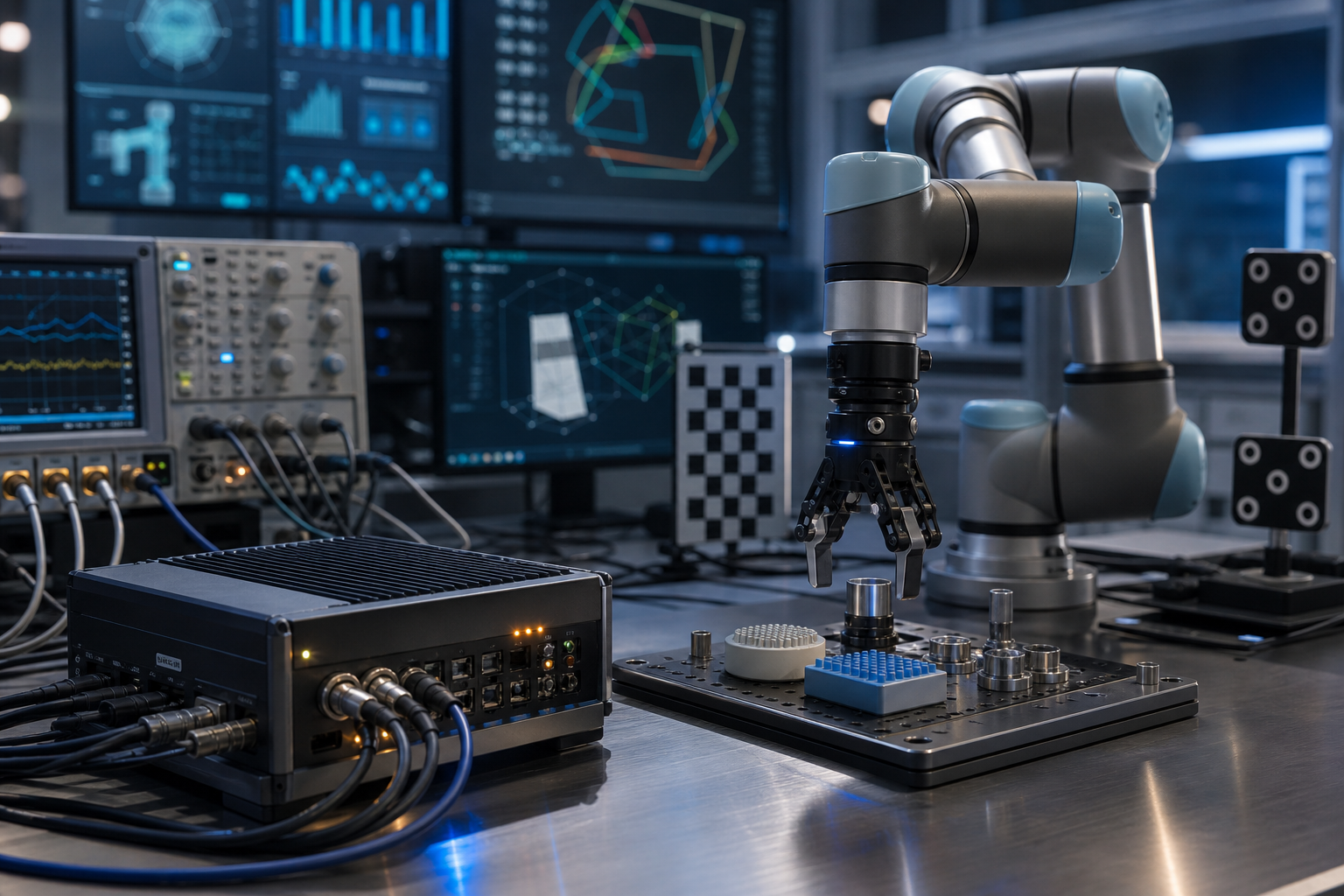
- Simulation is useful only when tied to real measurements. Teams still need calibration targets, sensor logs, actuation limits, and real-world regression tests.
Builder and industry impact
Robotics startups and integrators should treat ICRA season as a reminder to build their own scorecards. A warehouse arm, classroom rover, factory inspection robot, or edge-AI camera rig should have a small but explicit evaluation suite: known objects, known lighting setups, known fault cases, and a pass/fail threshold that can be repeated after every model, firmware, or mechanical change.
For STEM teams, the same lesson applies at smaller scale. Instead of “the robot worked yesterday,” teams should keep run logs, battery notes, sensor baselines, and short videos of failure modes. That habit is the bridge between competition tinkering and engineering practice.
Risks and unknowns
The risk is benchmark theater. A benchmark can become another marketing artifact if the task is too narrow, the environment is over-controlled, or the test data leaks into training. Builders should ask what changed between training and evaluation, how many trials were run, and whether failures are counted visibly.
Another open question is cost. The more robotics stacks depend on high-end compute, large datasets, and specialized sensors, the harder it becomes for small labs and school teams to reproduce state-of-the-art workflows. Practical robotics coverage should keep watching the tooling that makes these methods cheaper and easier to validate.
TVG Take
ICRA 2026’s engineering signal is clear: robotics credibility is moving from “can it do the task once?” to “can it be measured, repeated, and improved?” That is good news for serious builders. The next useful robotics stack will not just ship a model or a manipulator; it will ship a test discipline.