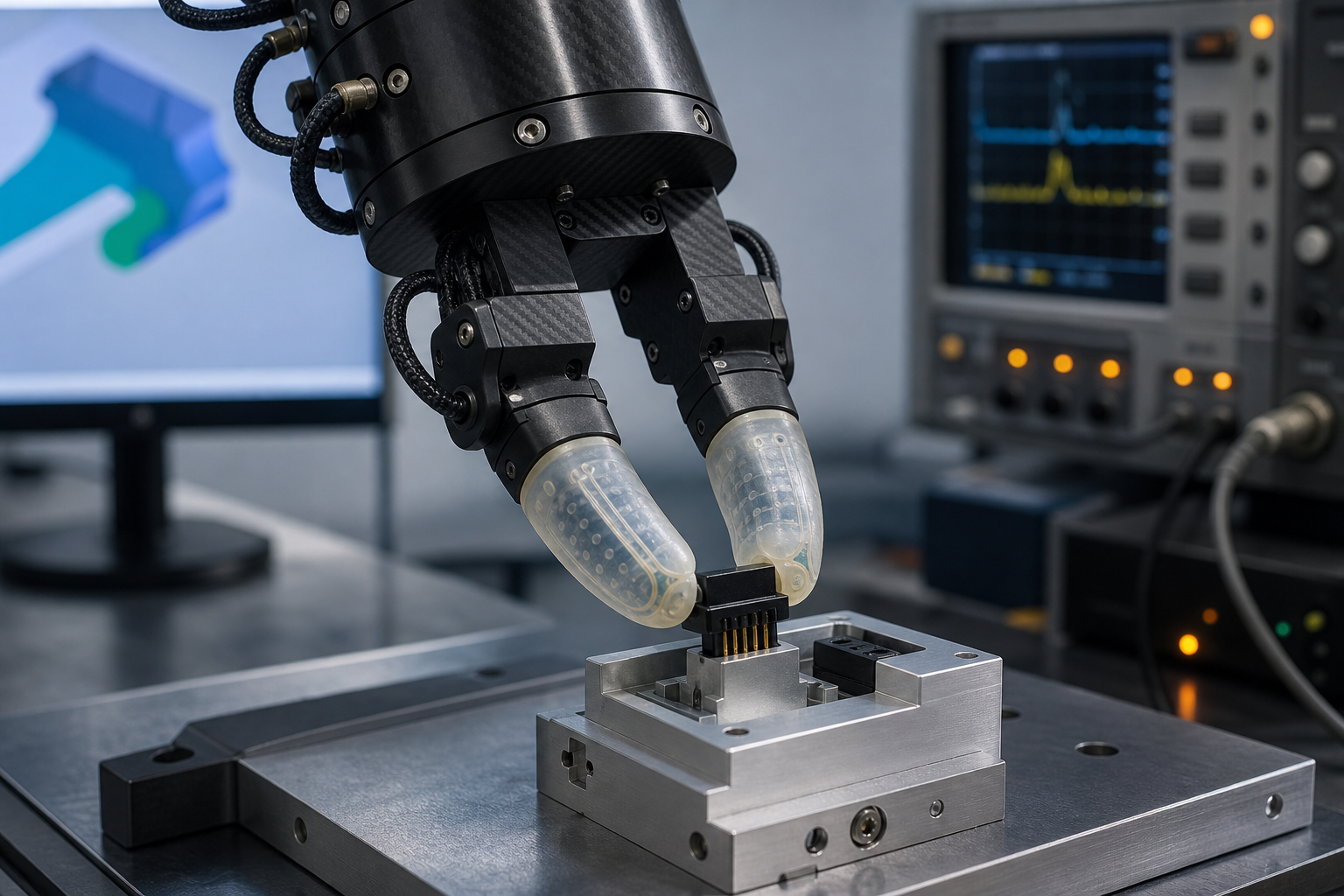
Daimon Robotics and Galbot used ICRA 2026 in Vienna to introduce RobOmni, an evaluation benchmark aimed at a specific weak point in embodied AI: how robot policies perform when physical contact matters, not just when cameras can see the scene.
Why it matters
Robotics progress is often measured with vision benchmarks, simulation demos, or single-platform manipulation tasks. RobOmni is useful because it pushes the discussion toward contact-rich work: grasping delicate objects, placing parts, inserting components, opening containers, and assembling hardware where force, slip, compliance, and fingertip state can change the outcome.
For builders, this is the gap between a robot that recognizes an object and a robot that can reliably handle it. Vision can tell a system where a connector is; tactile feedback can help determine whether the insertion is aligned, binding, or complete.
Technical breakdown
According to Robotics 24/7, RobOmni is an omni-modal evaluation benchmark that includes tactile sensing for physical interaction and is built on NVIDIA Isaac Sim. The benchmark combines high-fidelity simulation with standardized evaluation scenarios focused on contact-rich manipulation.
The observation stack is broader than a camera-only setup. The reported inputs include high-frequency fingertip tactile sensing, wrist-mounted RGB vision, gripper state information, TCP motion trajectories, action commands, and external camera observations. That combination matters because it lets researchers isolate whether tactile channels improve a policy, where they help, and when they add complexity without enough performance gain.
The platform also incorporates a 1:1 digital twin of Daimon’s DM-TacClaw tactile gripper while supporting multiple robot embodiments. That cross-embodiment angle is important: a manipulation policy that works on one arm or gripper often fails when geometry, compliance, payload, or sensing changes.
Builder, STEM, and industry impact
RobOmni should interest university robotics labs, industrial automation teams, and advanced STEM programs because it frames tactile sensing as something to benchmark, not just demonstrate. A good tactile gripper demo is not enough; teams need reproducible tasks, controlled inputs, and comparable results.
In factories, the near-term use case is not a general-purpose humanoid doing everything. It is better reliability on messy manipulation: connector insertion, small-part handling, deformable packaging, bin picking, fixture loading, and quality checks that depend on contact state.
For students and maker teams, the takeaway is simpler: if the task involves uncertainty at the point of contact, adding a camera may not be the final answer. Force, tactile, current sensing, compliance, and feedback loops deserve space in the design review.
Risks and unknowns
RobOmni is a benchmark, not proof that every robot needs expensive tactile hardware. The useful questions are how well simulation transfers to physical robots, whether tactile sensors survive industrial duty cycles, how much latency the system adds, and whether the benchmark rewards behaviors that translate to real production cells.
There is also a measurement risk. If a benchmark becomes too tailored to a specific gripper, simulator, or task suite, it may overstate progress. The strongest version of RobOmni will be one that attracts independent runs across different hands, arms, objects, and labs.
TVG Take
RobOmni points in the right direction because it treats touch as an engineering variable instead of a robotics flourish. The next meaningful robotics leap will not come from vision models alone. It will come from systems that can close the loop between seeing, touching, correcting, and retrying under measurable conditions.
For TVG’s robotics readers, the practical lesson is to ask tactile projects for data: task definitions, baseline comparisons, failure modes, latency, sensor durability, and sim-to-real evidence. That is how contact-rich manipulation moves from conference video to reliable automation.