NASA’s Dragonfly team has completed its first comprehensive real-time flight simulation on flight-like avionics, the agency announced October 23. For robotics developers, the useful result is an integration milestone: flight software and simulated sensors working through a landing sequence together, where timing and interfaces matter as much as individual components.
The run took place on a computer testbed at the Johns Hopkins Applied Physics Laboratory in Maryland. It was neither an airborne flight nor a test on Dragonfly’s actual flight system. Independently controlled Teknoblog reported the announcement on October 24, describing the same testbed milestone rather than a separate experiment.
A landing sequence with the pieces connected
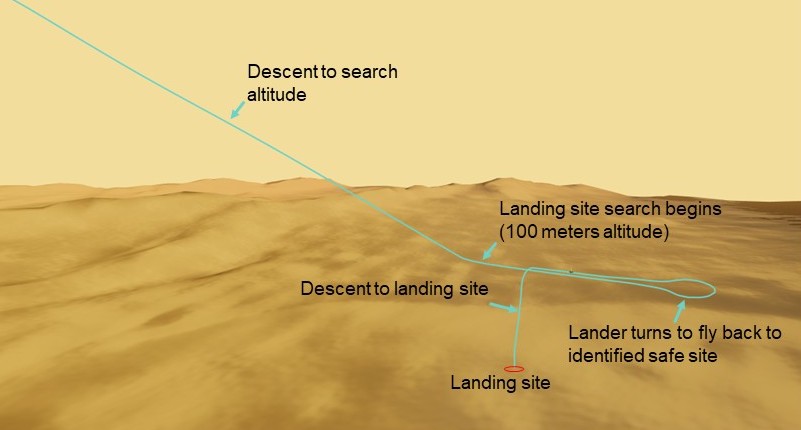
The simulated sequence began with descent toward the altitude for searching the terrain. Dragonfly then searched for a safe landing site, passed the chosen spot, turned back and descended to land. The cyan trajectory over the golden simulated terrain shows that search-and-return maneuver clearly: finding a destination and reaching it are distinct parts of the task.
Flight software ran on flight-like avionics with simulated inputs representing navigation cameras, inertial measurement units and lidar. Engineers generated terrain for the lidar and rendered the scenes the navigation cameras would see. NASA says lidar supplied the final piece needed for the comprehensive simulation; the system will help measure terrain altitude and slope and identify potential hazards.
That combination let the team exercise the sequence with sensor inputs and flight software interacting on representative computing hardware. NASA describes it as the most comprehensive first-flight test to date, incorporating most of the systems and maneuvers intended for arrival at Titan.
The camera emulator had to keep time
A custom camera emulator used graphics processing units to render simulated Titan scenes in roughly the same 20–70 millisecond exposure times that Dragonfly’s cameras will use during flight. The number describes the emulator’s scene-rendering timing relative to camera exposure. It is not a measured frame rate or the latency of the entire sensing-to-control loop.
The engineering payoff was the opportunity to observe how the connected processes exchanged information in real time. NASA specifically highlights interactions measured in milliseconds. For robotics teams, that makes the integration boundary the interesting part: a useful sensor model must also deliver its information in a way the receiving software and hardware can handle on time.
Built up from a single rotor
The team reached this run incrementally. Early simulations covered relatively simple activity, including spinning a single rotor. Later tests added a short reposition flight and a partial scouting flight, bringing in more sensors and capabilities before the comprehensive sequence.
That progression gives the milestone its context. The latest run connects capabilities developed through smaller tests, allowing engineers to examine their combined behavior through descent, site selection and landing. Its value is evidence about those interfaces and timing relationships under the simulated scenario, rather than a general certificate of readiness for Titan.
Next: flight hardware and deliberate faults
NASA says the team plans to run the first-flight sequence on Dragonfly’s actual flight system, test other flight profiles and deliberately introduce faults to examine autonomous responses. Those are upcoming steps, not results established by this announcement.
They matter because Dragonfly must fly at Titan without real-time help from Earth. The mission is planned to launch no earlier than 2028 and arrive in 2034. Before then, the next useful evidence will be how the software behaves on the flight system itself—and how it responds when engineers make the simulated flight go wrong.