Raspberry Pi’s latest featured community build, AI Arcade, is a useful signal for makers: generative AI is starting to show up as a physical interface problem, not just a chatbot problem.
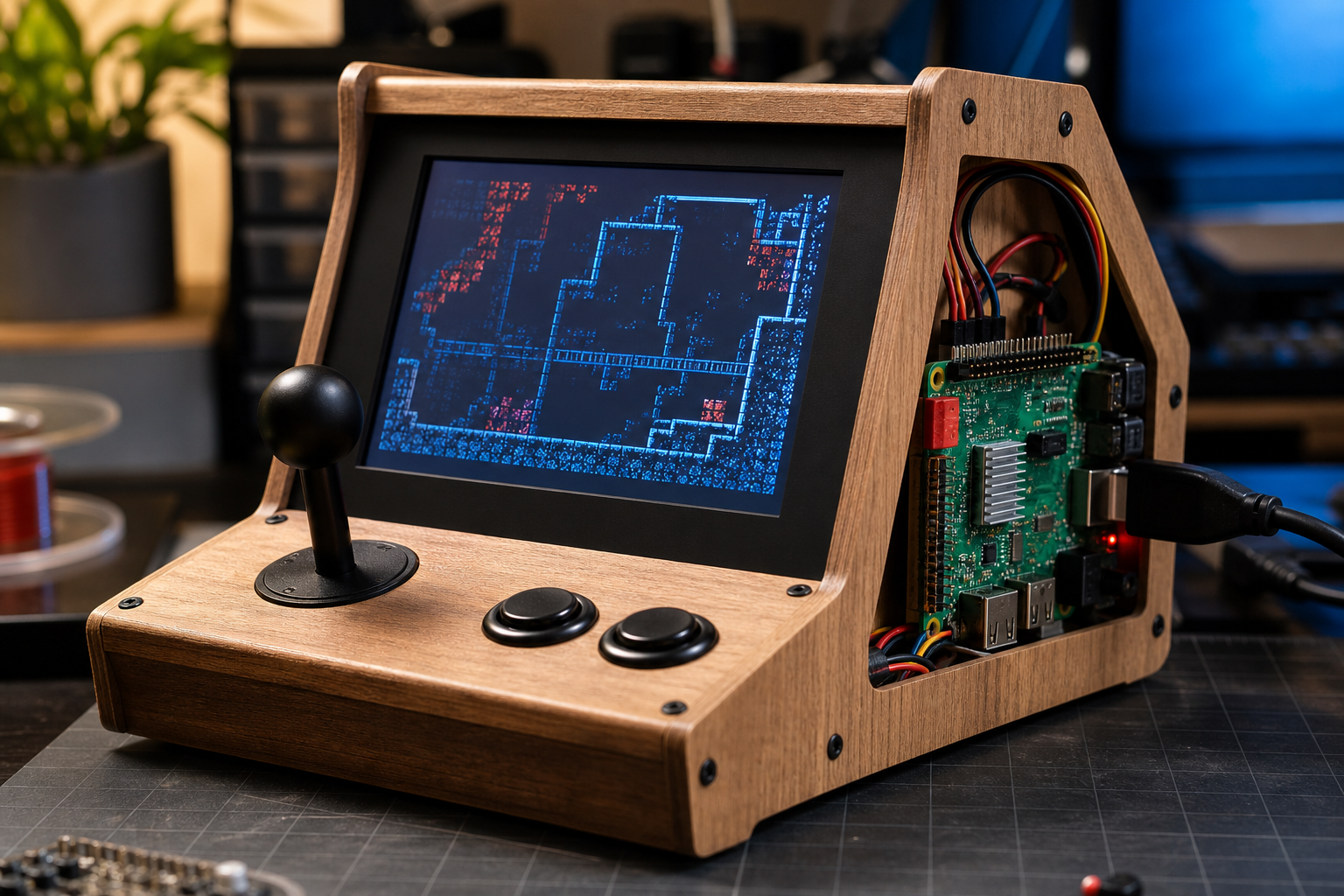
The project, built by Grigor Todorov and highlighted by Raspberry Pi this week, uses a Raspberry Pi-powered arcade box to generate small browser games on demand. Instead of emulating old consoles, the system asks the player for simple choices, uses an LLM workflow to create a new game, saves generated games for later play, and presents the whole experience through a joystick-and-buttons interface.
Why it matters
AI Arcade is not important because every generated mini-game is perfect. Raspberry Pi’s write-up is clear that the games are simple and can be unpredictable. The more interesting engineering point is that the project packages AI generation inside a familiar piece of hardware: a self-contained arcade cabinet that boots into a local web page and can be used without understanding the software stack underneath.
That is the direction many useful maker-AI projects will take. The winning demos will not be prompts floating in a browser tab; they will be physical objects where an AI system is constrained by controls, screens, latency, storage, power, and the patience of a real user standing in front of the device.
Technical breakdown
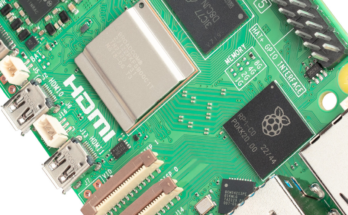
The system described by Raspberry Pi combines a compact single-board computer, a reused enclosure, arcade controls, HDMI display output, and a locally hosted web app. The interface is designed to launch full-screen on startup, so the Raspberry Pi behaves more like an appliance than a development board.
The project’s public GitHub repository describes a frontend that reads the controller through the browser Gamepad API while also supporting keyboard and mouse fallback bindings. That design choice matters: it keeps the hardware input layer simple, makes the generated game interface portable across browser contexts, and gives the builder a debugging path when the arcade controls are not connected.
There is also a practical product lesson in the generation loop. Raspberry Pi notes that games can take time to generate, so the project gives the player something to do while waiting. That is a small detail, but it is the difference between a lab demo and a usable object. Edge-AI and LLM-powered devices need loading states, saved results, recovery paths, and bounded choices just as much as they need model calls.
Builder and STEM impact
For makers, AI Arcade is a strong classroom and club pattern because it touches multiple disciplines without requiring a factory-scale robotics budget. Students can reason about enclosure design, controller wiring, startup behavior, UI state, generated code quality, file persistence, and model reliability in one project.
The project also creates a healthier way to teach generative AI. Rather than treating the model as a magic author, the cabinet frames AI as one subsystem inside a larger engineered product. The hardware constrains the interaction. The UI constrains the prompt space. The save/load behavior constrains repeatability. Those constraints make the build more testable.
Risks and unknowns
The obvious risk is reliability. If the generated game logic is broken, boring, or inconsistent with the player’s choices, the experience degrades quickly. Builders adapting this pattern should log model prompts and outputs, keep a known-good game library, and use validation steps before presenting generated content as playable.
There is also a cost and connectivity question. A project may call a hosted model service, run a smaller local model, or use a hybrid approach. Each option changes latency, privacy, operating cost, and hardware requirements. A STEM version should be explicit about which part of the system is local and which part depends on an external service.
TVG Take
AI Arcade is a better maker-AI example than another generic assistant because it forces the AI into a physical product boundary. The cabinet has controls, a boot flow, a screen, storage, waiting time, and a user who expects playability. That is exactly the kind of constraint stack builders need if they want generative AI to become hardware, not just a prompt demo.