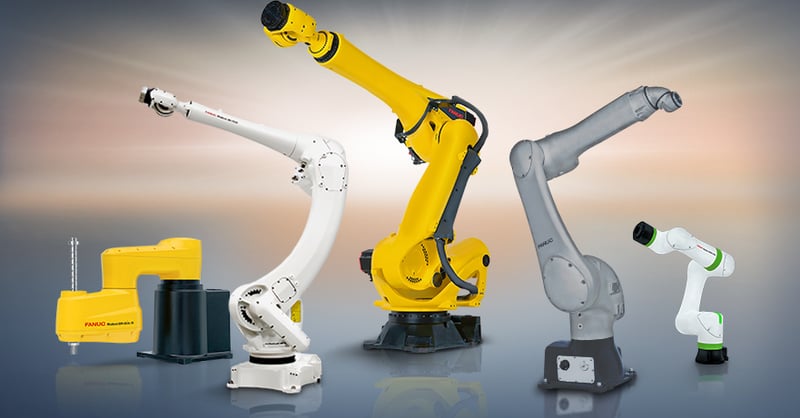
FANUC America’s Automate 2026 message is not just that robots are getting more capable. The more important signal is that robot vendors are trying to package perception, motion, and operator interaction into workflows that factories can actually deploy.
The company says its Automate 2026 booth will feature physical-AI and AI-enabled robotics demos, including flexible automation, 3D vision, bin picking, cobot applications, and systems aimed at adapting to real production variation. For TVG Report, the useful question is not whether “AI robots” sound impressive. It is whether these systems reduce the amount of custom engineering required after the trade-show demo ends.
Why it matters
Traditional industrial robots are powerful but brittle. They excel when parts arrive in known positions, tooling is controlled, and the workcell is engineered around repeatability. The harder problems—mixed bins, variable part presentation, inspection, human handoff, and fast changeovers—usually require cameras, custom fixtures, safety analysis, and a lot of integrator time.
Physical AI is the industry’s shorthand for closing that gap. In a credible factory workflow, perception is not an add-on camera bolted to a robot arm. It becomes part of the control loop: the robot sees a part, estimates pose, selects a grasp, moves safely, and recovers when the scene does not match the expected script.
Technical breakdown
FANUC’s announcement points toward a stack built around vision-guided robotics, AI-assisted programming, cobot deployment, and real-time adaptation. That is the right direction for manufacturers that want automation without rebuilding every line around one perfectly staged task.
The engineering challenge is still substantial. A bin-picking demo may work well with clean lighting, known parts, and a controlled feeder. Production floors add oil, dust, glare, damaged parts, operator interruptions, and mixed SKUs. The AI portion can help with perception and decision-making, but the robot cell still needs mechanical design, safety validation, cycle-time tuning, and maintenance procedures.
Impact for factories and integrators
For integrators, FANUC’s push matters because it suggests the major robot suppliers are trying to make advanced perception less bespoke. If a vendor can provide repeatable building blocks for 3D picking, inspection, and cobot handling, smaller manufacturers may be able to justify automation projects that previously required too much engineering overhead.
For factory teams, the practical benefit is not “robots with AI” as a slogan. It is faster commissioning, fewer hard fixtures, and better recovery from small variations. Those are the points that determine whether a robot cell stays productive after the launch week.
Risks and unknowns
The unknowns are the same ones that separate a good booth demo from a reliable production system: lighting tolerance, failure recovery, cycle time, operator training, support cost, and the ability to document safety behavior. Buyers should ask for examples in comparable environments, not just polished demonstrations.
TVG Take
FANUC is right to frame physical AI as workflow technology rather than magic. The factories that benefit first will be the ones with clear, bounded tasks: picking, sorting, inspection, machine tending, and cobot assistance. The winners will not be the flashiest demos; they will be the systems that make setup, recovery, and support boring enough for everyday production.
What to watch next
The next proof point will be case studies that show uptime, rejected-part rates, changeover time, and maintenance burden. A factory buyer should ask whether the same vision model or workflow can be retuned by plant staff, or whether every product change requires a specialist visit. That support model may matter more than the robot arm itself.
There is also a workforce angle that deserves practical treatment. Physical-AI cells will still need technicians who understand tooling, sensors, safety zones, and recovery procedures. The strongest vendors will package training with the robot workflow, not leave factories to interpret AI outputs on their own.
FANUC Automate 2026 FAQ
What does physical AI mean in this context?
For factory robotics, physical AI usually means combining perception, motion, task logic, and operator interaction so a robot can handle more variation than a fixed scripted cell.
What should integrators ask after a demo?
Ask how the system handles lighting variation, part changes, safety validation, cycle-time guarantees, operator training, failure recovery, and the amount of custom integration still required.
Why does this matter for smaller manufacturers?
If physical-AI tooling reduces setup friction, smaller manufacturers may be able to automate more variable tasks. If it still requires heavy custom engineering, the trade-show demo may not translate into a practical deployment.
Related TVG reading
- Robot safety standards for moving machines
- CODESYS and software-defined factory control
- CAN bus basics for robotics projects