Product summary
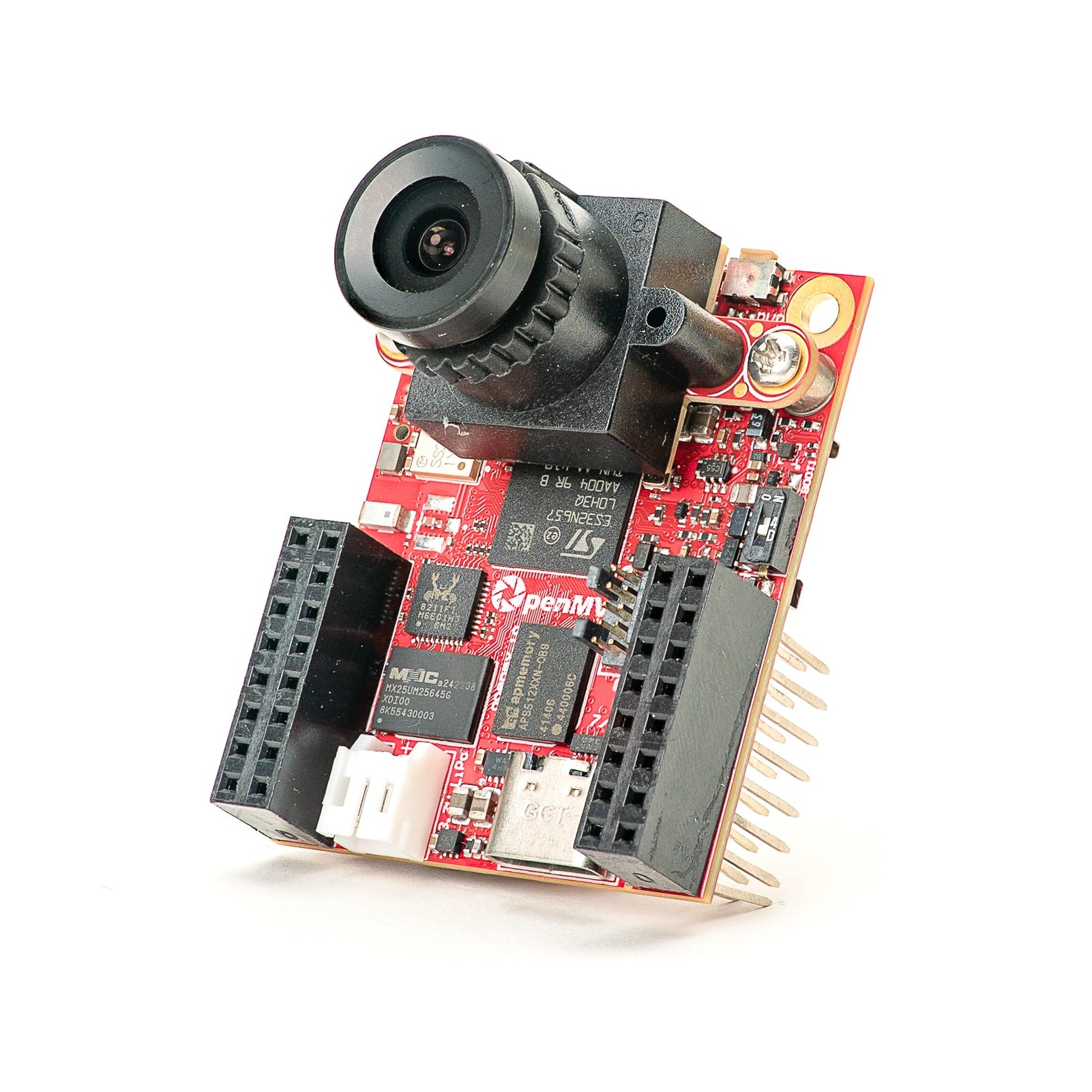
The OpenMV N6 is a compact, MicroPython-programmable machine-vision board built around STMicroelectronics’ STM32N657. Its headline hardware combines an 800 MHz Cortex-M55, a 1 GHz Neural-ART accelerator rated at 600 GOPS INT8, 64 MB of external SDRAM, 32 MB of flash, and a removable PAG7936 1 MP global-shutter camera module.
That combination is more interesting than the accelerator number alone. OpenMV is trying to package capture, inference, scripting, storage, wired and wireless networking, motion sensing, and battery support into one 45 × 35 mm board. The official documentation says the N6 can run YOLOv8 or YOLOv11 detection at 30 frames per second while streaming live video. That is a vendor-documented result, not a TVG benchmark, and model input size, preprocessing, post-processing, overlays, and network traffic all matter.
As checked on September 30, 2026, OpenMV listed the board at $195, available for backorder, with an expected early-October delivery for an incoming batch. Availability can change quickly. The product page also says the headers do not arrive pre-soldered, an important detail for classrooms and teams expecting a ready-to-wire appliance.
Who it is for
The N6 is aimed at builders who want more vision performance than a conventional microcontroller camera but do not want to deploy a Linux single-board computer for every node. Likely fits include mobile robots, machine-monitoring prototypes, smart fixtures, motion-triggered data loggers, low-power wildlife or lab instruments, and advanced STEM labs teaching embedded vision.
It is especially relevant to teams already comfortable with Python but still needing deterministic GPIO access, a small physical footprint, fast boot behavior, and local inference without a cloud connection. It is less obviously suited to buyers who need polished enclosure-ready hardware, a turnkey industrial camera, 5 V-tolerant I/O, or a mature Linux software stack with broad package support.
Technical specs and design signals
Compute and memory
The STM32N657 pairs its Cortex-M55 core with Helium vector extensions and the dedicated NPU. OpenMV specifies 4.2 MB of internal SRAM, 64 MB of external SDRAM, and 32 MB of octal flash. Official documentation describes a read-only ROM filesystem for bundled models, allowing models to be memory-mapped rather than copied into working RAM. That architecture could leave more memory available for live framebuffers and application logic, although usable headroom still depends on the exact model, frame size, and pipeline.
Camera and imaging path
The included PAG7936 is a 1280 × 800 color global-shutter sensor on a removable carrier. OpenMV lists 120 FPS at 1280 × 800, 240 FPS at 640 × 400, and 470 FPS at 320 × 200 for the sensor. Those sensor readout rates should not be confused with full application throughput: inference, exposure, copies, encoding, storage, and transport can each become the limiting stage.
Global shutter is a meaningful design signal for robotics because it avoids the line-by-line geometric skew associated with rolling-shutter capture during fast motion. The removable M12-lens camera module also leaves focus, lens choice, distortion, field of view, and mechanical retention dependent on the selected setup rather than fixed at the board level. OpenMV lists a 2.8 mm F2.0 lens with a roughly 68.8-degree horizontal field of view on the included sensor.
I/O, storage, networking, and power
- High-speed USB-C documented at 480 Mb/s
- Gigabit Ethernet PHY, with an external jack or PoE shield needed for a practical cable connection
- Wi-Fi a/b/g/n and Bluetooth 5.1, with chip-antenna and U.FL options
- microSD storage, two SPI buses, I2C/I3C, UART, PWM, ADC, and 18 interrupt-capable 3.3 V I/O pins
- Onboard microphone, accelerometer/gyroscope, real-time clock, LiPo charging, and battery-voltage monitoring
The breadth is useful, but integration details matter. The N6’s GPIO is explicitly not 5 V tolerant, and the documentation says the board should be powered through VIN rather than through its 3.3 V pins. OpenMV lists 150 mA at 5 V, or 0.75 W, at full power and about 1.6 mA from a 3.7 V battery in deep sleep. Those are manufacturer figures rather than independently measured application power, and real use will vary with capture, inference, networking, idle time, and wake behavior.
A software platform in transition
The current OpenMV firmware v5.0.0 changelog describes a substantial platform update: MicroPython 1.28, a rebuilt host protocol, simulator targets, new machine-learning support, and a class-based csi.CSI camera API. It also documents breaking changes for older scripts that used the legacy sensor interface. Buyers evaluating years of tutorials should check examples against their installed firmware rather than assuming old code will run unchanged.
One concrete gap is CAN. The hardware pin map exposes CAN1 signals, but the N6 quick reference says CAN is not yet supported on this board in firmware v5.0.0. That distinction between silicon capability, routed pins, and usable firmware support matters when selecting the board for a current design.
Who should consider it
The strongest prospective users are robotics teams, advanced maker labs, embedded-vision developers, and educators who value MicroPython access and a tightly integrated sensor-to-inference path. It also looks useful as an evaluation board for the STM32N6 when a team wants working camera hardware and examples instead of starting from a bare MCU design.
Buyers should look elsewhere—or at least prototype cautiously—if they require certified industrial housings, 5 V-tolerant field I/O, guaranteed CAN support today, high-resolution inspection imagery, Linux packages, or a finished network-camera appliance. The N6 is a developer platform, and its value depends on whether its software and peripheral details align with the intended deployment.
TVG Take
The OpenMV N6 is a credible attempt to make high-rate edge vision feel like embedded Python rather than a miniature Linux deployment. Its global-shutter sensor, removable camera module, NPU, storage, networking, IMU, and low-power features form an unusually complete robotics platform on paper.
The deciding question is not whether 600 GOPS sounds fast. It is whether OpenMV’s firmware turns that silicon into repeatable capture-to-action performance without forcing builders to fight memory limits, API churn, power noise, or accessory gaps. Without independent hands-on measurements, the N6 is best treated as a technically promising developer board rather than a proven deployment platform. Its documented strengths are unusually broad for a microcontroller-class camera, but teams should confirm that the current firmware, I/O limits, camera resolution, and accessory requirements fit the intended system.