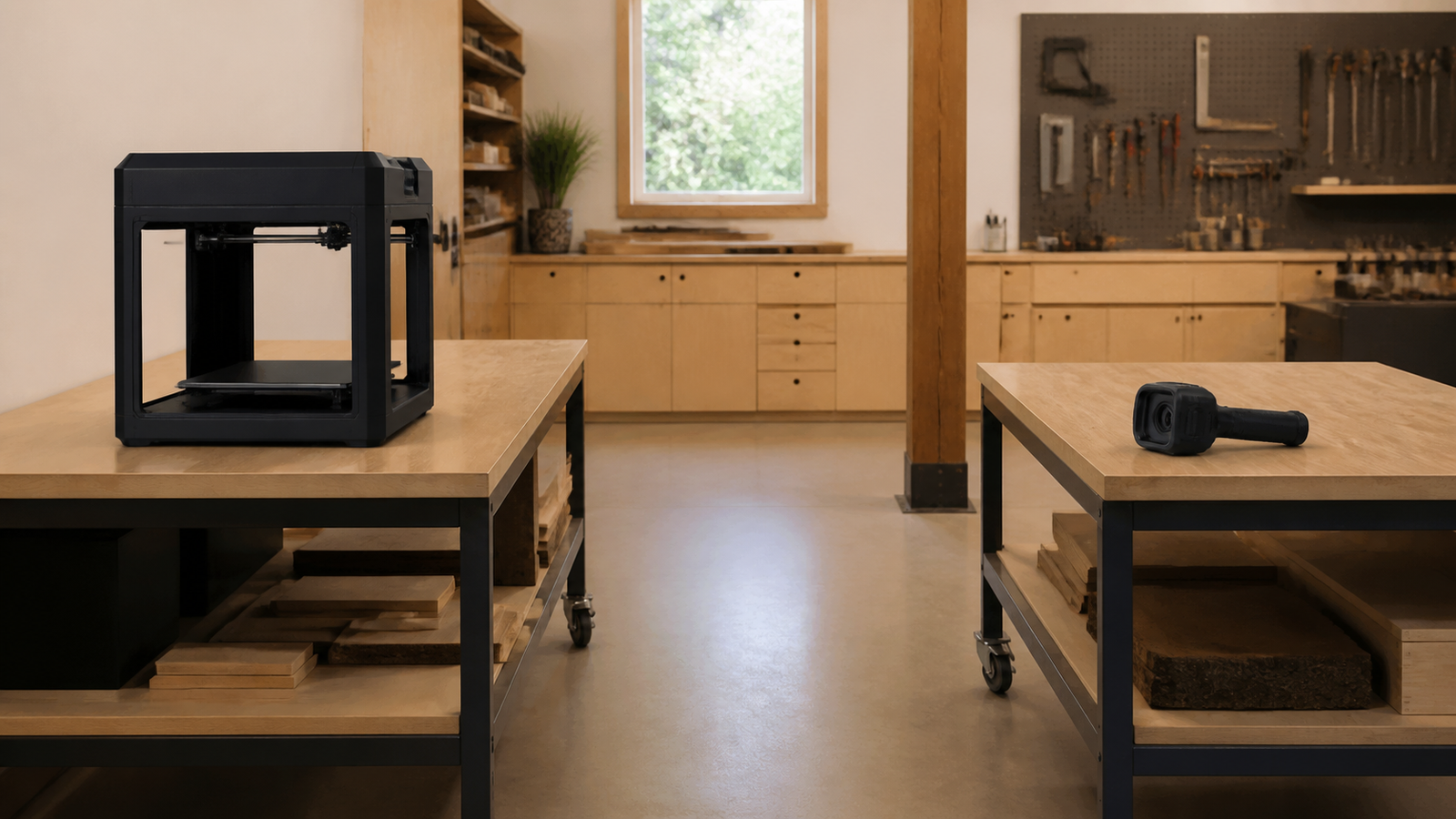
A thermal camera is better at showing patterns; an infrared thermometer is better at making a quick spot check. Neither tool automatically reports the true temperature of every 3D-printer surface. Shiny metal, viewing angle, distance, target size, and emissivity can all mislead a non-contact reading.
This is a buyer evaluation, not a hands-on product review. TVG did not test a specific camera or thermometer for this article. The goal is to choose the class of tool that matches the fault you are trying to find.
Quick comparison
- Choose a thermal camera when you need to see bed uniformity, connector hot spots, airflow patterns, or the location of an unexpected heat source.
- Choose a spot IR thermometer for lower-cost repeat checks on a known, sufficiently large, matte target.
- Use a contact probe when surface emissivity or target size makes non-contact readings unreliable and safe access is possible.
- Do not use either tool as permission to touch energized terminals or defeat printer safety systems.
The camera’s advantage is spatial context
A thermal camera maps many measurement points into one image. On a build plate, that can reveal a cold corner, a heating pattern around an element, or a gradient near an open enclosure. On electronics, it may help locate one connector that is warmer than adjacent parts under the same load.
Resolution matters. A small sensor spread across the whole printer may assign only a few pixels to the connector you care about. Focus, minimum distance, thermal sensitivity, and export options can matter more than a long temperature-range claim.
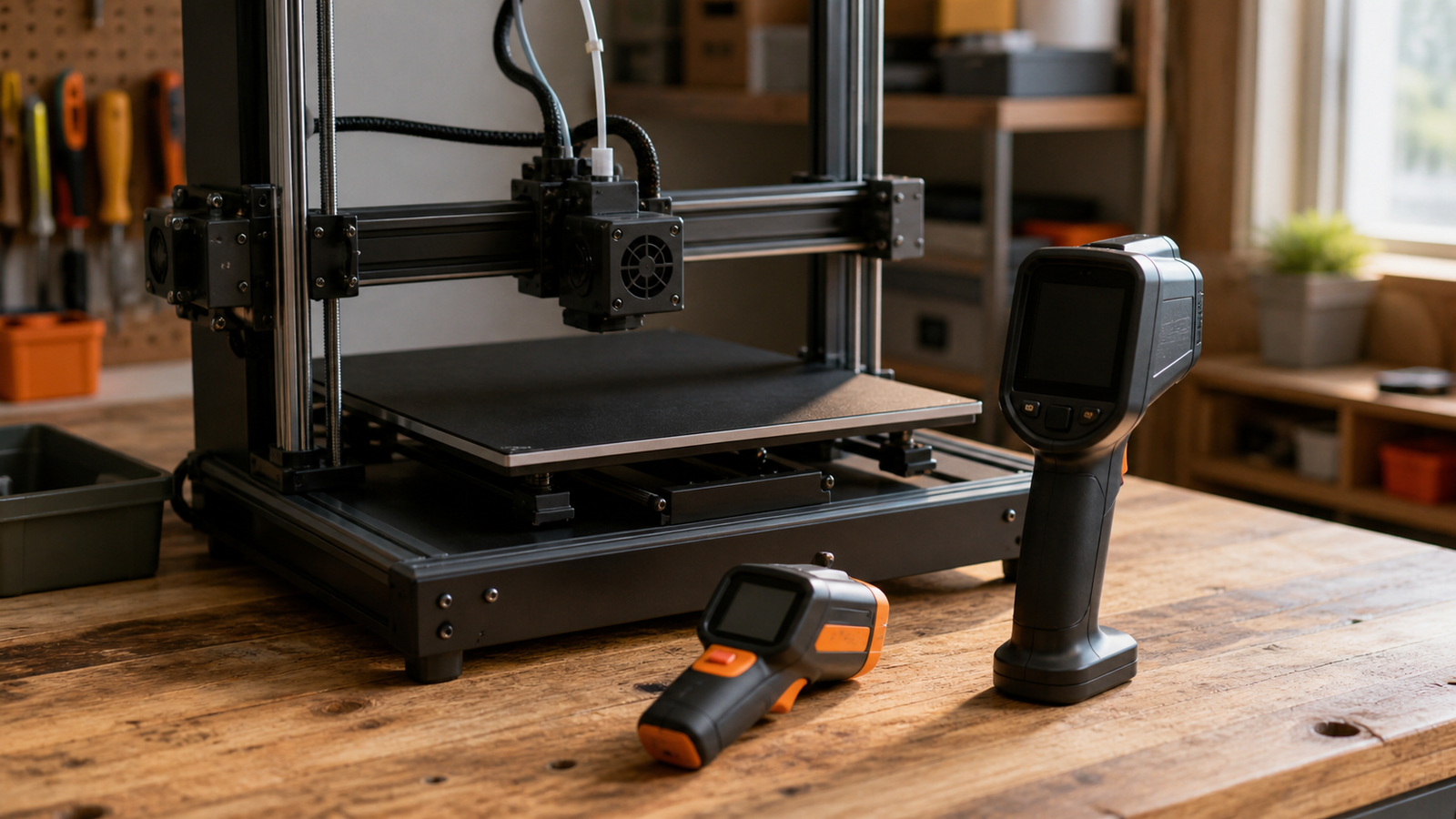
Where a spot thermometer still wins
A spot IR thermometer is fast, inexpensive, and easy to repeat. It can answer questions such as whether the same matte patch on an enclosure is warmer after a fan change. The key limitation is the distance-to-spot ratio: the instrument averages an area, and that area grows with distance. If the target is smaller than the measured spot, the background contaminates the result.
That makes a spot tool a weak choice for tiny screw terminals, narrow heater traces, or individual components. A laser dot shows aim, not necessarily the full sampled area.
Emissivity is the shared trap
FLIR’s emissivity guidance explains why surfaces emit infrared energy differently. Matte polymer and painted surfaces are often easier to measure than bare aluminum, polished steel, or reflective foil. A shiny object can reflect the apparent temperature of the room, the operator, or a nearby heater.
For comparisons, use the same surface, distance, angle, load, and warm-up time. A small patch of suitable high-emissivity tape can create a repeatable target where material and electrical safety allow. Do not place tape on moving parts, heater contacts, or surfaces beyond its temperature rating.
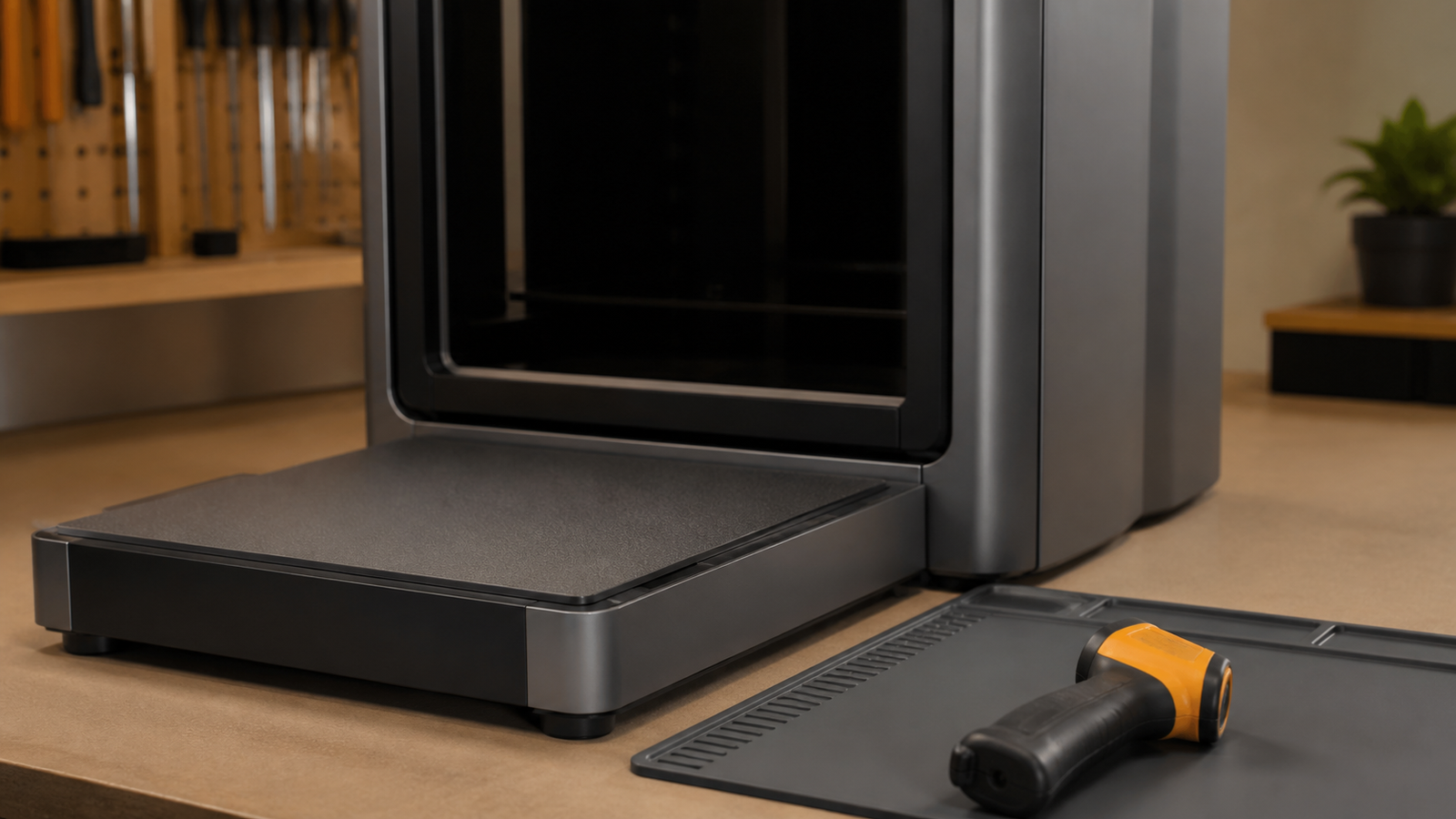
Safety systems come first
Marlin’s configuration documentation describes firmware checks intended to detect heating behavior that departs from expectations. Prusa’s thermal-runaway guidance likewise treats the warning as a fault to investigate, not an alert to bypass.
Thermal imagery can help locate evidence, but it does not certify a repair. If a terminal is discolored, an insulation path is damaged, or a heater circuit behaves unpredictably, disconnect power and follow the manufacturer’s service process. Mains-powered beds and power supplies add shock and fire hazards beyond ordinary maker troubleshooting.
Buyer checklist
For a camera, compare detector resolution, focus, minimum measurement distance, emissivity adjustment, radiometric image export, battery replacement, and software support. For a spot thermometer, compare distance-to-spot ratio, adjustable emissivity, repeatability, response time, and the temperature range you actually need.
Also budget for a reference contact probe when accuracy matters. Two non-contact tools can agree and still share the same emissivity error.
TVG Take
A thermal camera is the more informative first choice for a shared printer lab because it shows where to investigate. A spot thermometer remains useful for routine checks on defined targets. Buy measurement context before headline range, and document the surface conditions with every reading.
For related heat-management planning, see TVG’s 3D-printer enclosure and filament-drying checklist.