
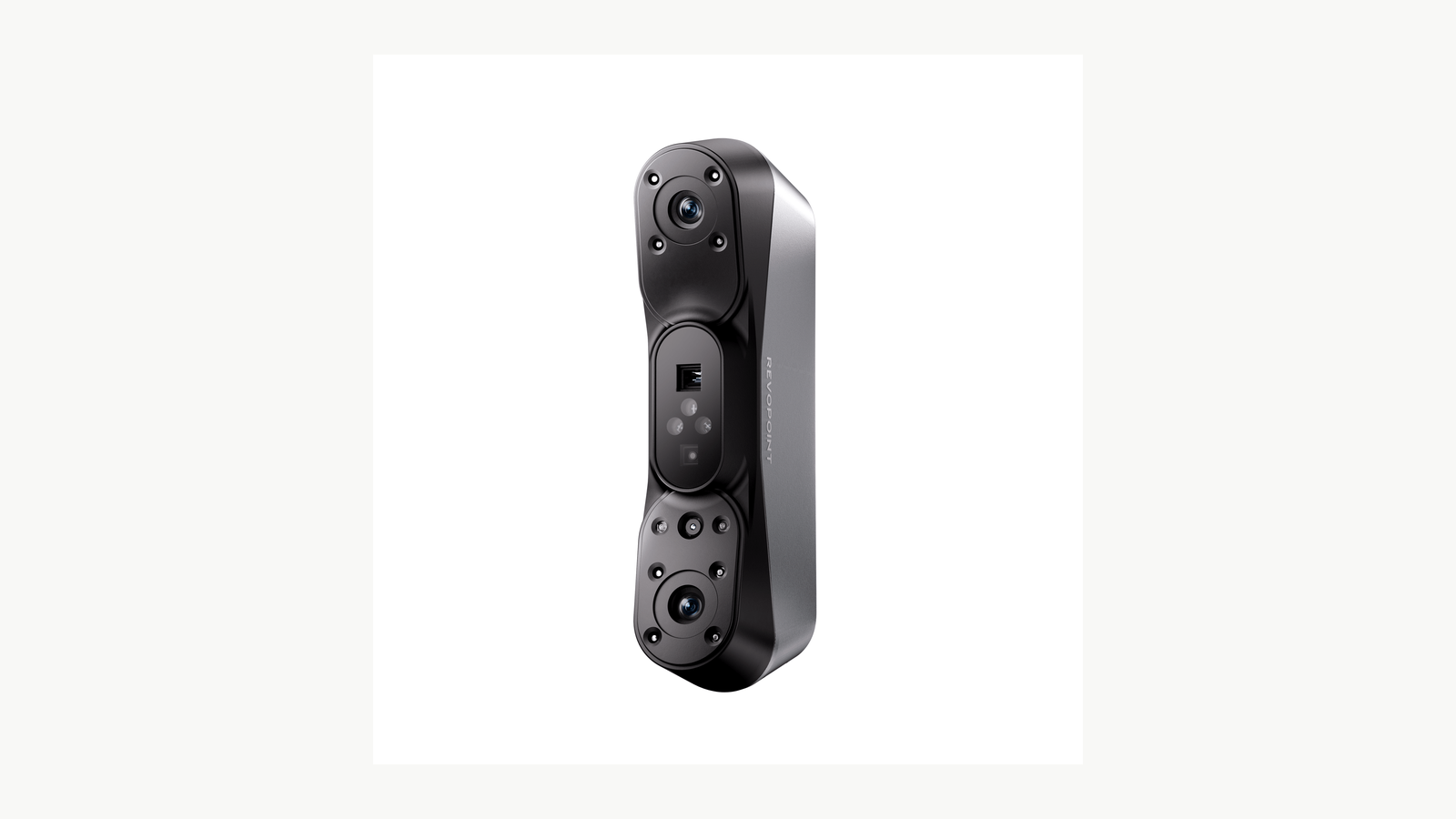
Revopoint’s POP 4 has the right shape for a TVG project-watch article: it is a real 3D-scanner product/campaign with maker-lab appeal, a broad spec sheet, and enough uncertainty that buyers should evaluate it as a workflow fit rather than a guaranteed shortcut.
The official Revopoint POP 4 product page describes the scanner as an AI-powered wireless hybrid 3D scanner combining blue laser and infrared capture. Revopoint lists five scanning modes, wireless operation for infrared scans, compatibility across Windows, macOS, iOS, and Android, real-time AI object segmentation and tracking, photorealistic 3D Gaussian Splatting, volumetric accuracy of 0.03 mm + 0.05 mm × L(m), laser scanning up to 105 fps, and outdoor scanning claims up to 100,000 lux. The company’s homepage also says POP 4 has raised more than $2.6 million on Kickstarter from more than 3,300 backers.
Those are attractive numbers for makers, educators, prop builders, reverse-engineering hobbyists, and small studios. They are also exactly the kind of numbers that need context before a lab budgets around them.
Disclosure: this is not a hands-on review
TVG has not tested the Revopoint POP 4, has not received a review unit, and has not measured its scan accuracy, tracking behavior, software reliability, or outdoor performance. This article is a buyer evaluation and project-watch checklist based on public Revopoint materials, Kickstarter discovery signals, and TVG’s 3D-scanning workflow coverage.
Why the hybrid sensor stack matters
Portable 3D scanners usually force tradeoffs. Infrared structured-light scanning can be convenient for faces, bodies, and general objects, but some surfaces remain difficult. Blue laser scanning can help with detail capture, edges, and more challenging surfaces, but it may require markers, steadier technique, stronger compute, or a more controlled workflow. A hybrid design is useful only if switching modes is quick enough and the software merges results cleanly.
That is the first thing maker labs should test. A spec sheet can list multiple scanning modes, but the real question is whether students, technicians, or creators can move from “object on bench” to “usable mesh” without spending the afternoon fighting tracking loss, calibration drift, or cleanup artifacts.
TVG’s earlier guide to 3D scanner accuracy specs for maker labs explains why published accuracy numbers do not automatically predict real scan quality. Accuracy depends on object size, distance, surface finish, lighting, tracking, alignment, calibration, and the software pipeline after capture.
Specs to verify before backing or buying
- Accuracy conditions: Ask what object size, distance, markers, surface type, lighting, and post-processing were used for the listed accuracy claim.
- Mode switching: Test whether blue laser, infrared, and full-field modes are separate workflows or a smooth combined pipeline.
- Dark and shiny surfaces: Try black plastic, glossy parts, machined metal, translucent resin, and printed fixtures.
- Outdoor use: The claimed high-lux operation should be tested on the actual field schedule, not just near a window.
- Wireless limits: Confirm which modes work wirelessly and which require a PC or tethered compute path.
- Mesh cleanup: Measure time from scan to printable, CAD-reference, or game-ready mesh.
- Software licensing: Check whether any measurement, design, export, or cloud features require paid add-ons.
- Support lifecycle: Look for firmware update cadence, replacement cables, calibration tools, and documented troubleshooting.
Who POP 4 may fit
POP 4 looks most relevant for maker labs that need a portable scanner for small-to-medium objects, body or face scans, classroom demonstrations, costume/prop work, repair references, and rough reverse-engineering workflows. The official page’s mix of blue laser and infrared modes suggests a tool aimed at users who want one device to cover more surfaces rather than a narrow metrology instrument for one controlled job.
It may be less suitable if a lab needs certified inspection, repeatable industrial measurement, very large assemblies, or fully predictable CAD-grade reverse engineering with minimal cleanup. For those jobs, the scanner is only one part of the cost; fixtures, markers, calibration artifacts, surface prep, software training, and validation time matter just as much.
TVG has also compared phone LiDAR versus handheld 3D scanners. POP 4 sits in the “dedicated scanner” lane, where the purchase only makes sense if the team will use the extra capture modes, not just scan objects occasionally for quick visualization.
Crowdfunding and launch risk
Even when a company has prior products, campaign coverage should be treated carefully. Crowdfunding specifications, prices, delivery timing, software features, and final quality can change. Backers are not buying from a normal retail shelf with the same return path and support expectations. Revopoint’s official product page is live, but labs should still confirm shipping region, warranty, taxes, software terms, and what happens if campaign bundles differ from retail units.
A safe procurement path is to avoid building a semester, client job, or production workflow around an unrevealed delivery date. If the scanner is essential, wait for independent hands-on testing or buy only when the team can tolerate delays and workflow rework.
What TVG would test first
If TVG had POP 4 on the bench, the first tests would be practical rather than theatrical: a matte 3D print, a glossy black injection-molded part, an aluminum bracket, a small textured object, a face/body scan with consent, and an outdoor scan under hard light. We would track setup time, lost tracking events, marker requirements, mesh cleanup time, export compatibility, phone versus PC behavior, and whether claimed high-speed scans reduce total workflow time.
The scanner’s strongest promise is not one headline number. It is the possibility of a portable tool that moves between classroom, workshop, field, and studio with fewer compromises than older entry-level scanners. The risk is that “hybrid” becomes a longer menu instead of a simpler job.
TVG Take
Revopoint POP 4 is worth watching because it targets a real gap: makers want better-than-phone scans without stepping into expensive industrial systems. The buyer question is whether the scanner’s multiple modes produce reliable results on the messy parts people actually scan. Before backing or buying, evaluate the whole path from object prep to cleaned mesh. If that path is predictable, POP 4 could be a useful lab tool. If it is not, the spec sheet will not save the workflow.

That’s a really good rundown of the key things to check. I’m especially interested in how the accuracy holds up over longer scans – it would be great to see some data on that.