Quick answer: First confirm whether the sensor uses Matter over Thread or Matter over Wi-Fi. Then record the battery, environment, event rate, firmware and connectivity history before changing hardware. For a Thread device, change one network variable at a time.
First identify the transport
Matter and Thread are not interchangeable names. Matter is an IP-based smart-home standard that can run over Thread, Wi-Fi or Ethernet. Thread is the low-power IPv6 mesh commonly used by battery sensors. A Thread topology investigation does not apply to a Matter-over-Wi-Fi device.
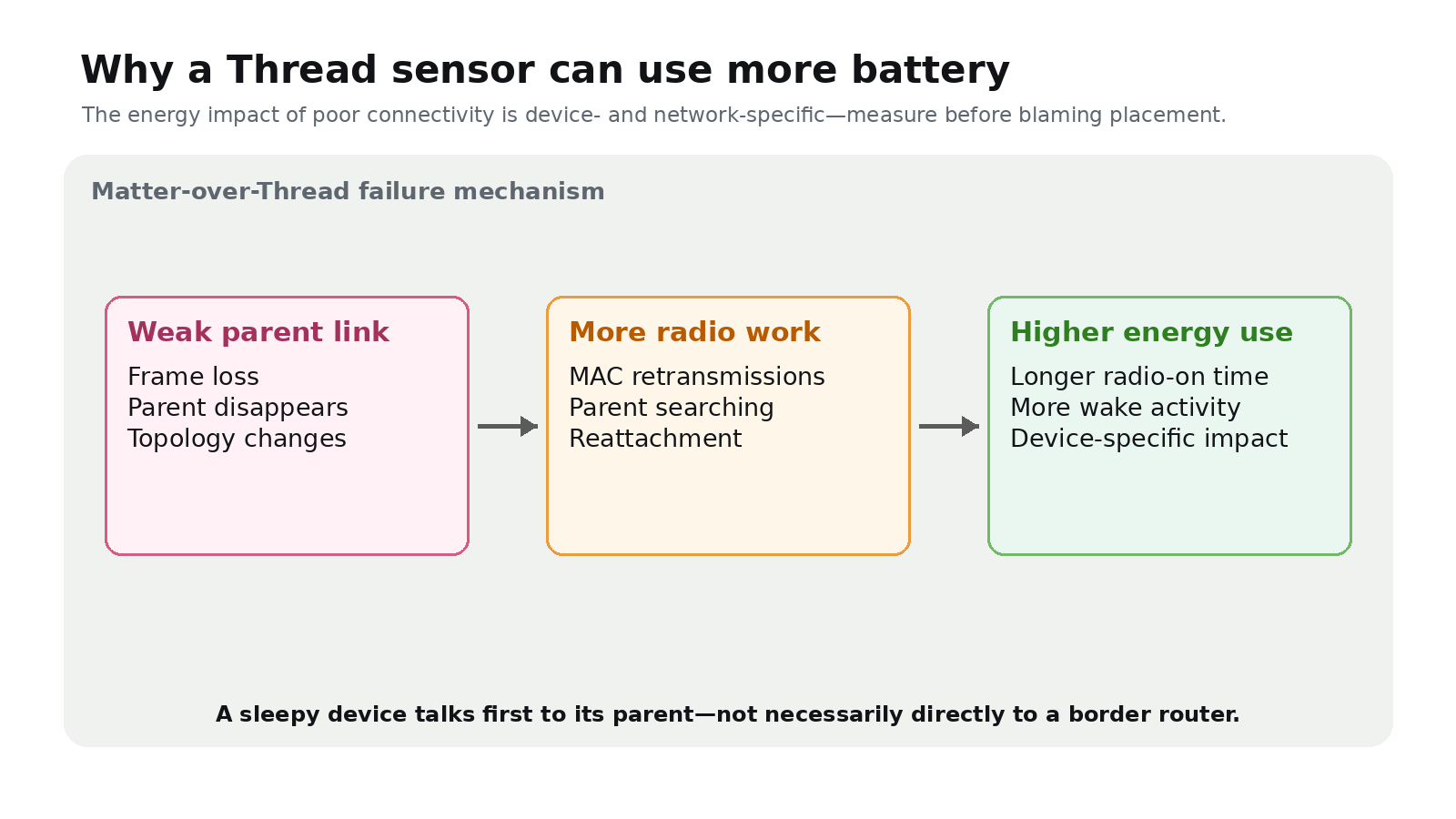
Battery-powered Thread sensors are typically Sleepy End Devices. They keep the radio off much of the time, wake to poll, and communicate through a parent router. A border router connects the Thread network to other IP networks; it is not necessarily the sensor’s direct radio neighbor.
Record evidence that can separate the causes
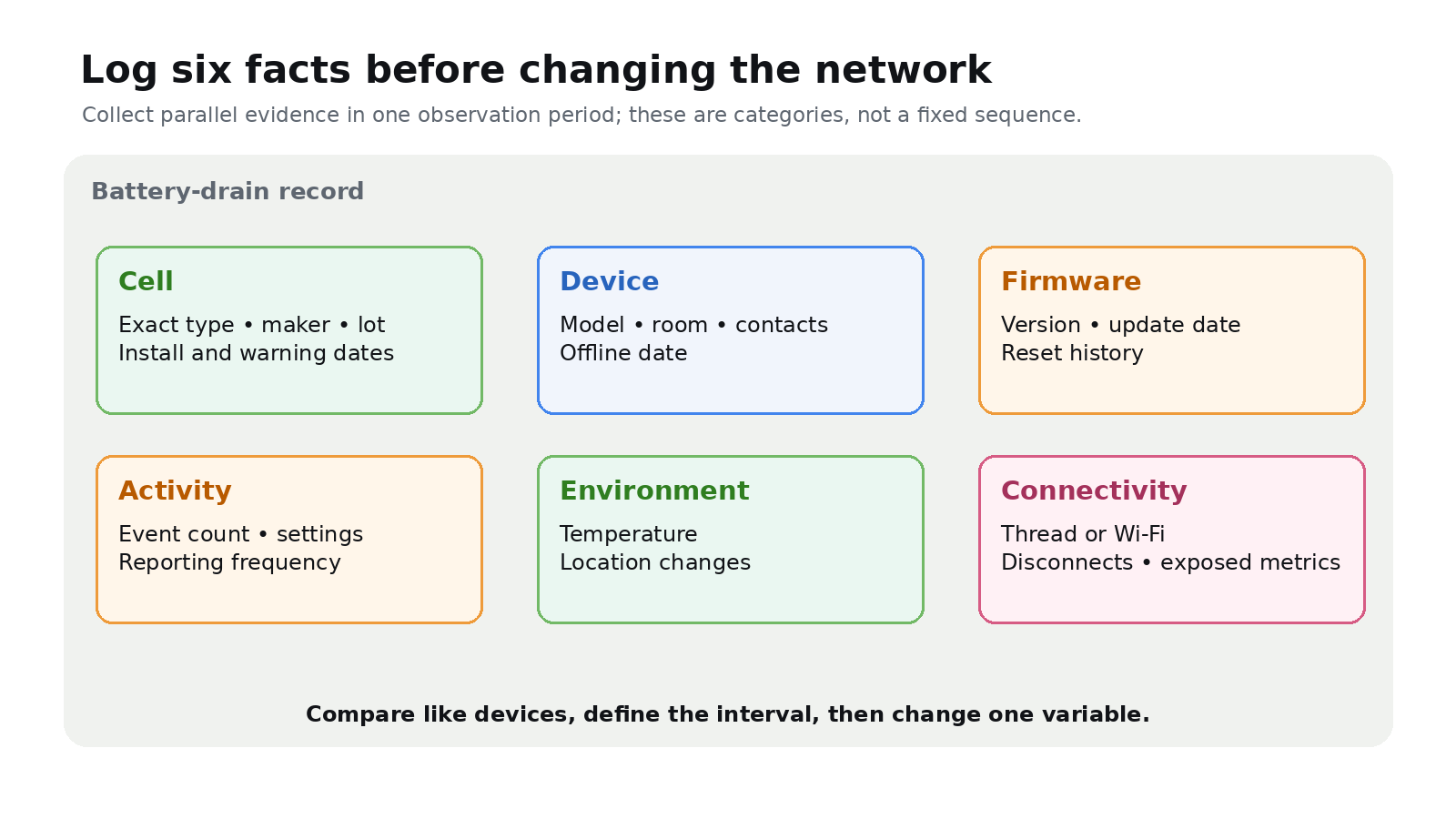
- device manufacturer, model, asset ID and room;
- whether the transport is Thread or Wi-Fi;
- battery manufacturer, exact type or chemistry, marked expiry or lot, package source and installation date;
- low-battery warning date, offline date and replacement date as separate events;
- firmware version and update date;
- ambient temperature and device-specific event or reporting settings;
- disconnects, commissioning failures and any router, border-router or device move;
- parent, link quality, RSSI or retransmission data only if the platform exposes it.
Use only a battery type approved by the sensor maker and consult the exact cell’s datasheet for load and temperature behavior.
Use the pattern to choose the next check
If abnormal drain follows one sensor across locations while comparable devices remain stable, inspect its contacts, approved battery fit, firmware and vendor support history. If several sensors begin failing after the same firmware release, preserve version and date information before resetting anything.
If problems cluster by location or begin after a Thread topology change, investigate connectivity. Nordic Semiconductor identifies MAC retransmissions and parent searching as contributors to Matter-over-Thread energy use. Their effect is device- and network-specific, so a floor plan or distance estimate is a clue—not proof.
Event rate also matters only in context. Compare like devices with the same settings instead of assuming every event has the same cost.
Change one variable
Start the next observation period with the same approved battery type and a timestamp. Choose one intervention: replace the cell, correct a contact problem, move the sensor, change a reporting setting, update firmware, or alter Thread coverage. Define the observation interval in advance and record low-battery and offline events separately.
The record may not expose every radio metric, but it can show whether the symptom follows the cell, sensor, room, update or topology change—and give the vendor usable evidence if the drain continues.