TVG has not received a review unit for this article; this analysis is based on manufacturer specifications, official product information, public documentation, and TVG’s engineering review criteria.
Product Summary
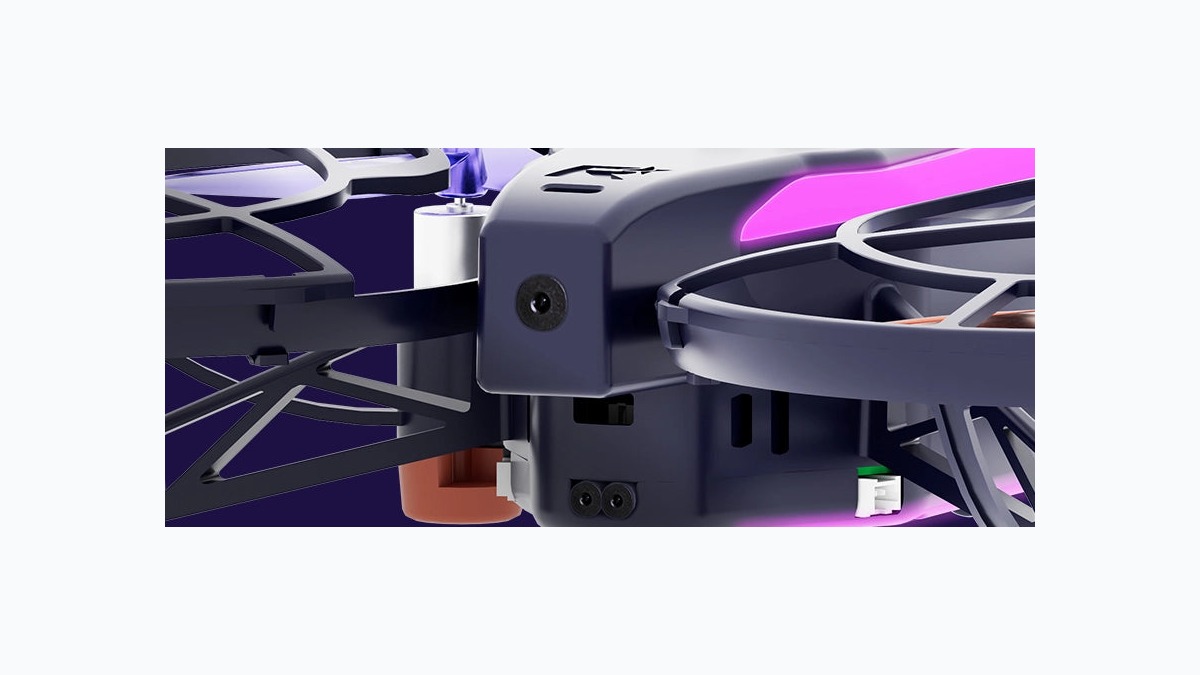
The Robolink CoDrone EDU Plus is the 2026 iteration of the popular classroom drone platform, shifting from simple flight mechanics to advanced computer vision and AI learning. Recognized as a CES 2026 Innovation Awards Honoree, the Plus model introduces dual programmable cameras (front and bottom-facing) to a compact, indoor-safe airframe designed for middle and high school engineering programs.
Who It Is For
This platform targets STEM educators and student “makers” who have outgrown basic block-based flight and want to tackle real-world robotics challenges like object classification, autonomous landing on moving targets, and visual SLAM (Simultaneous Localization and Mapping) within a constrained, classroom-safe environment.
Technical Specs and Design Signals
- Sensors: Dual programmable cameras, 3-axis gyroscope, 3-axis accelerometer, barometer, and infrared range sensors.
- Connectivity: Enhanced 2.4GHz radio with stable multi-drone pairing for classroom swarms.
- Programming: Tiered support for Blockly (beginners) and Python (advanced), with custom libraries for computer vision.
- Design: Modular guards protect rotors during collision, while the clear chassis provides “visible engineering” for students to inspect the internal PCB and sensor layout.
What TVG Would Test
If we get this in the lab, our first tests wouldn’t be about speed, but about sensor fusion reliability. We would specifically evaluate the latency of the bottom-facing camera when performing optical flow for position holding and the frame rate of the front-facing camera during real-time object detection in Python. We also want to verify the “repairability score”—how easily a student can swap a motor or a guard after the inevitable first-flight crash.
Failure Points / Risks / Unknowns
The primary risk with dual-camera drones in this weight class is battery life vs. compute load. Running onboard object detection is power-intensive; we would be looking for how much flight time is sacrificed when the AI features are fully engaged. Additionally, the software transition from Blockly to Python can often be rocky if the library abstractions are too thick or poorly documented.
Who Should Consider It
Programs looking for a direct path from “flying robot” to “AI vision platform” should prioritize the EDU Plus. It bridges the gap between toy drones and complex, unshielded DIY racing quads that are often too dangerous for a standard school lab.
TVG Take
The CoDrone EDU Plus signals that “STEM Drones” are finally moving past the novelty phase. By integrating dual cameras and serious computer vision tools, Robolink is positioning this not as a toy, but as a flying edge-AI node. For labs focused on the intersection of robotics and machine learning, this is the hardware signal to watch in 2026.
What to watch next
For readers following this topic as an engineering problem, these related TVG Report pieces are the best next context:
- Spec Review: Arducam’s Pico4ML Pro Targets On-Device AI Workflows
- Spec Review: Raspberry Pi 500+ Looks Like a Better Lab Keyboard PC, If the Workflow Fits
- Raspberry Pi’s New Python Projects Book Fills the STEM Gap After Beginner Tutorials

That’s a really interesting piece – it’s fantastic to see how easily computer vision is becoming accessible for education.