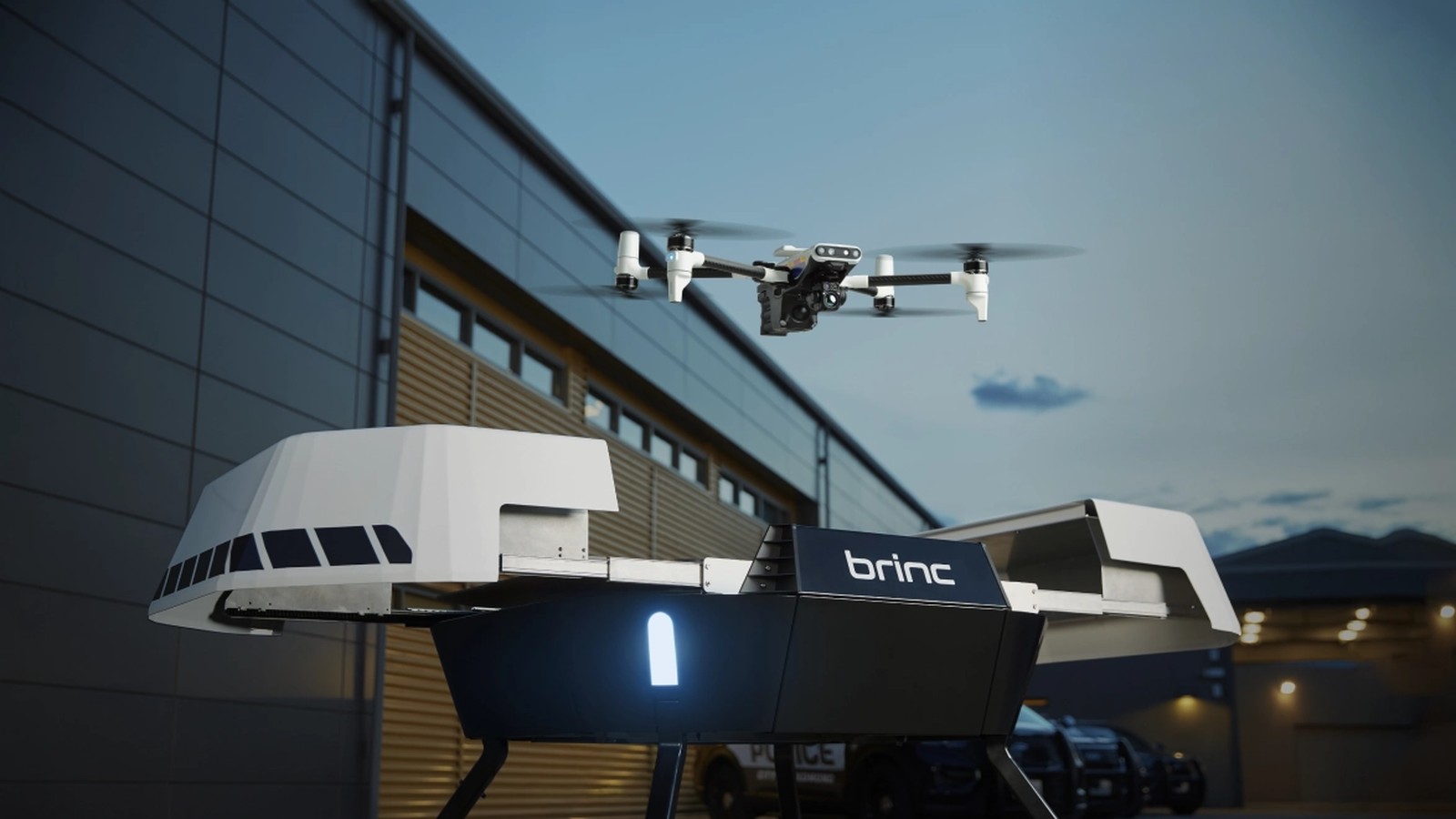
BRINC said Tuesday that it has raised $125 million in a financing round led by Motorola Solutions, with participation from Index Ventures and Figma founder and CEO Dylan Field. The Seattle public-safety drone company said the capital will support its goal of putting 911 response drones on police and fire station roofs across the United States.
The company’s own announcement says the round brings total capital raised to well over a quarter billion dollars. BRINC also says it plans to expand domestic manufacturing, bring new products to market, and move into a facility three times the size of its current factory by the end of the year.
That makes this more than another drone funding headline. For public-safety agencies, the hard part is not proving that a drone can arrive before a patrol car or fire crew. The hard part is making the system repeatable: charging, launch authority, connectivity, video routing, pilot oversight, maintenance, evidence handling, airspace rules, and after-action review.
What BRINC says the money is for
BRINC frames the funding around “911 response drones,” also known in the industry as drone-as-first-responder programs. The company says the investment is intended to help deploy drones at roughly 80,000 police and fire stations in the United States. It also points to domestic manufacturing capacity as a major use of the new capital.
The company’s Responder product page describes the drone as a platform for automated DFR systems, patrol-led approaches, or manual deployment. In practical terms, that means agencies may use the same hardware in different operating models: a fixed station launch, an officer-controlled response, or a more conventional manually piloted deployment.
DroneDJ and The Drone Girl both highlighted Motorola Solutions’ role in the round, which matters because Motorola already sells into public-safety communications and command-center environments. A drone program that plugs into dispatch and incident-management workflows has a different path than one sold as a standalone aircraft kit.
Why it matters
Public-safety drones sit at the intersection of aircraft engineering, communications, video, software permissions, and local policy. A reliable program has to work at night, in poor connectivity, during shift changes, and under records-retention rules. It also has to survive boring operational failures: a charging dock that does not seat correctly, a firmware update that changes behavior, a camera feed that drops, or a weather threshold that is not obvious to the dispatcher.
That is why funding tied to manufacturing and deployment scale is important. Agencies are not only buying airframes. They are buying an operating model.
TVG Analysis
The technical signal to watch is whether BRINC can turn public-safety drone deployments into a standardized field workflow. The company’s funding gives it more room to build inventory, support, and new products, but the outcome will depend on integration details: dispatch handoff, remote identification compliance, secure video access, maintenance cadence, evidence chain-of-custody, and clear rules for when a drone should not launch.
For robotics teams, this is a useful case study in physical AI and automation adoption. The aircraft is only one layer. The control room, network link, charging station, audit log, training process, and support contract decide whether a drone remains a demo or becomes part of daily emergency response.
BRINC has not announced every product detail tied to the new capital, and local agencies will still have to justify policies, budgets, and community oversight. TVG will be watching whether the next wave of deployments publishes uptime, response-time, maintenance, and incident-review data rather than only launch-count milestones.
Sources
Related TVG reading: DJI Osmo 360 spec review for field teams and action camera storage specs for robotics and maker field tests.