Disclosure: TVG has not tested or benchmarked VENTUNO Q. Specifications and capabilities below are attributed to Arduino’s official documentation and store listing.
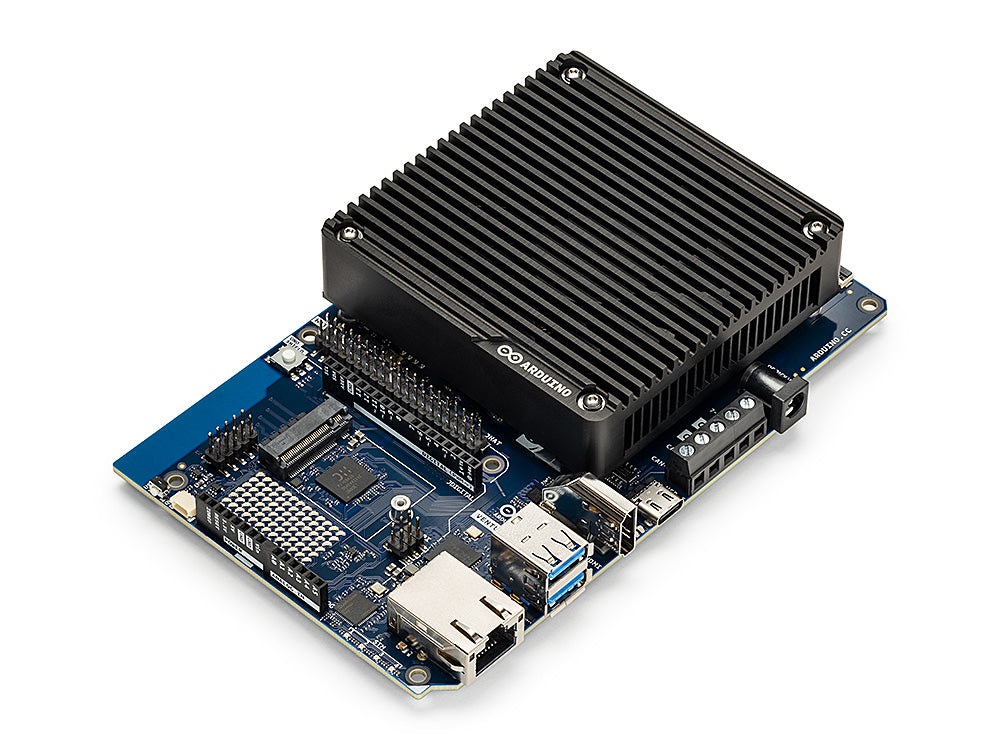
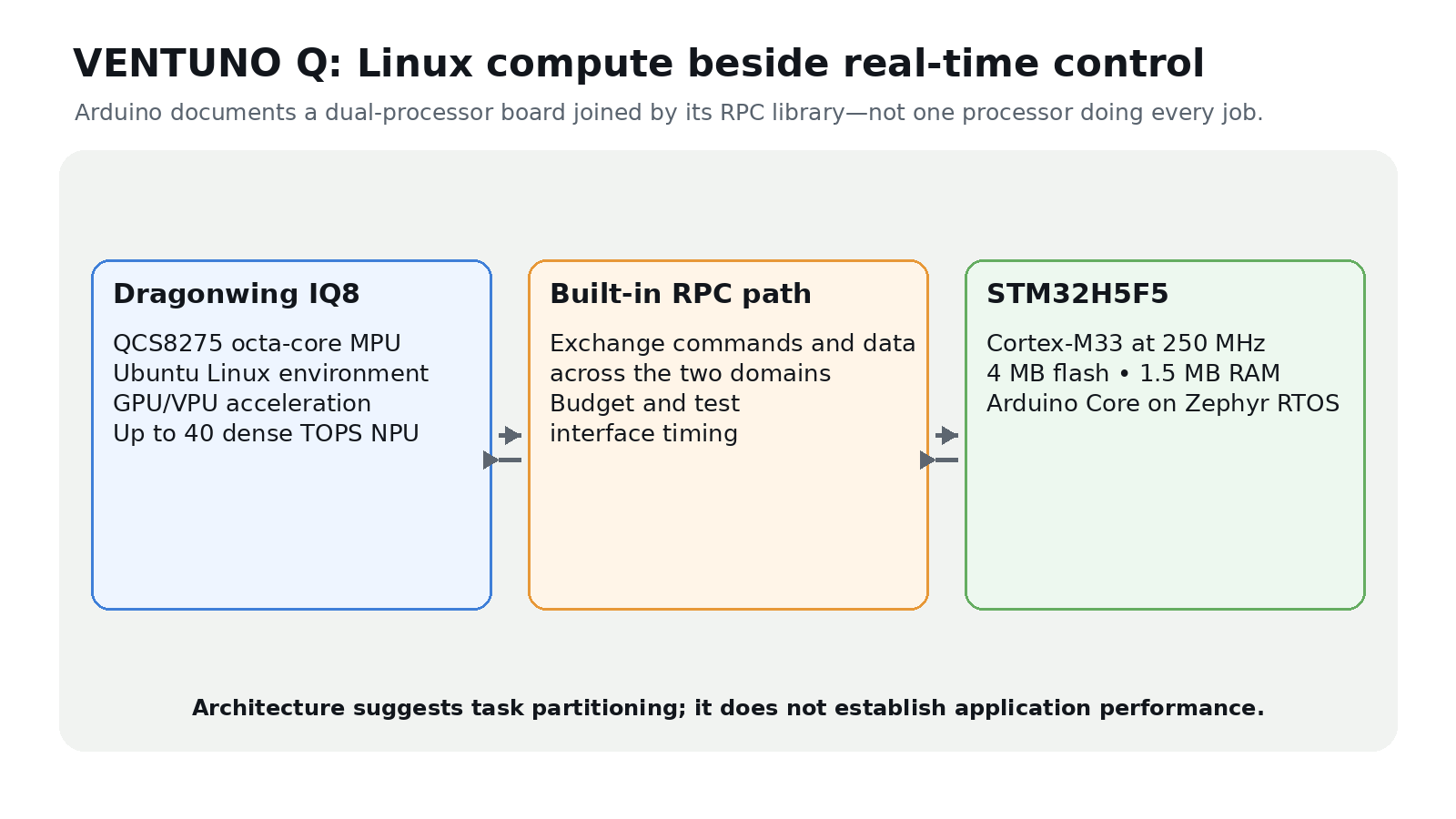
Architecture first: Arduino VENTUNO Q is a two-processor platform. Its Qualcomm Dragonwing IQ8 QCS8275 side runs Ubuntu Linux and targets AI and application workloads. A separate STM32H5F5 microcontroller runs Arduino Core on Zephyr RTOS for real-time I/O and control. Arduino connects the domains through a built-in RPC library.
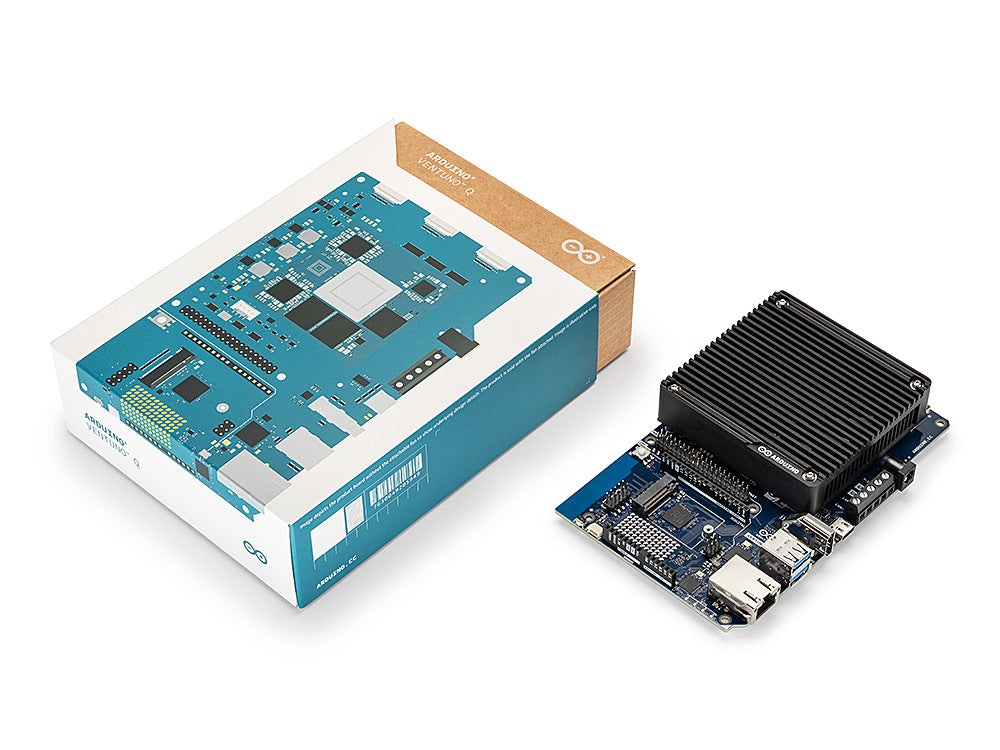
What Arduino documents
The IQ8 is listed as an octa-core Arm processor with an Adreno GPU/VPU, Spectra 692 ISP and Hexagon AI processor rated at up to 40 dense TOPS. Arduino lists 16 GB LPDDR5 memory and 64 GB industrial-grade eMMC, plus an M.2 connector for NVMe Gen4 expansion.
The board documentation lists 2.5 Gbit Ethernet, Wi-Fi 6 across 2.4/5/6 GHz, Bluetooth 5.3, two USB 3.0 Type-A ports, a role-switching USB-C port with video output, and HDMI multiplexed with MIPI DSI. Expansion includes UNO shield headers, Qwiic, carrier headers and a 40-pin HAT-compatible header.
The control side is not Linux
The STM32H5F5 is a Cortex-M33 microcontroller clocked at 250 MHz with 4 MB flash and 1.5 MB RAM. Arduino positions this Zephyr-based domain for GPIO, PWM, CAN-FD and motor-control work where deterministic scheduling matters. Linux can host higher-level planning, vision, ROS 2 software or local models, while the MCU owns explicitly bounded control tasks.
Acceptance work should measure RPC latency and failure behavior in the intended software image rather than infer them from processor specifications.
Questions to answer before adoption
- Which signals and safety states remain local to the MCU?
- What data crosses RPC, at what rate, and what happens if Linux restarts?
- Do the required cameras, displays, HATs and shields share pins or multiplexed interfaces?
- What power, thermal and enclosure limits apply to the complete workload?
- Can the selected model actually run within its memory, accelerator and software constraints?
The dual-domain design is the meaningful feature: it creates a place for Linux/AI software and a separate place for real-time control. Published TOPS, interface rates and processor clocks are component specifications—not proof of application latency or inference performance.