
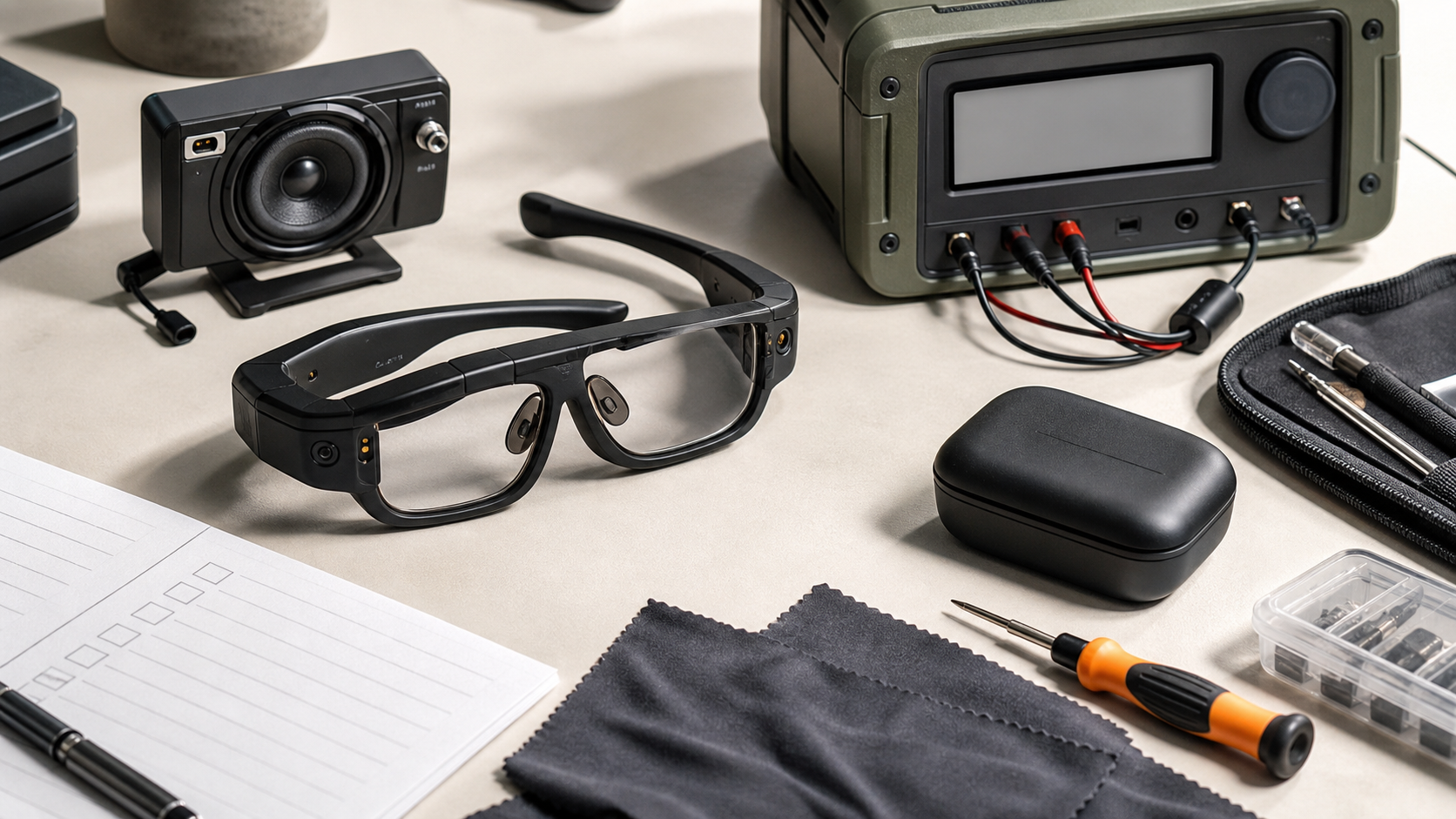
AI wearables are easy to evaluate like gadgets and hard to evaluate like long-term tools. A pair of smart glasses, pendant, ring, or clip-on assistant may ship with useful sensors and clever software, but many of the features buyers care about are controlled by services that can change after purchase.
That issue became more visible after Engadget reported that Meta is putting monthly limits on the Conversation Focus feature for its smart glasses, with more use tied to a paid Meta One Premium plan. The Verge also covered the change, criticizing the idea of limiting a feature that users may treat as a practical listening aid in noisy spaces.
This buyer evaluation is not a hands-on review of any one device. TVG has not tested current Meta smart glasses, Apple’s rumored products, or competing AI wearables for this article. The point is to build a checklist for service-dependent wearables before a lab, creator, educator, or technical buyer treats them as dependable gear.
Why service limits matter
Traditional hardware fails in familiar ways: the battery ages, the hinge loosens, the sensor breaks, the firmware gets old. AI wearables add another layer. A feature can remain physically possible on the device but become limited by account tier, regional policy, usage quota, server availability, or app support.
Engadget’s report on Meta smart-glasses rate limits says Conversation Focus is free for three hours per month, with a higher allowance under a paid plan. The Verge’s coverage of the same change frames the decision as a reminder that useful wearable features may not stay purely tied to hardware ownership.
For buyers, that changes the question from “does the device have the feature?” to “what controls access to the feature over time?”
Hardware specs are only the first screen
Ray-Ban’s official Ray-Ban Meta smart-glasses page lists camera, audio, and performance features, while Meta’s launch post for the second-generation glasses described the use of Qualcomm’s Snapdragon AR1 Gen 1 platform. Those are legitimate hardware details, and they matter.
But for AI wearables, the hardware list does not fully describe the product. Microphones may enable voice pickup, but the user experience depends on noise handling, model routing, local processing, cloud latency, wake behavior, and privacy controls. A camera may support capture, but object recognition or assistant features may depend on app policy and cloud services.
That is why a spec review should include both device specs and service terms. A wearable with modest hardware but stable offline features may be more dependable for field notes than a more impressive device whose best capabilities depend on quota-limited cloud tools.
The buyer checklist
1. Identify which features are local. Ask what works with no network connection. Audio playback, capture, basic controls, and some sensors may work locally. AI summaries, recognition, translation, or advanced listening features may not.
2. Check monthly limits. Look for quotas measured in minutes, messages, images, requests, or “premium” usage. If a feature matters for accessibility, field work, or teaching, a low monthly limit can turn a useful tool into a demo.
3. Separate device price from operating cost. A $299 to $499 wearable can become a more expensive purchase if core features require a monthly plan. Build a 24-month cost view before comparing products.
4. Read the update history. Wearables are software products. Feature additions are useful, but removals, region changes, account requirements, or rate limits also matter. A product that changes often needs change-management thinking.
5. Test privacy workflow. For smart glasses and microphones, the question is not only what data is captured. It is how the device signals recording, how bystanders are informed, how clips are stored, and how team policies handle classrooms, labs, customer visits, or public spaces.
6. Evaluate repair and battery life realistically. A wearable that works all day on paper may not survive all-day AI use. Charging case behavior, battery aging, sweat exposure, hinge durability, and replacement policy affect long-term ownership.
Where AI wearables can still make sense
Service risk does not make the category useless. Smart glasses can be valuable for hands-free capture, quick field notes, language support, first-person training footage, and accessibility-adjacent listening tools. Rings and smaller wearables can be useful for lightweight sensing when users would not tolerate a watch or phone.
The strongest use cases are narrow and testable. A robotics club might use smart glasses to record build sessions. A creator might use them for point-of-view clips. A field team might test hands-free notes during inspections. In each case, the evaluation should include what happens when the network is poor, the subscription lapses, or a feature limit is reached.
TVG’s earlier Meta glasses buyer evaluation focused on AI eyewear checks before purchase. For teams pairing wearables with field workstations, TVG’s portable monitor field-dashboard guide is a useful companion because the surrounding kit often determines whether a wearable becomes a real workflow tool or a novelty recorder. This broader service-lifecycle view adds a second layer: whether buyers really own the feature set they are counting on.
TVG Take
AI wearables should be bought like connected tools, not fashion accessories with a model attached. If a feature is important enough to influence the purchase, it is important enough to test for quota, offline behavior, account dependency, privacy handling, battery drain, and support policy.
The most durable buyer question is simple: “Would this device still be useful if its AI plan changed tomorrow?” If the answer is no, treat the purchase as a service bet, not a hardware investment.

That’s a really good point about considering subscriptions and cloud features – it’s easy to get caught up in the hardware and forget that’s a recurring cost.
Exactly — the hardware is only part of the purchase now. For AI wearables, we think buyers should look just as closely at rate limits, subscription tiers, cloud dependence, and what happens if the service changes after the device is already paid for.