One ESP32 chassis, many module paths
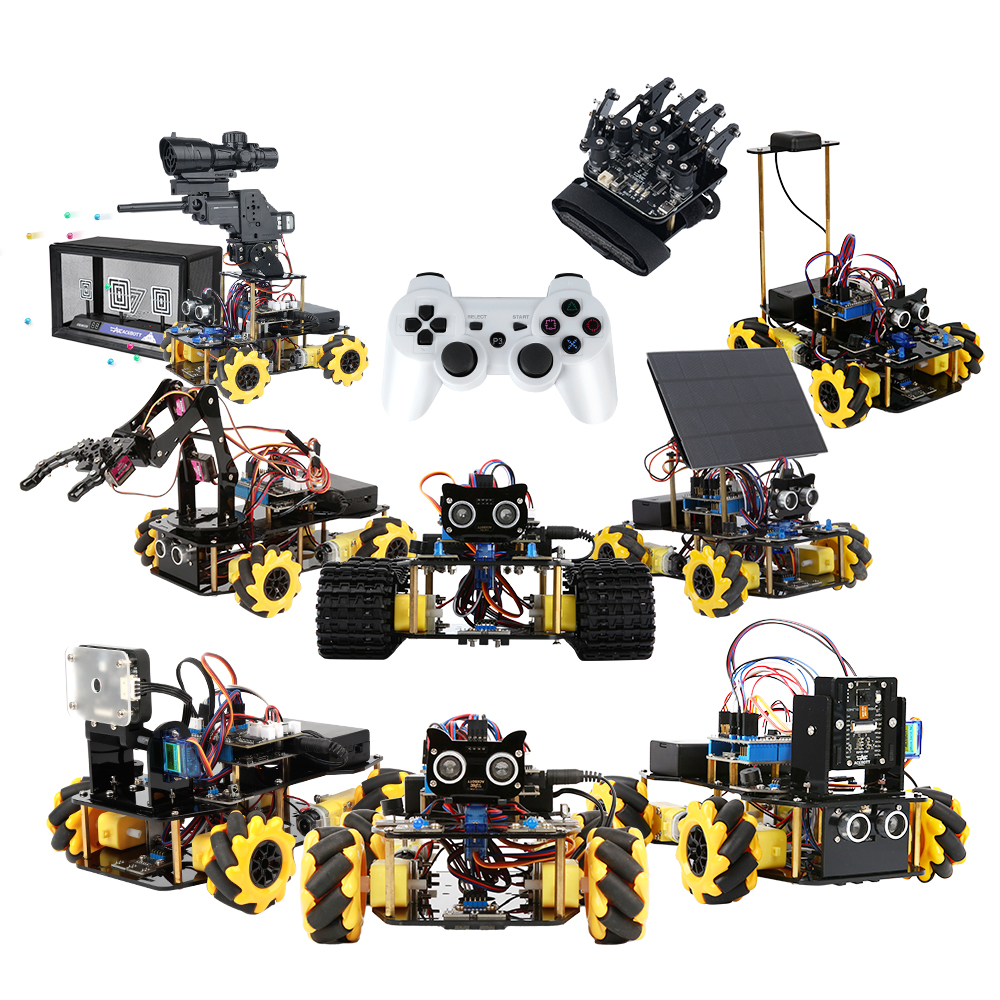
ACEBOTT’s QD400 Flagship ESP32 Robot Car All-in-One Kit is a broad classroom robotics bundle built around an ESP32 smart car platform and a stack of expansion modules. Instead of selling one fixed robot shape, ACEBOTT positions QD400 as a modular package: Mecanum-wheel driving, AI vision, video transmission, tracked/off-road conversion, target/shooting modules, a robot arm, solar charging, GPS, controller options, and a motion-sensing glove all orbit the same learning platform.
QD400 is more than a toy-car specification sheet. Its value depends on whether one electrical, mechanical and software ecosystem can support beginner lessons, sensor work, repeated debugging and project-based robotics without becoming a module-management burden.
The classroom case
The strongest fit appears to be STEM classrooms, robotics clubs, after-school labs, homeschool maker programs, and educators who want one ESP32-based car platform that can be reconfigured across multiple lessons. ACEBOTT’s product language emphasizes home and K-12 STEM education, while its docs for the related QD001 starter car describe beginner-friendly tutorials around Mecanum wheel drive, line tracking, obstacle avoidance, IR/Web/App control, and ESP32 programming.
For individual makers, the QD400 is likely most compelling if the buyer wants a concentrated set of robot-car experiments in one ecosystem rather than collecting separate camera, arm, GPS, solar, track, and controller modules from different vendors.
What the module list actually implies
The headline design signal is modular breadth. ACEBOTT says QD400 includes the QD401 base package with two 18650 batteries plus multiple expansion packs: QD002, QD003, QD004, QD005, QD006, QD007, QD008, QD009 with battery, QD010 with a 602040 lithium battery, and QD023. The official page lists an ESP32 controller board and Arduino, ACECode, and Python as programming paths.
The related QD003 STEM AI Vision Car Kit page describes an AI/machine-vision expansion for the QD001 robot car and calls out a K210 edge-AI chip. ACEBOTT’s official blog coverage of QD002 and QD003 describes video transmission, face recognition, color tracking, and QR-code detection use cases. The official QD001 documentation frames the base smart car around Mecanum movement, line tracking, obstacle avoidance, multiple remote-control modes, and 16 story-based tutorials.
For a classroom kit, the important issue is coherence across the electrical, mechanical, software and documentation layers. A long module list adds little if each expansion introduces incompatible wiring, firmware or lesson assumptions.
Expansion creates its own support burden
The obvious risk is that QD400 tries to do too much. A broad expansion ecosystem can be valuable in a classroom, but it can also create a support burden if each module has its own wiring assumptions, lesson dependencies, firmware quirks, or fragile mechanical mounts.
Power is another open question. Cameras, servos, wireless control and add-on modules can expose voltage sag, loose battery contacts, heat or inconsistent charging practice during longer sessions. ACEBOTT’s public materials do not establish how much margin remains as the expansion load grows.
Face recognition, color tracking and QR detection are useful classroom hooks, but the official material does not establish their accuracy across changing light, distance and backgrounds. The educational value depends on whether students can inspect those failure modes instead of treating recognition as a black box.
Which programs fit
ACEBOTT QD400 looks most promising for educators and clubs that want one ESP32 robot-car ecosystem with a wide module roadmap. It is less likely to be the best choice for buyers who only need a single low-cost line-following car, a pure ROS/SLAM platform, or a polished consumer robot with minimal assembly.
Breadth is the deciding factor
ACEBOTT’s QD400 is compelling because it concentrates many STEM robotics lessons around a single ESP32 smart-car platform. The product-page promise is not just “robot car with camera”; it is a modular learning system with drive control, vision, manipulation, solar, GPS, and alternative controllers.
QD400’s breadth is useful only if teachers can move from one module to the next without rebuilding the lesson around undocumented wiring, power and firmware differences. Buyers who need a single line-following exercise can choose a simpler kit; QD400 is aimed at programs that will actually use the shared expansion ecosystem.

That’s a really interesting combination of features for a testing kit, especially with the AI vision and solar power.