OpenCAL, an open-source project for computed axial lithography, is giving advanced builders a more accessible look at a 3D-printing technique that does not behave like the layer-by-layer machines most maker labs already know.
The project’s GitHub repository describes OpenCAL as open-source software for building and operating a computed axial lithography, or CAL, printer. The repository says the system is intended for research purposes and is designed around commercially available optical components and 3D-printed parts. OpenCAL’s public project page frames the work as a configurable control system rather than a consumer printer kit.
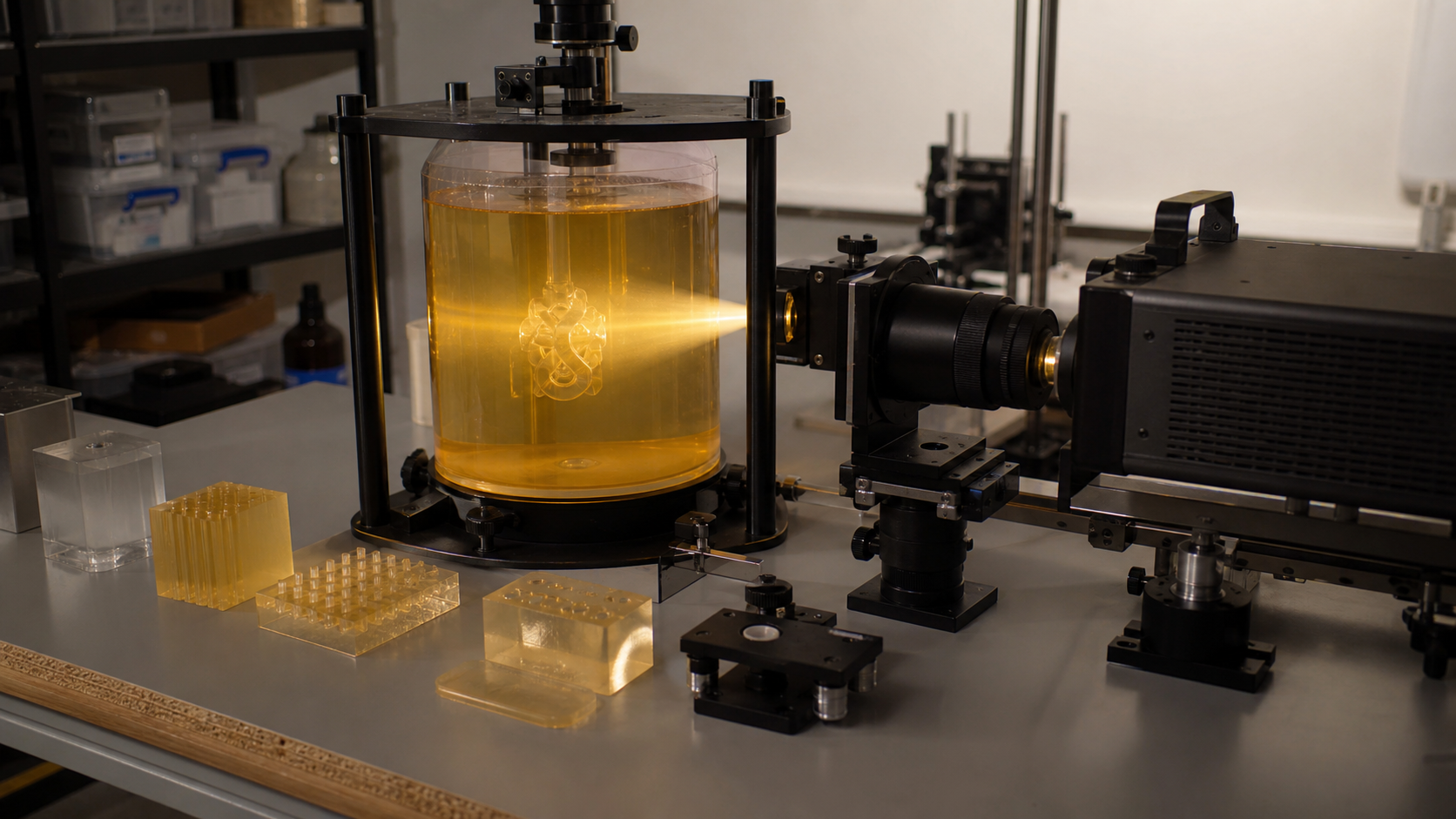
That distinction matters. CAL creates an object by projecting changing light patterns into a rotating volume of photosensitive resin. Instead of curing one flat layer at a time, the process aims to build the part volumetrically inside the resin. Hackaday’s June coverage called attention to the project’s release and the way the approach can appear almost theatrical: light patterns enter a resin volume and a part emerges inside it. Hackaday reported on OpenCAL as a route for technically capable experimenters to explore the method.
What OpenCAL actually changes
For schools, fab labs, and research-minded maker spaces, the most interesting part is not speed alone. It is the possibility of studying an unusual printing geometry with hardware that can be documented, modified, and audited.
DeepWiki’s technical index of the project describes OpenCAL as a high-level control system for CAL printers, covering software architecture, hardware requirements, installation, configuration, and operation. That overview is useful because it makes clear that the project touches the full stack: projection, rotation, resin behavior, calibration, and control software.
In conventional resin printing, a lab usually tunes exposure, lift speeds, supports, peel forces, and post-processing. CAL shifts the hard questions. Builders have to care about optical alignment, resin absorption, the relationship between projected dose and cured volume, rotation stability, and whether the reconstruction math matches the physical setup well enough to produce repeatable parts.
That is why TVG would not treat OpenCAL as a drop-in replacement for an MSLA or DLP printer. It is better understood as a research and teaching platform for labs that want to learn how volumetric printing works from the inside.
Why it matters
Open hardware and open software have been central to 3D printing’s growth, but many advanced resin-printing techniques remain hard for small labs to inspect. A documented CAL project lowers the barrier for universities, advanced high-school programs, and independent researchers that want to test the method without relying only on closed commercial systems.
The maker value is also educational. A CAL build forces students to connect computational imaging, optics, materials, mechanical rotation, and safety practice. That makes it a stronger STEM platform than a simple speed demo.
TVG has been tracking adjacent fabrication questions, including 3D scanner accuracy for maker labs and the practical limits of accessible capture workflows. OpenCAL sits on the other side of that same loop: once a lab can capture or design geometry, how does it choose a fabrication method that is repeatable enough for real projects? The same discipline applies to TVG’s coverage of field manuals and maker-lab documentation workflows: the tool is only useful when the process around it is repeatable.
Risks and limits
The open-source release does not remove the hard parts. Photosensitive resin requires careful handling, ventilation, protective equipment, cleanup discipline, and waste management. Optical systems require calibration. Rotating-vat systems introduce mechanical and fluid-behavior variables that are not obvious to a beginner.
There is also a documentation gap that every lab should expect when working near the edge of a research workflow. The GitHub project can show how the system is built and operated, but local builders still need to validate their own resin, projector, geometry, exposure behavior, and safety controls.
TVG Analysis
OpenCAL is most credible as a lab platform, not as a casual desktop-printer recommendation. The practical test is whether a motivated team can reproduce calibration steps, get stable parts across multiple resin batches, and document failures clearly enough for another team to learn from them.
If that happens, OpenCAL could become an unusually useful bridge between maker fabrication and research-grade additive manufacturing. The next signals to watch are build reports, resin recipes, calibration documentation, and whether educators can turn the project into repeatable coursework instead of a one-off demonstration.