
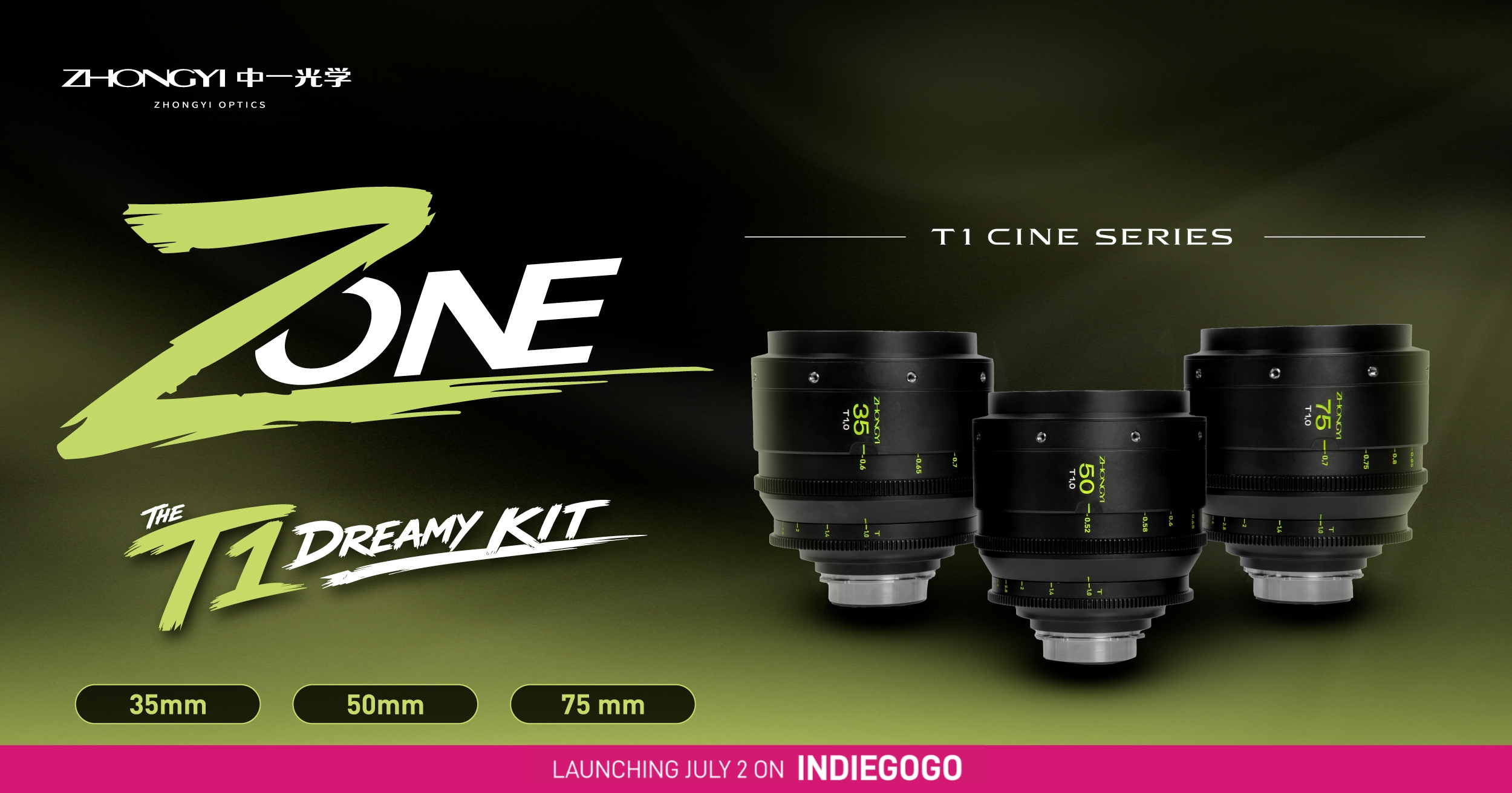
Zhongyi Optics, the company behind Mitakon lenses, is using crowdfunding to launch the Zone T1 Cine Series, a trio of very fast full-frame cinema primes aimed at filmmakers who want shallow depth of field and low-light flexibility without renting a high-end cine kit.
This is not a hands-on review. TVG has not tested the lenses, measured transmission, checked flange consistency, or inspected the mechanical build. Treat this as a project watch and backer-risk checklist based on public information from Zhongyi Optics and coverage from PetaPixel.
PetaPixel reports that the debut Zone T1 set includes 35mm, 50mm, and 75mm primes, each with a T1 maximum aperture, in PL and EF mounts for full-frame and VistaVision cinema systems. Zhongyi’s own homepage currently promotes the project as “Brushes of light – Shaped by T1” and links to the Indiegogo campaign for the Zone T1 Cine Series.
Why T1 matters, and why it is not the whole story
A T-stop is a transmission measurement. Unlike an f-number, which describes the geometric aperture ratio, a T-stop attempts to account for how much light actually reaches the sensor after losses through the lens. That is why cinema sets use T-stops: exposure should remain more consistent when switching lenses during a scene.
A T1 lens is extremely fast. In practical terms, it promises more light to the sensor and a very shallow focus plane. That can be useful for interviews, low-light narrative work, product shots, and controlled studio scenes. It can also be unforgiving. At T1, focus pulling, breathing, field curvature, chromatic aberration, and mechanical repeatability become more visible.
For a creator lab or maker media team, the question is not only “How fast is it?” The better question is whether the lens set can be used repeatably by a small team with the camera bodies, mounts, follow-focus hardware, matte boxes, filters, and storage workflow it already owns.
Mount and camera-body checks
PetaPixel says the Zone T1 primes are being offered in PL and EF mount. That is important because PL is common in cinema workflows, while EF remains useful for many camera bodies and adapters. But neither mount automatically makes a lens a fit for every small studio.
Before backing or pre-ordering, a team should map the entire chain: camera mount, adapter, sensor coverage, support foot, follow-focus position, matte-box clamp, filter diameter, and whether the camera rig can balance the lens without stressing the mount. Full-frame and VistaVision coverage sounds attractive, but it does not solve rig ergonomics.
What TVG would test first
- Transmission consistency: Does T1 match exposure closely across the 35mm, 50mm, and 75mm lenses?
- Sharpness wide open: Is the center usable at T1, and how quickly do the corners improve when stopped down?
- Focus breathing: Does framing shift noticeably during focus pulls?
- Color matching: Do the three focal lengths cut together without heavy grading correction?
- Minimum focus: Can the set handle product, robot, board-level, and bench footage without constant diopters?
- Mechanical feel: Are the focus and iris rings damped consistently enough for repeat takes?
- Mount tolerance: Does the lens hold flange distance and repeat focus marks on the target camera system?
- Thermal and field use: Does performance shift after an outdoor shoot, a warm studio session, or travel?
Crowdfunding risk checklist
Crowdfunding can be useful for niche optics because it gives manufacturers a way to measure demand before scaling a specialized product. It also shifts risk to backers. Specs, pricing, accessories, shipping dates, and final quality can change before delivery. A campaign page is not the same as a retail product with broad third-party testing.
Backers should look for production sample footage, unedited high-resolution frames, MTF or optical data if available, clear mount and coverage notes, warranty terms, repair support, and realistic shipping milestones. If a campaign relies mostly on heavily graded beauty shots, it is harder to judge whether the lenses will work for controlled technical production.
For creator teams, support may matter as much as image character. A fast cine set is a long-term tool. If a focus ring becomes inconsistent or a mount needs adjustment, the repair path matters. If the team cannot afford downtime, it should wait for retail availability and independent tests.
Where the Zone T1 could fit
The strongest fit is a controlled creator or lab video workflow where shallow depth of field and low-light capture are part of the look: product reels, robotics demos, documentary interviews, tabletop fabrication shots, and short-form educational videos. A fast 35/50/75 trio covers many common scenes without changing to a zoom.
The weaker fit is run-and-gun field work. Wide-open manual cinema primes demand focus discipline, lens support, and time. For maker labs documenting builds, a slower autofocus lens or stabilized zoom may produce more usable footage with fewer failed takes.
TVG Take
The Zone T1 project is interesting because it brings an extreme cine-lens spec into a price and access channel that more small studios may watch. But T1 is a stress test, not a guarantee of better footage. Small teams should judge the set by repeatability, rig fit, support, and real sample behavior before treating it as a production upgrade.
If TVG were evaluating a review unit, the first bench would be simple: exposure match across the set, focus breathing on a controlled target, product-shot sharpness at T1/T1.4/T2, handheld rig balance, and a short robotics-demo shoot with a follow-focus operator. Until those checks exist, this remains a promising project watch rather than a recommendation.
Sources
- Zhongyi Optics / Mitakon official homepage linking to the Zone T1 campaign
- Official Zhongyi Zone T1 Indiegogo campaign page
- PetaPixel: “Mitakon’s New Full-Frame Cine Primes Have a Ludicrously Fast T1 Aperture”
Internal reading: For related creator-field workflow planning, see TVG’s memory card specs guide for drones and action cameras and maker-lab audio buyer evaluation.

That’s a really interesting angle on the T1 lenses – I’m curious to see how the mount fit actually holds up over time, especially with heavier cameras.
Thanks — mount fit is one of the details we’d want to see tested carefully too. Fast lenses can look great on paper, but for creator labs the long-term question is whether the mount, follow-focus setup, and heavier camera builds stay stable after real use.